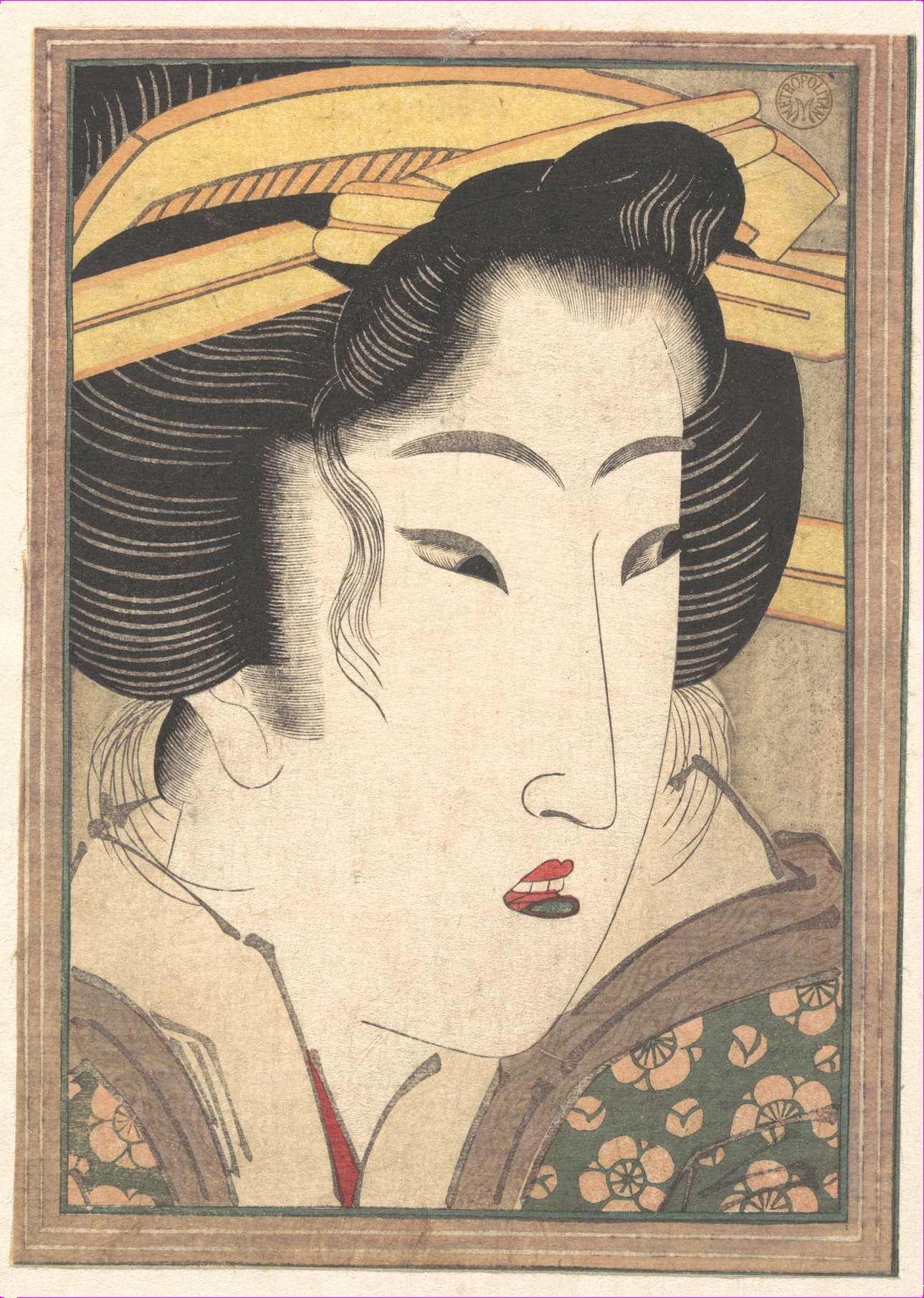
Head of a Beauty
by Keisai Eisen
- Date:
- ca. 1825
- Medium:
- Woodblock print; ink and color on paper
- Source:
- Metropolitan Museum of Art
Description
Head of a Beauty, dated about 1815 and held by the Metropolitan Museum of Art, is a Keisai Eisen okubi-e — a large-head close-up portrait — that exemplifies the bijin-ga genre at one of its most commercially productive moments. The okubi-e format had been popularised by Utamaro a generation earlier and was adopted by Eisen and his contemporaries as a way of maximising the pictorial attention paid to the subject's face, hair, and immediate accessories. The figure is shown from the shoulders up, her hair dressed in an elaborate coiffure with multiple kanzashi ornaments, her gaze directed obliquely outside the frame in a pose that suggests both intimacy and detachment. Eisen's 1815 was an early-mature year: he had been working in Edo for roughly a decade, had absorbed and modified the Utamaro tradition, and was beginning to develop the elongated, slightly mannered female type that would distinguish his later work. The Met's holding of this Head of a Beauty exemplifies the print buying patterns of mid-1810s Edo, when okubi-e were sold both as standalone images and as parts of larger series identifying named women from the licensed quarter. The print's relatively restrained palette — flesh tones, hair black, the muted greys and pinks of the surrounding kimono collar — concentrates the viewer's attention on facial detail. Eisen's later Edo bijin-ga, particularly those from the 1820s and 1830s, would push the proportions further; this earlier sheet shows him working within the inherited tradition with technical confidence.
More Prints by Keisai Eisen

Act 6, Yoichibei's Home

Nunobiki Falls at Jakko Shrine (Jakko Nunobiki no taki), from the series "Scenic Spots in the Mountains of Nikko (Nikkosan meisho no uchi)"
1843/46
Color woodblock print; oban

Distant View of Snow on the Sumida River in Edo
c. 1840/44
Color woodblock print; oban

Backward-viewing Falls, One of the Three Waterfalls (Urami-ga-taki, santaki no sono ikkei), from the series "Famous Scenic Spots in the Mountains of Nikko (Nikkosan meisho no uchi)"
1843–1847
Color woodblock print
Frequently Asked Questions
Head of a Beauty was created by Keisai Eisen (渓斎英泉) in ca. 1825.