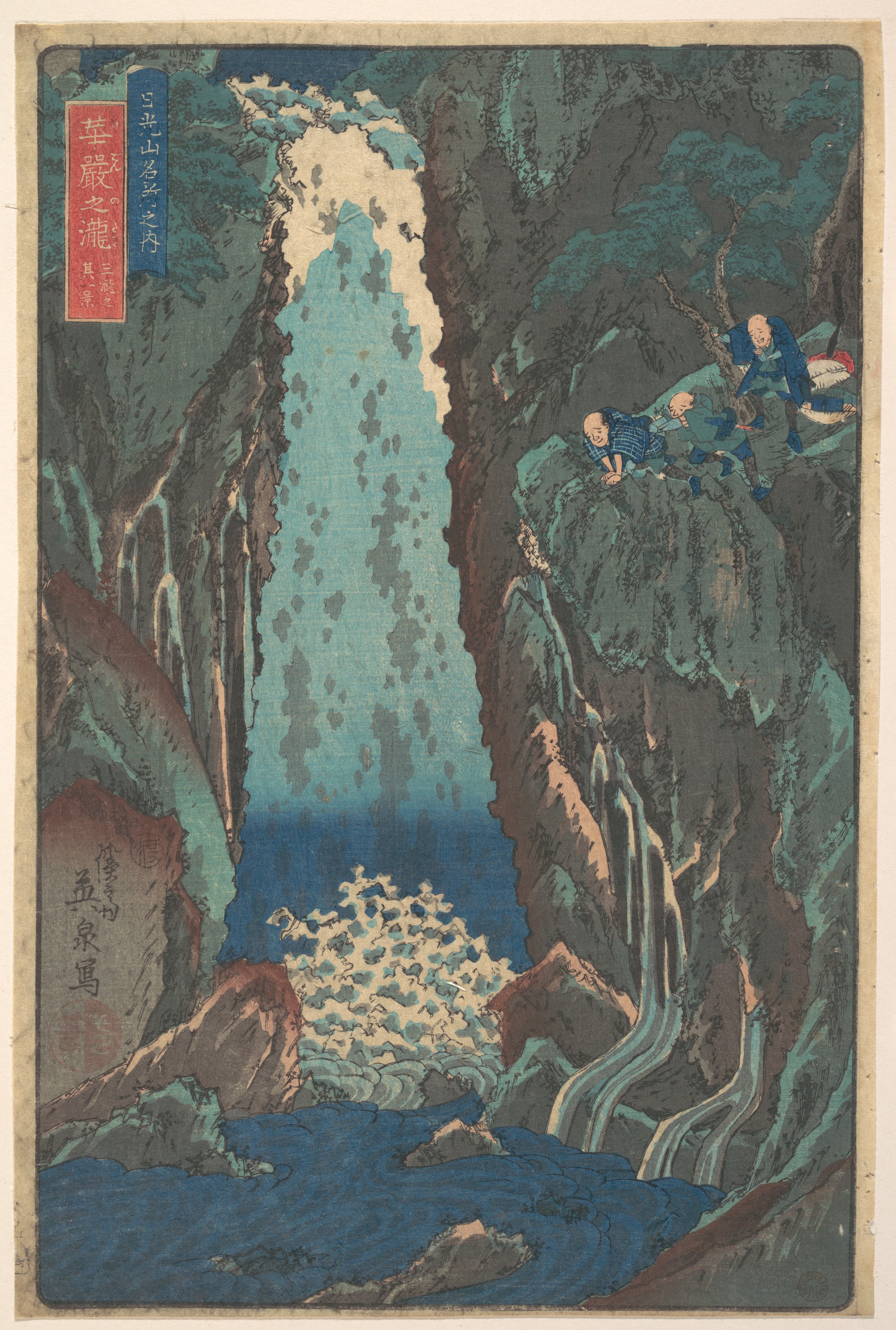
Kegon Waterfall
by Keisai Eisen
- Medium:
- Woodblock print; ink and color on paper
- Source:
- Metropolitan Museum of Art
Description
Kegon Waterfall, held by the Metropolitan Museum of Art and given a working date around 1790 in the museum's records (a date that should be read with caution given Eisen's career dates), depicts the most famous of the Nikko falls, a towering vertical drop that has been a tourist and pilgrim destination since the medieval period. Kegon-no-taki sits below Lake Chuzenji and falls almost a hundred metres in a single sheet of water; its grandeur made it a standard subject for Edo landscape printmakers. Keisai Eisen's treatment is most consistent with his 1840s Nikko series — Famous Scenic Spots in the Mountains of Nikko — though it may also be an independent landscape sheet. He renders the waterfall as a vertical column of pale blue against dark cliff faces, with the spray at its base rendered through reserved areas of the paper and the surrounding vegetation in dense greens and browns. Small figures placed at viewing platforms below the cascade give scale to its drop. Eisen's late landscape practice continued the documentary impulse of his Kisokaido collaboration while shifting from station-by-station travel sequences to single-site studies of named natural features. The Met's holding of Eisen prints includes both his earlier bijin-ga and his later landscape sheets, and this Kegon image falls clearly in the latter group. It exemplifies the way nineteenth-century ukiyo-e absorbed both the conventions of Chinese ink painting — heavy verticals, mist effects, dramatic cliffs — and the Edo demand for accessible, identifiable views of well-known domestic landmarks.
More Prints by Keisai Eisen

Act 6, Yoichibei's Home

Nunobiki Falls at Jakko Shrine (Jakko Nunobiki no taki), from the series "Scenic Spots in the Mountains of Nikko (Nikkosan meisho no uchi)"
1843/46
Color woodblock print; oban

Distant View of Snow on the Sumida River in Edo
c. 1840/44
Color woodblock print; oban

Backward-viewing Falls, One of the Three Waterfalls (Urami-ga-taki, santaki no sono ikkei), from the series "Famous Scenic Spots in the Mountains of Nikko (Nikkosan meisho no uchi)"
1843–1847
Color woodblock print
More Waterfalls Prints


Frequently Asked Questions
Kegon Waterfall was created by Keisai Eisen (渓斎英泉).
Kegon Waterfall depicts waterfalls and autumn foliage.