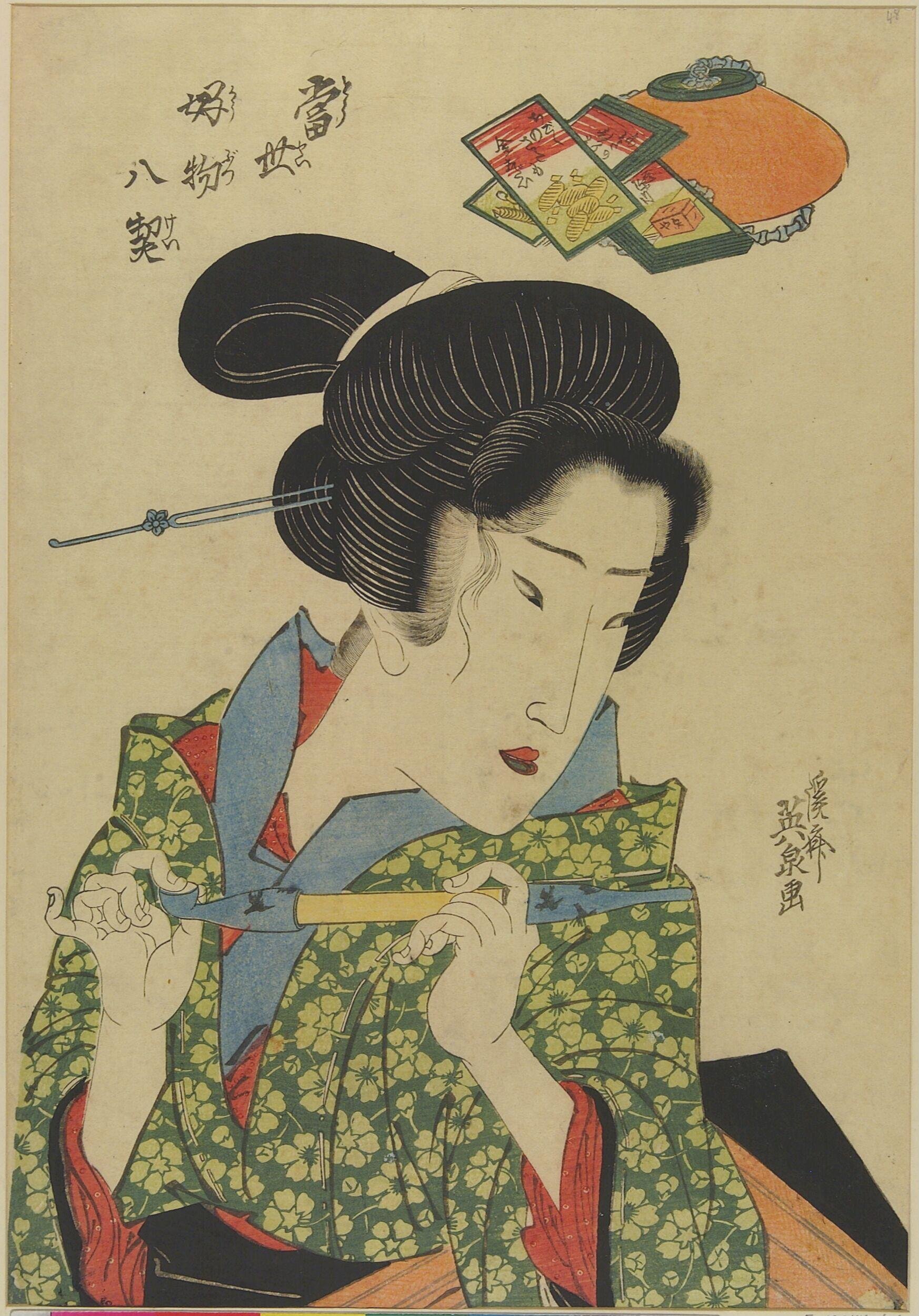
Smoking
by Keisai Eisen
- Medium:
- Source:
- Victoria and Albert Museum
Description
This undated bijin-ga by Keisai Eisen, titled simply Smoking in the Victoria and Albert Museum's records, depicts a woman of the pleasure quarters or merchant class engaged in the daily ritual of preparing a long-stemmed kiseru pipe. In Edo ukiyo-e, the act of tobacco smoking was a frequent attribute of fashionable women, courtesans, and geisha, treated by artists from Kitagawa Utamaro onward as a moment of pause that allowed close attention to facial expression, hairstyle, and the texture of the kimono. Eisen, working in the generation after Utamaro, shaped a distinctive Edo bijin-ga style characterized by taller, more elongated figures with a slightly downturned gaze and a worldly, sometimes melancholic presence, and that mature figure type is evident here. He renders the subject with an economy of contour line, allowing carefully tuned blocks of color in the kimono pattern and obi to carry the visual weight, while details such as the tobacco pouch, lacquered tray, and pipe itself situate the woman in a recognizable interior of the city. The print is preserved in the Victoria and Albert Museum's Japanese art holdings in London, an institution that has collected and displayed Edo ukiyo-e since the late nineteenth century. As an example of Eisen's bijin-ga production for the commercial print market, the design illustrates how everyday objects and gestures were used to anchor portraits of contemporary women within the visual culture of late Edo Japan.
More Prints by Keisai Eisen

Act 6, Yoichibei's Home

Nunobiki Falls at Jakko Shrine (Jakko Nunobiki no taki), from the series "Scenic Spots in the Mountains of Nikko (Nikkosan meisho no uchi)"
1843/46
Color woodblock print; oban

Distant View of Snow on the Sumida River in Edo
c. 1840/44
Color woodblock print; oban

Backward-viewing Falls, One of the Three Waterfalls (Urami-ga-taki, santaki no sono ikkei), from the series "Famous Scenic Spots in the Mountains of Nikko (Nikkosan meisho no uchi)"
1843–1847
Color woodblock print
Frequently Asked Questions
Smoking was created by Keisai Eisen (渓斎英泉).