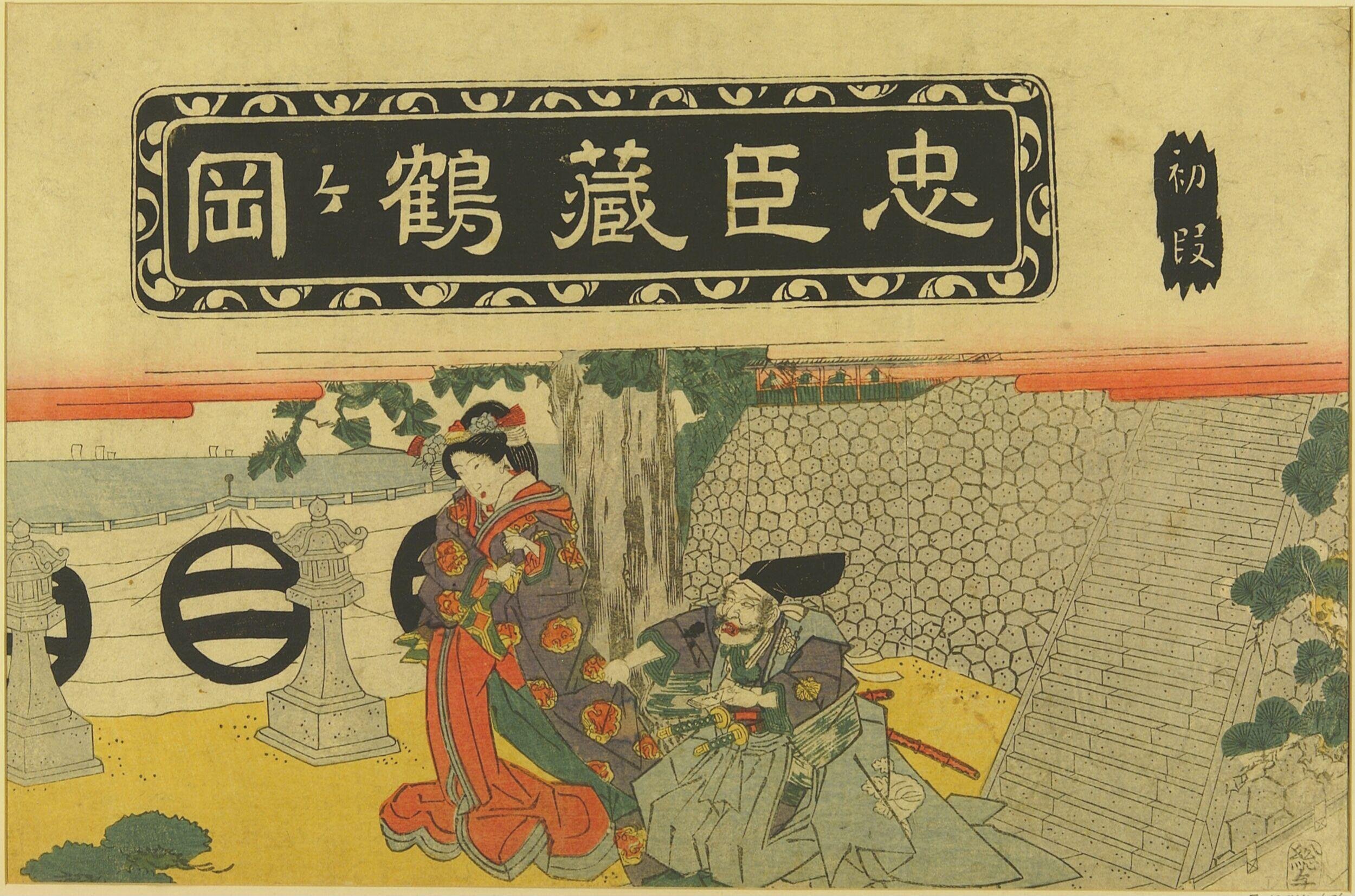
The Chiushingura
by Keisai Eisen
- Medium:
- Source:
- Victoria and Albert Museum
Description
The Chiushingura by Keisai Eisen draws on one of the most beloved theatrical narratives of late Edo ukiyo-e culture: the story of the forty-seven loyal retainers who avenge their lord's forced suicide. Held in the Victoria and Albert Museum, this design demonstrates Eisen's ability to translate kabuki staging into the static medium of woodblock printing. Eisen, who worked in Edo during the Bunsei and Tenpo eras (roughly the 1820s through the 1840s), was one of the major figures in late ukiyo-e and is best known for his bijin-ga, or pictures of beautiful women, though he produced a substantial body of landscape and narrative work as well. The Chiushingura imagery he produced participated in a long tradition stretching back to the puppet and kabuki play Kanadehon Chushingura, first staged in 1748. Eisen organizes the composition around the gestural language of the actors, with patterned robes carrying the strong contrasts of color and line that became hallmarks of his mature style. The Victoria and Albert Museum's holdings of Japanese woodblock prints contextualize this sheet within the broader Edo ukiyo-e print industry, where serialized depictions of the loyal retainers offered publishers a reliable commercial subject. For a contemporary viewer of Edo, prints like this one functioned as souvenirs of theatre, illustrated commentary on the play's moral structure, and decorative objects in their own right. The V&A's record preserves the sheet as a witness to Eisen's contribution to a print culture that bound kabuki, popular literature, and visual art into a tightly interwoven commercial and artistic system.
More Prints by Keisai Eisen

Act 6, Yoichibei's Home

Nunobiki Falls at Jakko Shrine (Jakko Nunobiki no taki), from the series "Scenic Spots in the Mountains of Nikko (Nikkosan meisho no uchi)"
1843/46
Color woodblock print; oban

Distant View of Snow on the Sumida River in Edo
c. 1840/44
Color woodblock print; oban

Backward-viewing Falls, One of the Three Waterfalls (Urami-ga-taki, santaki no sono ikkei), from the series "Famous Scenic Spots in the Mountains of Nikko (Nikkosan meisho no uchi)"
1843–1847
Color woodblock print
Frequently Asked Questions
The Chiushingura was created by Keisai Eisen (渓斎英泉).