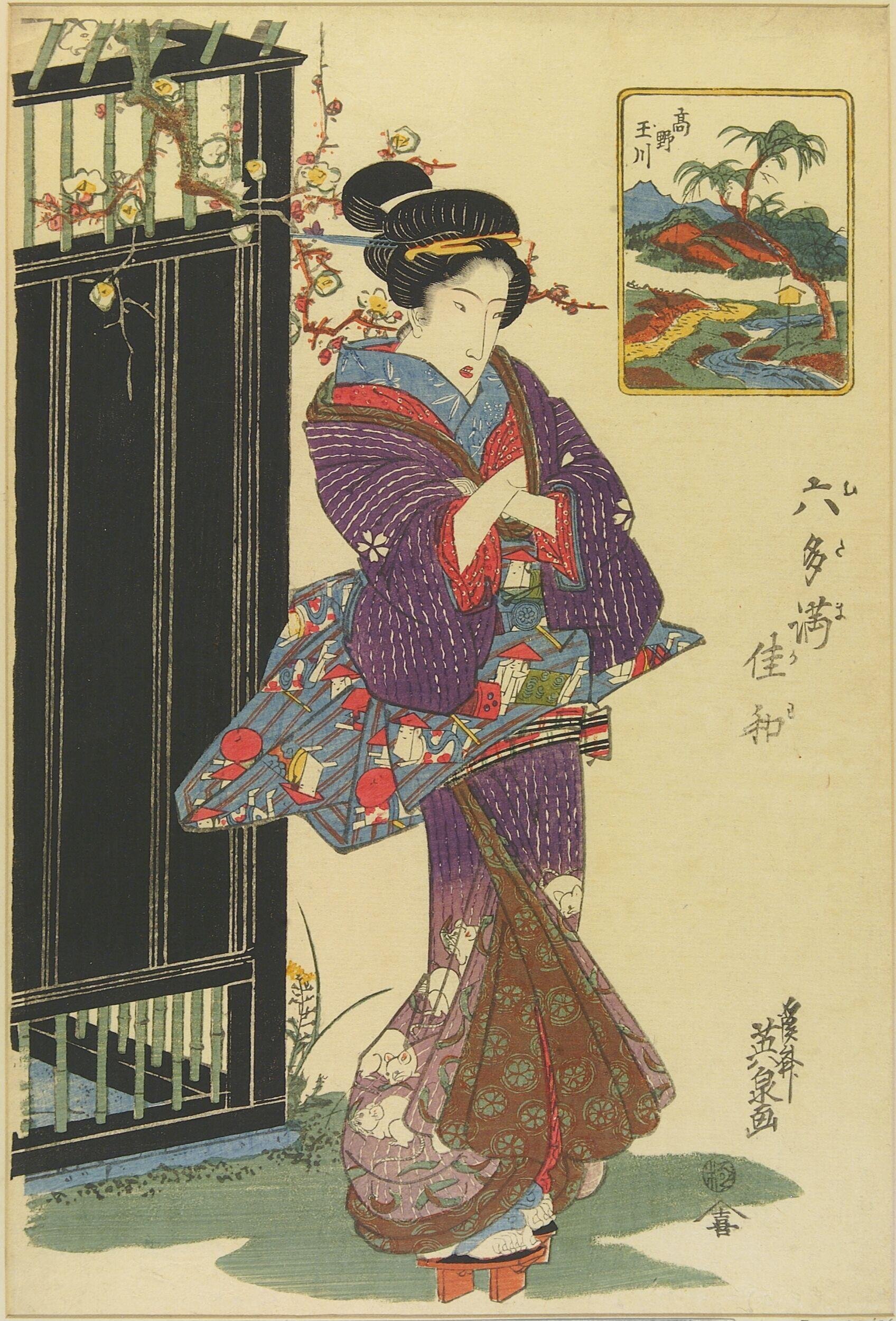
The Jewel River of Mount Kōya (Kōya no Tamagawa)
by Keisai Eisen
- Date:
- Early 1820s
- Medium:
- Source:
- Victoria and Albert Museum
Description
The Jewel River of Mount Kōya (Kōya no Tamagawa), held by the Victoria and Albert Museum and dated about 1820, belongs to a recurring Japanese poetic theme — the six jewel rivers, mu Tamagawa, a set of celebrated streams scattered across the country that had been linked by classical waka tradition into a single iconographic group. Each of the six rivers had its own associated poetic image; the Kōya example was tied to Buddhist asceticism on Mount Kōya, the great Shingon monastic complex in modern-day Wakayama prefecture. Keisai Eisen depicts the river with figures whose dress and activities allude to the Kōya tradition — typically pilgrims or robed monks — set against a riparian landscape rendered in cool blues and greens. The composition follows the mitate tendency that runs throughout Eisen's career: classical poetic content is reworked into a contemporary print, allowing buyers to enjoy both the cultural reference and the modern image. Edo bijin-ga sometimes appropriated the mu Tamagawa theme by replacing the conventional pilgrim figures with fashionable women, and Eisen produced versions in both modes. The V&A's holding places the print within a substantial run of his work assembled in the late nineteenth and early twentieth centuries. The date positions it in the productive middle of Eisen's career, when he was issuing bijin-ga, kacho-ga, and the occasional landscape in roughly parallel streams, well before the Kisokaido project that would consolidate his reputation in the following decade.
More Prints by Keisai Eisen

Act 6, Yoichibei's Home

Nunobiki Falls at Jakko Shrine (Jakko Nunobiki no taki), from the series "Scenic Spots in the Mountains of Nikko (Nikkosan meisho no uchi)"
1843/46
Color woodblock print; oban

Distant View of Snow on the Sumida River in Edo
c. 1840/44
Color woodblock print; oban

Backward-viewing Falls, One of the Three Waterfalls (Urami-ga-taki, santaki no sono ikkei), from the series "Famous Scenic Spots in the Mountains of Nikko (Nikkosan meisho no uchi)"
1843–1847
Color woodblock print
Frequently Asked Questions
The Jewel River of Mount Kōya (Kōya no Tamagawa) was created by Keisai Eisen (渓斎英泉) in Early 1820s.