
A Courtesan and her Attendant
- Date:
- c. 1803/04
- Medium:
- Color woodblock print; naga-oban
- Source:
- Art Institute of Chicago
Description
Dated to 1798 and preserved in the Art Institute of Chicago, A Courtesan and Her Attendant is one of Kitagawa Utamaro's mature studies of the social fabric of the Yoshiwara. The pairing of an established courtesan with a younger kamuro or shinzō was a staple structure of Edo bijin-ga and gave Utamaro endless room to explore differences in proportion, costume, and demeanor. In this print he uses the senior woman's poised height and elongated profile against the attendant's rounder face and smaller frame to suggest both age and rank without recourse to overt narrative. The composition's near-vertical orientation echoes the kakemono-e format associated with high-end pictorial commissions, encouraging the viewer to read upward through layered textiles, hair ornaments, and the careful tilt of the courtesan's head. Color decisions are typical of late-1790s ukiyo-e: deep purples, warm greys, and selective bursts of red across the under-collar or lining, all chosen to direct the eye to the women's faces. The Art Institute's holding documents Utamaro's continuing investment in tightly framed portraits during a period when censorship pressures were beginning to constrain his more elaborate Yoshiwara designs. For viewers and scholars of his Edo bijin-ga catalogue, the print exemplifies how the artist transformed a familiar pictorial trope into a meditation on the everyday hierarchy and intimacy that bound Yoshiwara women into a working community.
More Prints by Kitagawa Utamaro
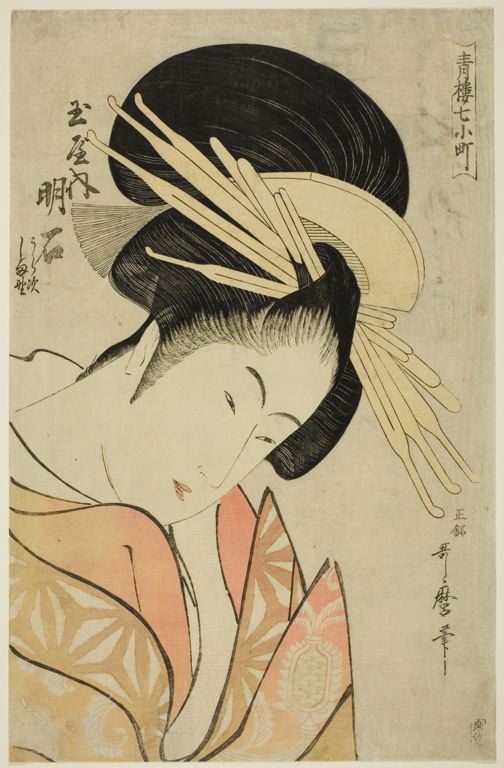
Akashi of the Tamaya, from the series Seven Komachis of Yoshiwara (Seiro nana Komachi) (Tamaya uchi Akashi, Uraji, Shimano)
Woodblock print
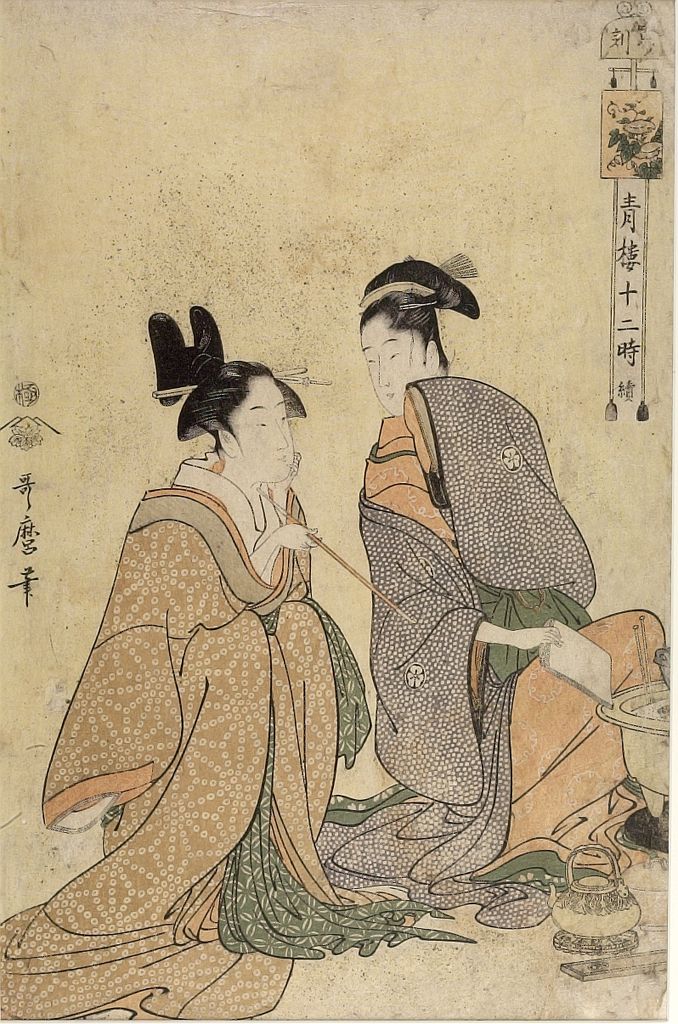
Hour of the Tiger (Tora no koku = 4 AM) from the series Twelve Hours in Yoshiwara (Seirô jûni toki tsuzuki), Late Edo period, circa 1794
Woodblock print
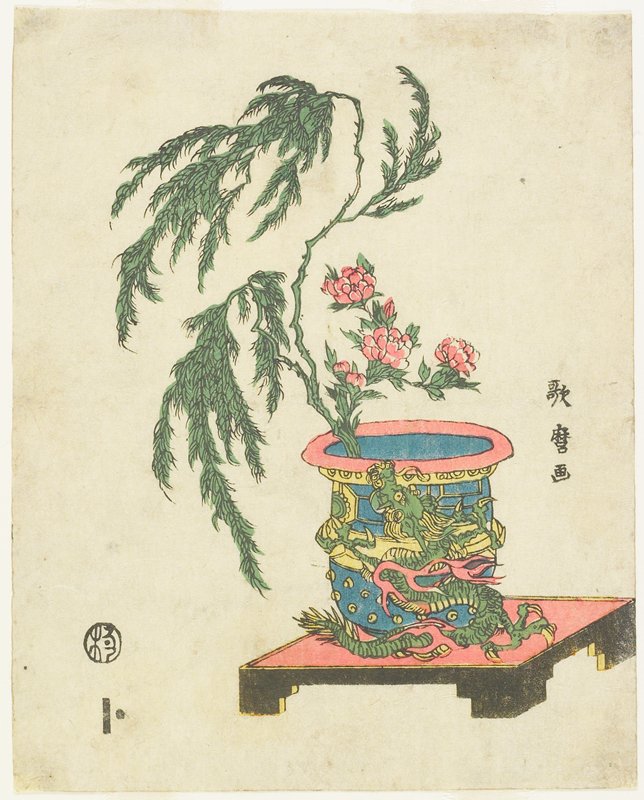
Ikebana arrangement of Peony and Willow in Dragon Pot
1781–1806
Woodblock print (nishiki-e), ink and color on paper
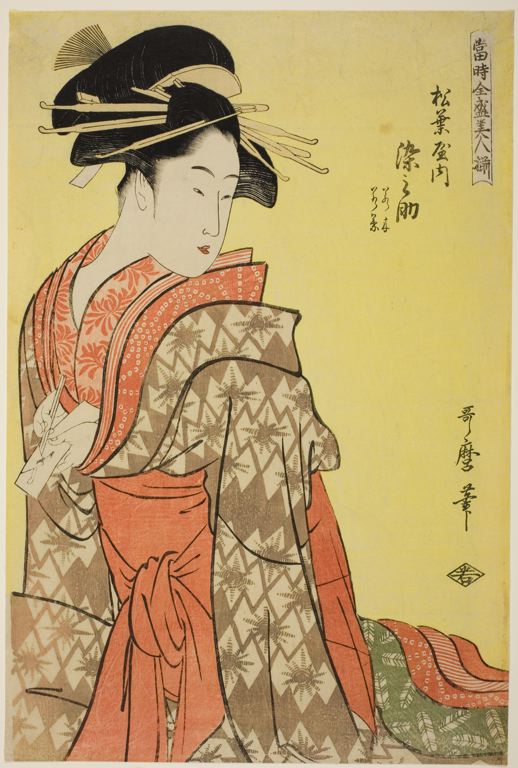
The Greatest Beauties of Our Time (Toji zensei bijin zoroe): Somenosuke of the Matsubaya with Attendants Wakagi and Wakaba
Woodblock print
Frequently Asked Questions
A Courtesan and her Attendant was created by Kitagawa Utamaro (喜多川歌麿) in c. 1803/04.