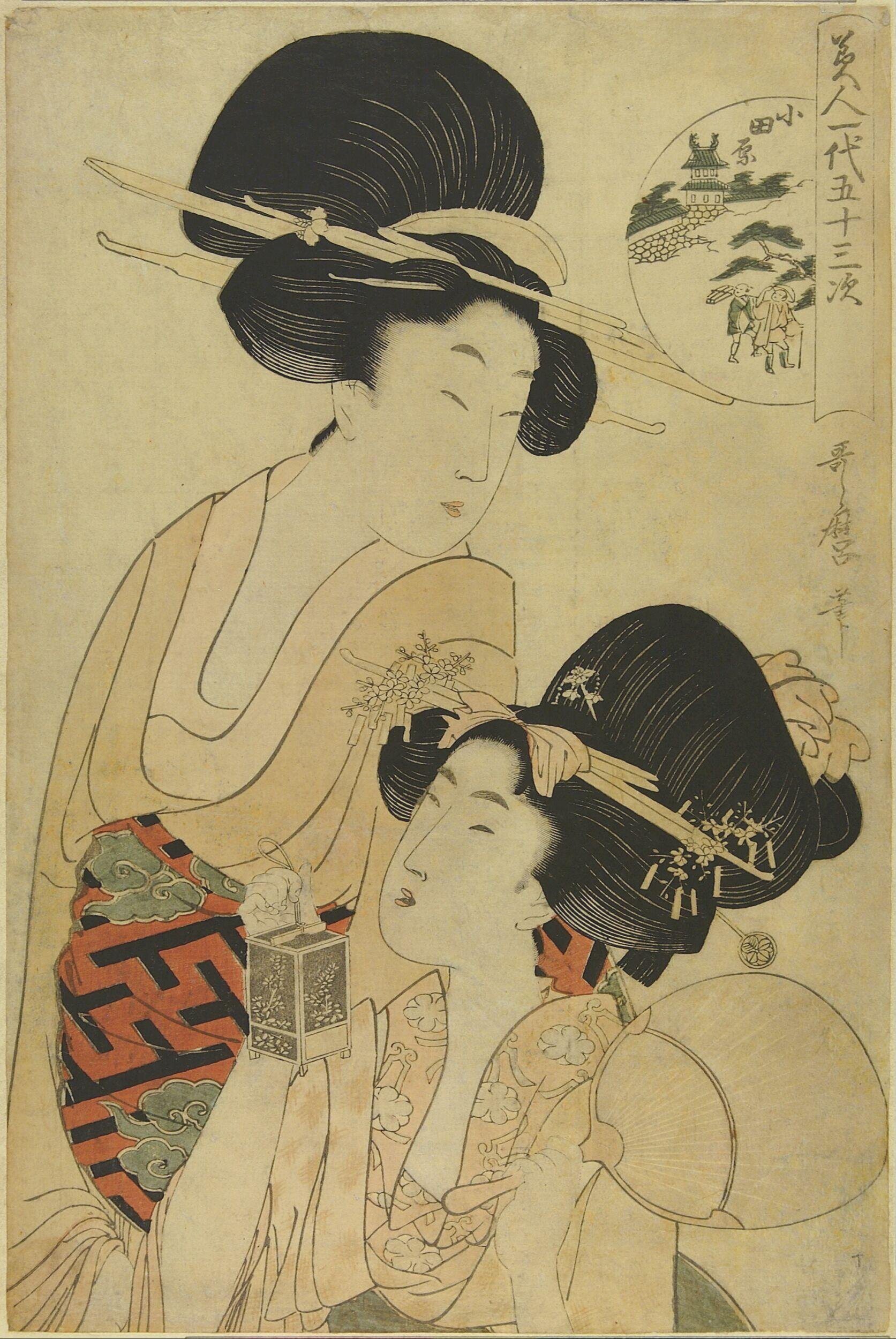
'Beauties for the Fifty-Three Stations'
- Date:
- 1804
- Medium:
- Source:
- Victoria and Albert Museum
Description
Kitagawa Utamaro's Beauties for the Fifty-Three Stations, dated circa 1804, is held by the Victoria and Albert Museum (museum number O421974). The title invokes the famous Tokaido road, the highway linking Edo and Kyoto via fifty-three official post stations, a route that supplied subjects to generations of ukiyo-e artists, most famously Utagawa Hiroshige in his later Tokaido series. Utamaro's contribution to this geographic theme is characteristically a bijin-ga one: instead of dwelling on travelers, landscapes, or station inns, he gives the road over to women, pairing each station with a beauty whose dress, accessory, or pose alludes to that locality. The Edo bijin-ga tradition was deeply invested in this kind of mitate, an analogical pairing that allowed Utamaro to bring together the prestige of poetic and geographic naming with the visual market for portraits of fashionable women. The 1804 date situates the design near the end of Utamaro's career, after the rise of strong rivals such as Hosoda Eisho and Chokosai Eisho, and during the difficult years following his official punishment in 1804 for an unauthorized print. The V&A's holding preserves the design within an internationally important ukiyo-e collection, useful for researchers comparing Utamaro's late series with similar Tokaido-themed productions by other artists. For collectors, Beauties for the Fifty-Three Stations is representative of how Utamaro continued to convert public, mappable subjects into the private surface of Edo bijin-ga, asking his viewer to read each woman as both an individual figure and a stand-in for a place on the great road between Edo and the imperial capital.
More Prints by Kitagawa Utamaro
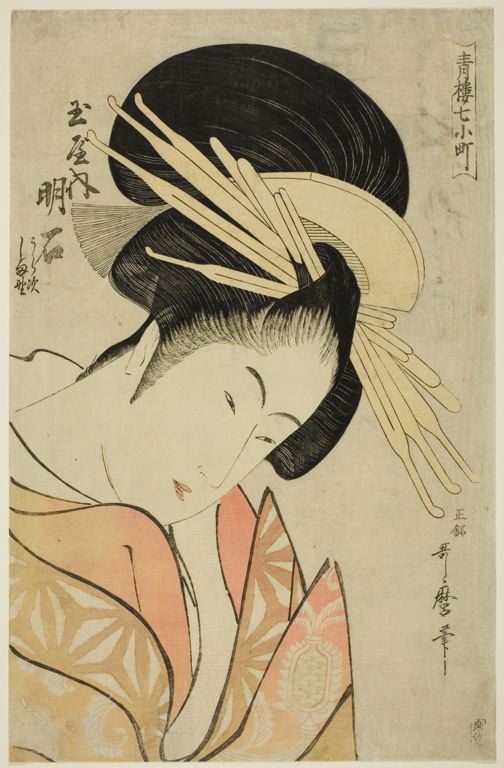
Akashi of the Tamaya, from the series Seven Komachis of Yoshiwara (Seiro nana Komachi) (Tamaya uchi Akashi, Uraji, Shimano)
Woodblock print
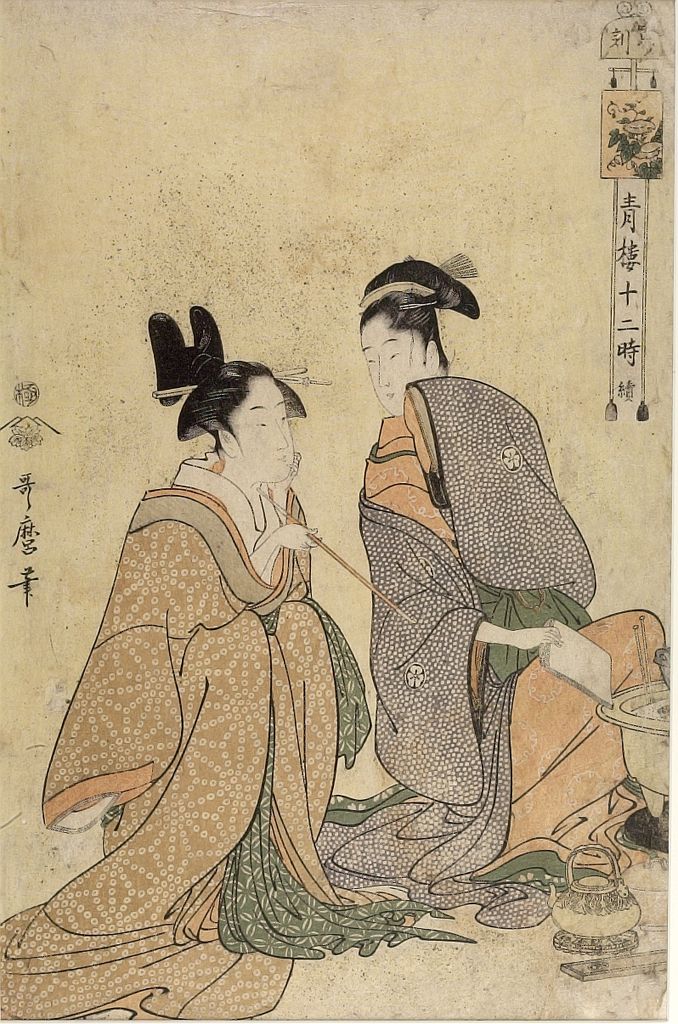
Hour of the Tiger (Tora no koku = 4 AM) from the series Twelve Hours in Yoshiwara (Seirô jûni toki tsuzuki), Late Edo period, circa 1794
Woodblock print
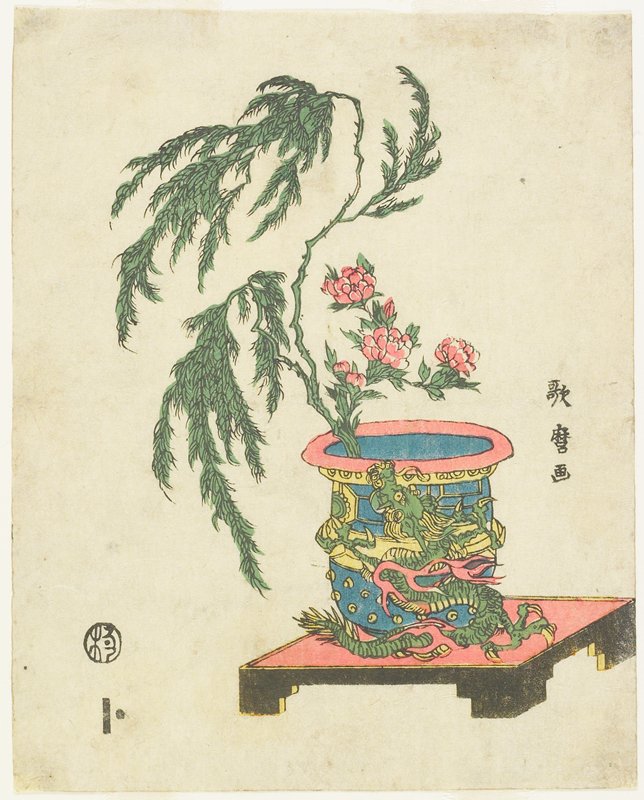
Ikebana arrangement of Peony and Willow in Dragon Pot
1781–1806
Woodblock print (nishiki-e), ink and color on paper
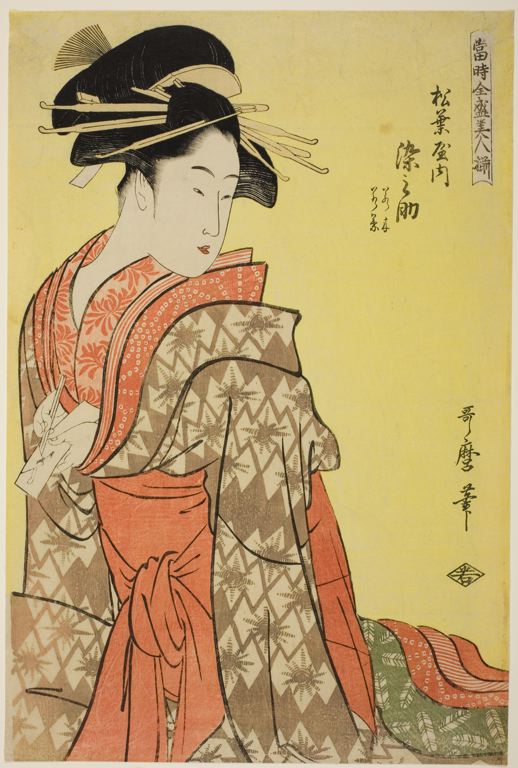
The Greatest Beauties of Our Time (Toji zensei bijin zoroe): Somenosuke of the Matsubaya with Attendants Wakagi and Wakaba
Woodblock print
Frequently Asked Questions
'Beauties for the Fifty-Three Stations' was created by Kitagawa Utamaro (喜多川歌麿) in 1804.