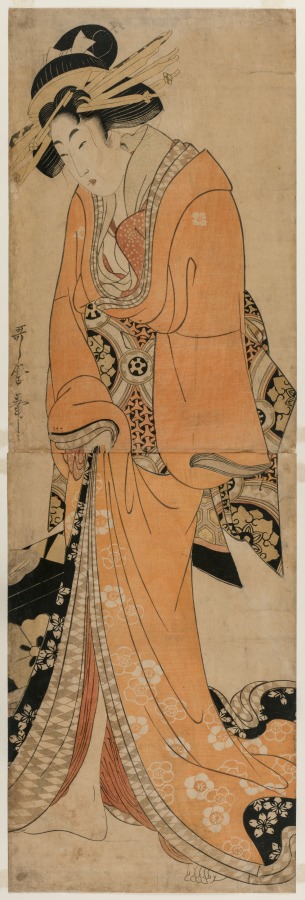
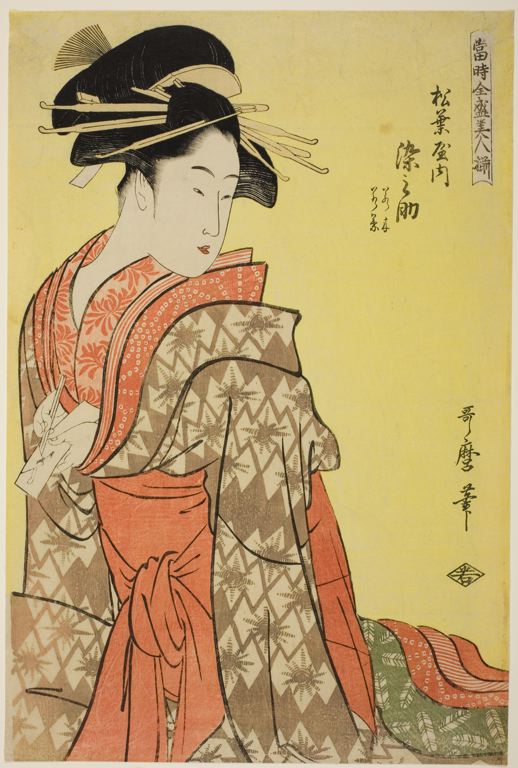
Geisha Standing Beside a Shamisen Case
- Date:
- c. 1810
- Medium:
- color woodblock print
- Source:
- Cleveland Museum of Art
Description
Dated to 1805 and in the Cleveland Museum of Art, "Geisha Standing Beside a Shamisen Case" is a late Kitagawa Utamaro Edo bijin-ga produced near the end of his career, after the censorship and personal difficulties of the early Bunka era. The figure is identified as a geisha, a category of female entertainer distinct from Yoshiwara courtesans, working in teahouses and at private parties as singer, shamisen player, and conversationalist. The wrapped shamisen case beside her signals her musical livelihood, just as kimono pattern and hairstyle signal her professional persona. By the early nineteenth century, geisha had become as prominent as courtesans in the iconography of ukiyo-e, reflecting shifts in the entertainment economy of Edo and the changing tastes of print buyers. Utamaro's late style retains the elongated proportions of his peak period but often shows a slightly grayer, more subdued palette, in part a response to fluctuations in publishing economics. The Cleveland Museum of Art's impression preserves a quiet, contemplative image that demonstrates how Utamaro continued to refine his signature mode of feminine portraiture even as he navigated a difficult final chapter following his 1804 arrest for a print related to Toyotomi Hideyoshi. This sheet thus carries both stylistic and biographical interest within the broader study of Japanese woodblock prints.
More Prints by Kitagawa Utamaro
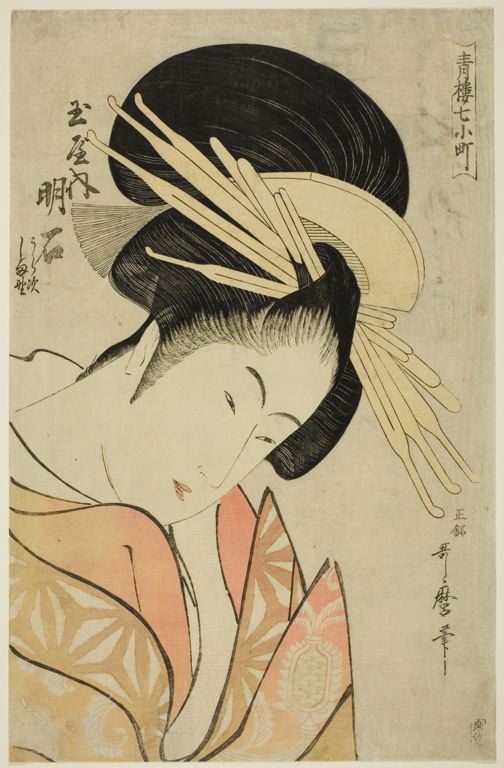
Akashi of the Tamaya, from the series Seven Komachis of Yoshiwara (Seiro nana Komachi) (Tamaya uchi Akashi, Uraji, Shimano)
Woodblock print
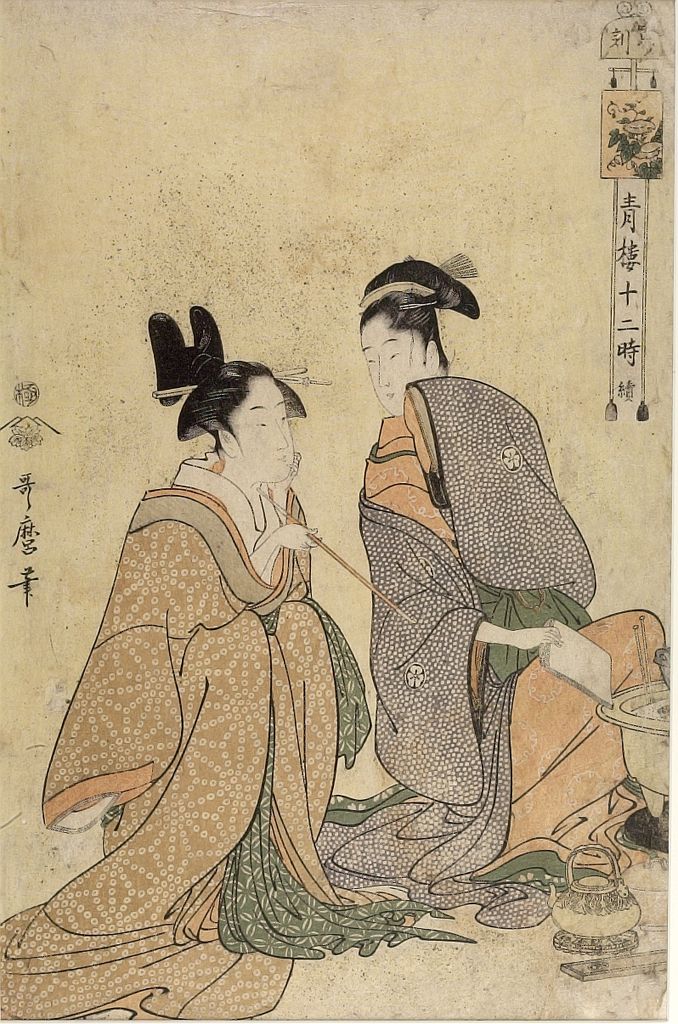
Hour of the Tiger (Tora no koku = 4 AM) from the series Twelve Hours in Yoshiwara (Seirô jûni toki tsuzuki), Late Edo period, circa 1794
Woodblock print
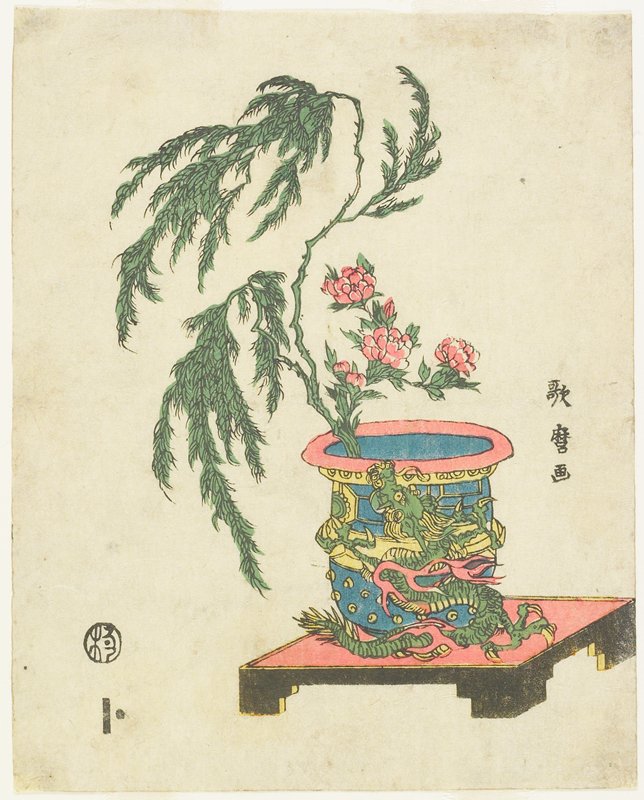
Ikebana arrangement of Peony and Willow in Dragon Pot
1781–1806
Woodblock print (nishiki-e), ink and color on paper
The Greatest Beauties of Our Time (Toji zensei bijin zoroe): Somenosuke of the Matsubaya with Attendants Wakagi and Wakaba
Woodblock print
Frequently Asked Questions
Geisha Standing Beside a Shamisen Case was created by Kitagawa Utamaro (喜多川歌麿) in c. 1810.