
Hour of the Ox (Ushi no koku) Fukagawa Pleasure Quarter (Tatsumi), from the series "Customs of Beauties Around the Clock (Fuzoku bijin tokei)"
- Date:
- c. 1798/99
- Medium:
- Color woodblock print; oban
- Source:
- Art Institute of Chicago
Description
Hour of the Ox (Ushi no koku), Fukagawa Pleasure Quarter (Tatsumi), from Kitagawa Utamaro's 1793 series Customs of Beauties Around the Clock (Fuzoku bijin tokei), belongs to one of the artist's most inventive contributions to Edo bijin-ga: a cycle that pairs the twelve traditional double-hours of the Japanese day with corresponding female types and social settings. The Hour of the Ox, roughly one to three in the morning, is matched here with a geisha of Fukagawa, the unlicensed Tatsumi quarter southeast of the Sumida River whose women were prized for an unaffected, faintly masculine chic distinct from the elaborate display of Yoshiwara courtesans. Utamaro renders his subject in the half-length okubi-e format he had perfected, allowing him to concentrate on the angle of the neck, the loose collar, and the half-attentive expression of a woman caught at the end of a long working night. The publisher Tsutaya Juzaburo issued the series, which collectively reads as a horological survey of female labor and pleasure in late-eighteenth-century Edo. The Art Institute of Chicago holds the present impression. Within Utamaro's ukiyo-e output the Fuzoku bijin tokei prints stand among the most coherent statements of his project to treat time, place, and social rank as inflections of feminine character rather than as mere backdrops to beauty.
More Prints by Kitagawa Utamaro
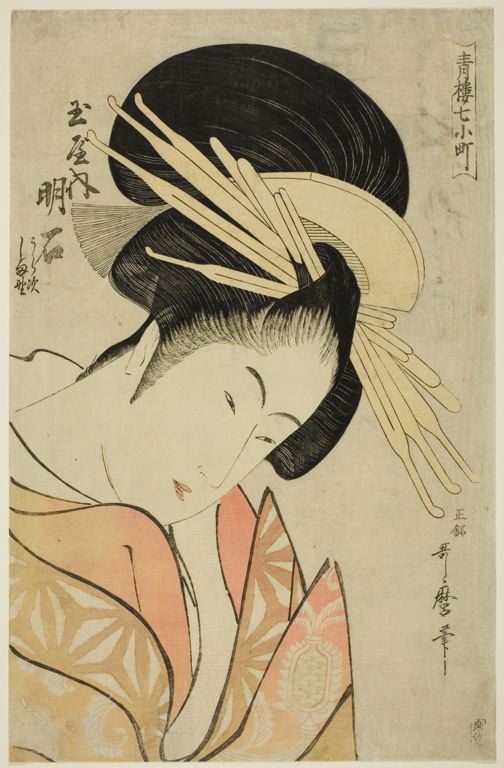
Akashi of the Tamaya, from the series Seven Komachis of Yoshiwara (Seiro nana Komachi) (Tamaya uchi Akashi, Uraji, Shimano)
Woodblock print
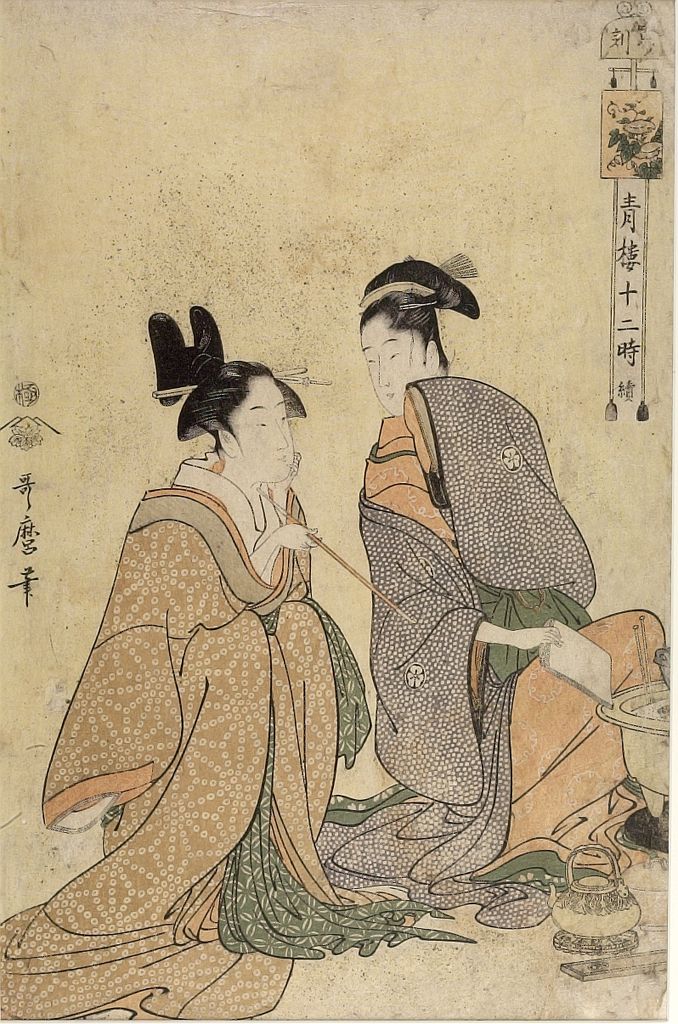
Hour of the Tiger (Tora no koku = 4 AM) from the series Twelve Hours in Yoshiwara (Seirô jûni toki tsuzuki), Late Edo period, circa 1794
Woodblock print
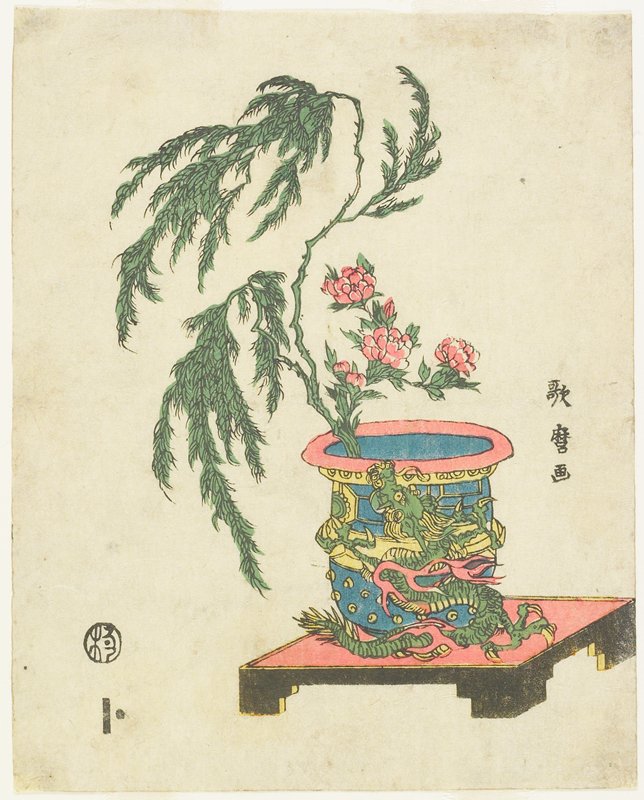
Ikebana arrangement of Peony and Willow in Dragon Pot
1781–1806
Woodblock print (nishiki-e), ink and color on paper
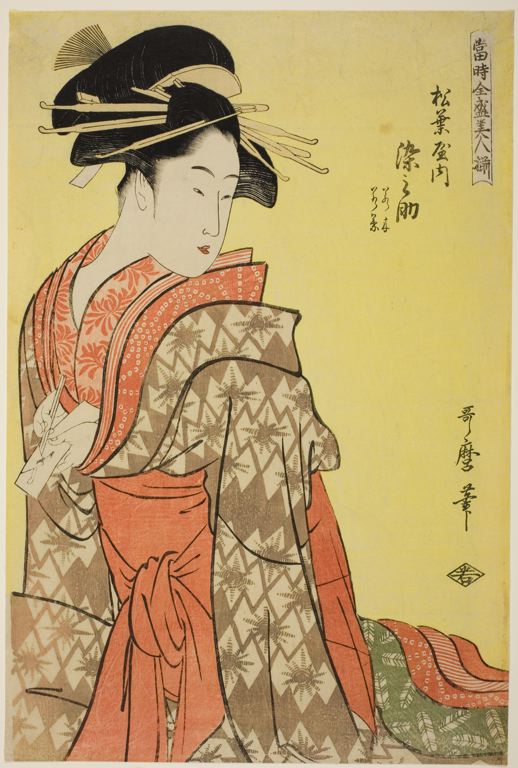
The Greatest Beauties of Our Time (Toji zensei bijin zoroe): Somenosuke of the Matsubaya with Attendants Wakagi and Wakaba
Woodblock print
Frequently Asked Questions
Hour of the Ox (Ushi no koku) Fukagawa Pleasure Quarter (Tatsumi), from the series "Customs of Beauties Around the Clock (Fuzoku bijin tokei)" was created by Kitagawa Utamaro (喜多川歌麿) in c. 1798/99.