
Komurasaki and Gonpachi, from the series "Fashonable Patterns in Utamaro Style (Ryuko moyo Utamaro-gata)"
- Date:
- c. 1798/99
- Medium:
- Color woodblock print; oban
- Source:
- Art Institute of Chicago
Description
Komurasaki and Gonpachi, from Kitagawa Utamaro's 1793 series Fashionable Patterns in Utamaro Style (Ryuko moyo Utamaro-gata), illustrates one of the most retold tragic-romantic narratives of the Edo period. The historical Komurasaki was a seventeenth-century Yoshiwara courtesan whose lover Gonpachi, a young samurai, descended into crime in his attempts to ransom her and was executed, after which Komurasaki took her own life on his grave. By the late eighteenth century the story circulated through kabuki, jōruri, and prose fiction as a paradigm of devotion. Utamaro's series boldly names itself for his own style, advertising Utamaro-gata as a recognizable fashion in itself, and applies that style to a sequence of celebrated lovers. Here he treats Komurasaki and Gonpachi in the close-paired format that he had developed for romantic couples in ukiyo-e, integrating costume, gesture, and inscription so that the design functions both as illustration and as autonomous Edo bijin-ga portrait. The publisher Tsutaya Juzaburo issued the set, and the Art Institute of Chicago holds the present impression. Within Utamaro's career the Ryuko moyo series stands as a confident assertion of his own status as a fashion-setter within Edo ukiyo-e, comparable to a designer who licenses his name to a line of finely worked illustrations of legendary couples.
More Prints by Kitagawa Utamaro
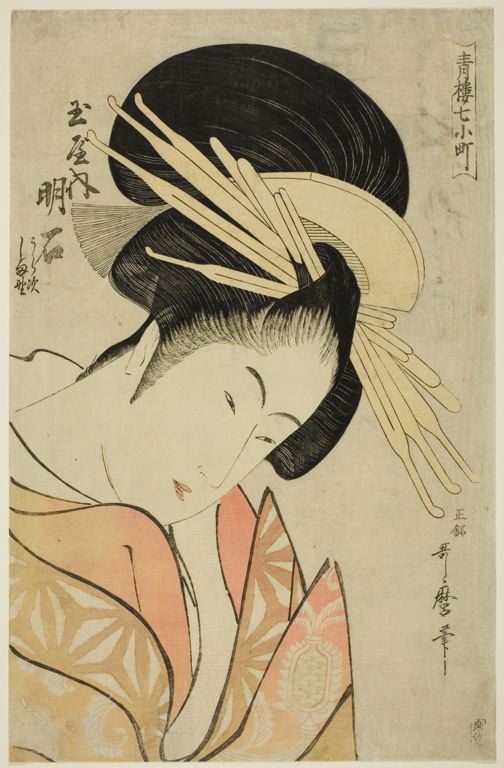
Akashi of the Tamaya, from the series Seven Komachis of Yoshiwara (Seiro nana Komachi) (Tamaya uchi Akashi, Uraji, Shimano)
Woodblock print
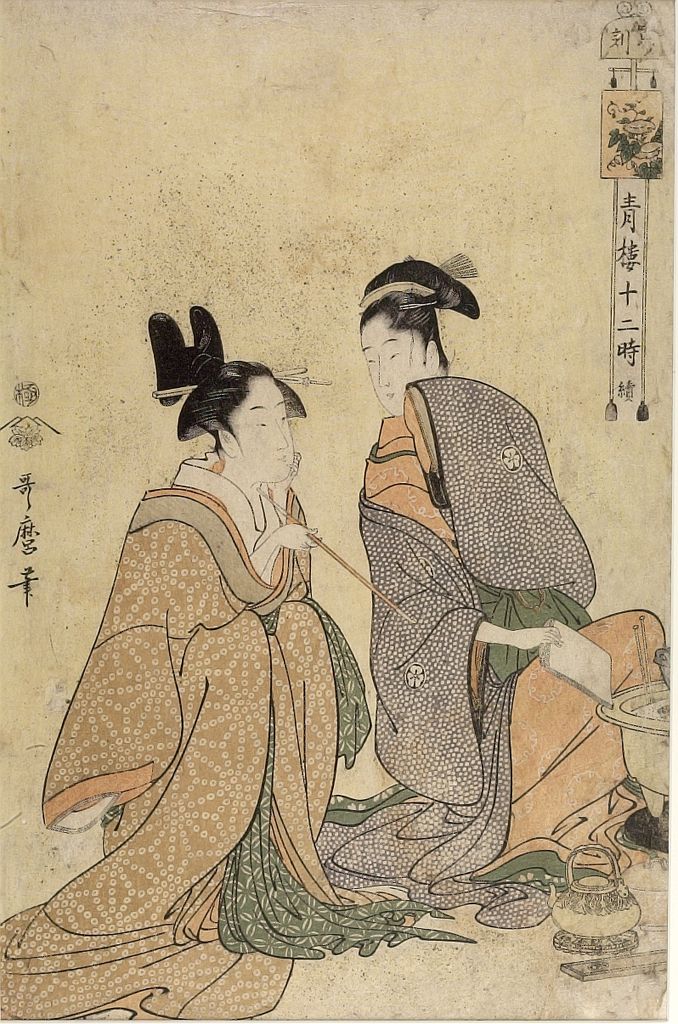
Hour of the Tiger (Tora no koku = 4 AM) from the series Twelve Hours in Yoshiwara (Seirô jûni toki tsuzuki), Late Edo period, circa 1794
Woodblock print
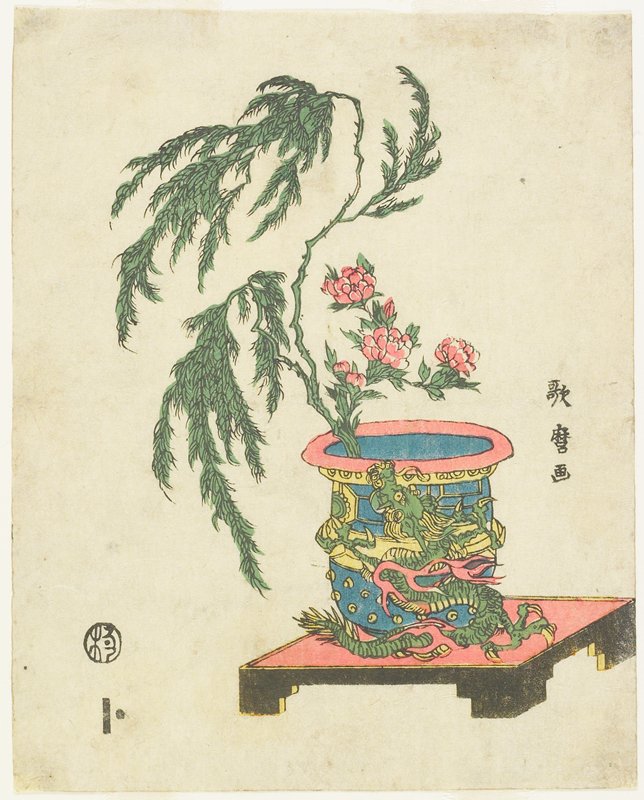
Ikebana arrangement of Peony and Willow in Dragon Pot
1781–1806
Woodblock print (nishiki-e), ink and color on paper
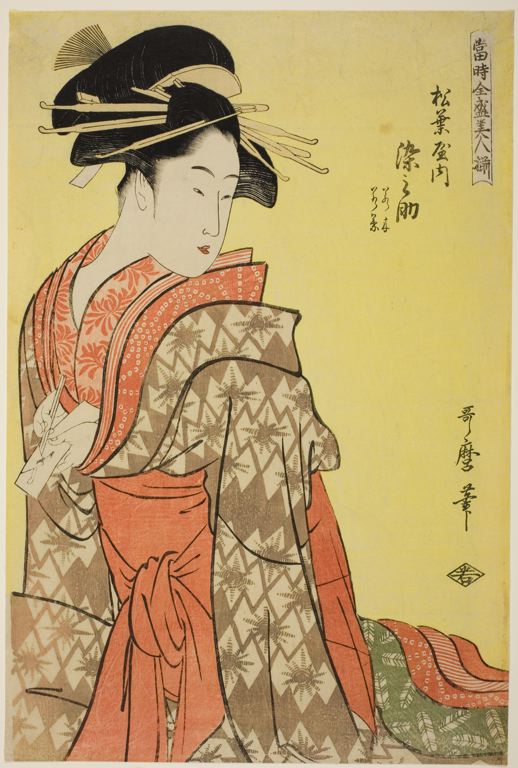
The Greatest Beauties of Our Time (Toji zensei bijin zoroe): Somenosuke of the Matsubaya with Attendants Wakagi and Wakaba
Woodblock print
Frequently Asked Questions
Komurasaki and Gonpachi, from the series "Fashonable Patterns in Utamaro Style (Ryuko moyo Utamaro-gata)" was created by Kitagawa Utamaro (喜多川歌麿) in c. 1798/99.
Yes — Komurasaki and Gonpachi, from the series "Fashonable Patterns in Utamaro Style (Ryuko moyo Utamaro-gata)" is part of the Fashonable Patterns in Utamaro Style series by Kitagawa Utamaro.