
Lovers Parting in the Morning, from the series "Elegant Five-needled Pine (Furyu goyo no matsu)"
- Date:
- c. 1797/98
- Medium:
- Color woodblock print; oban
- Source:
- Art Institute of Chicago
Description
Lovers Parting in the Morning, from the series Elegant Five-needled Pine (Furyu goyo no matsu), dated 1792 and held in the Art Institute of Chicago, is one of the more emotionally charged designs in Kitagawa Utamaro's bijin-ga repertoire. The series Furyu goyo no matsu takes its title from the five-needled pine, a poetic image associated with constancy, and uses it as a frame for exploring scenes of romantic life in the Edo floating world. This print depicts the kinuginu, or morning parting, a stock moment in Japanese literary and dramatic culture when lovers separate at dawn after a night together. Utamaro stages the scene with restrained body language: a man and woman lean toward one another at a final goodbye, their kimono partly undone, the morning light implied by the cool emptiness of the background. The artist's signature elongated proportions and softly drawn features add psychological weight without spilling into melodrama, and the relationship between the figures' faces, often nearly touching, becomes the central event of the design. Compared with his single-figure okubi-e portraits, prints like this show Utamaro's continued engagement with narrative scenes inherited from earlier ukiyo-e masters such as Suzuki Harunobu and Torii Kiyonaga, but reworked through the more intimate, character-driven mode of his maturity. As part of the Art Institute of Chicago's holdings of Kitagawa Utamaro, the sheet captures both the literary undercurrent of Edo bijin-ga and the longer history of love poetry the genre quietly extended.
More Prints by Kitagawa Utamaro
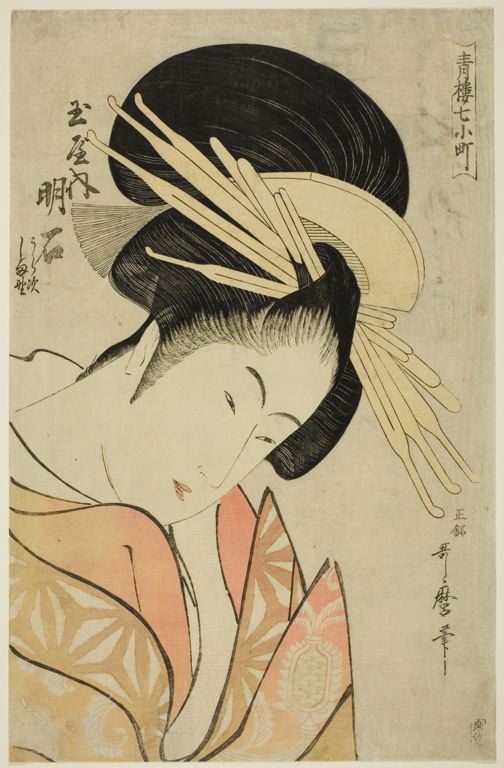
Akashi of the Tamaya, from the series Seven Komachis of Yoshiwara (Seiro nana Komachi) (Tamaya uchi Akashi, Uraji, Shimano)
Woodblock print
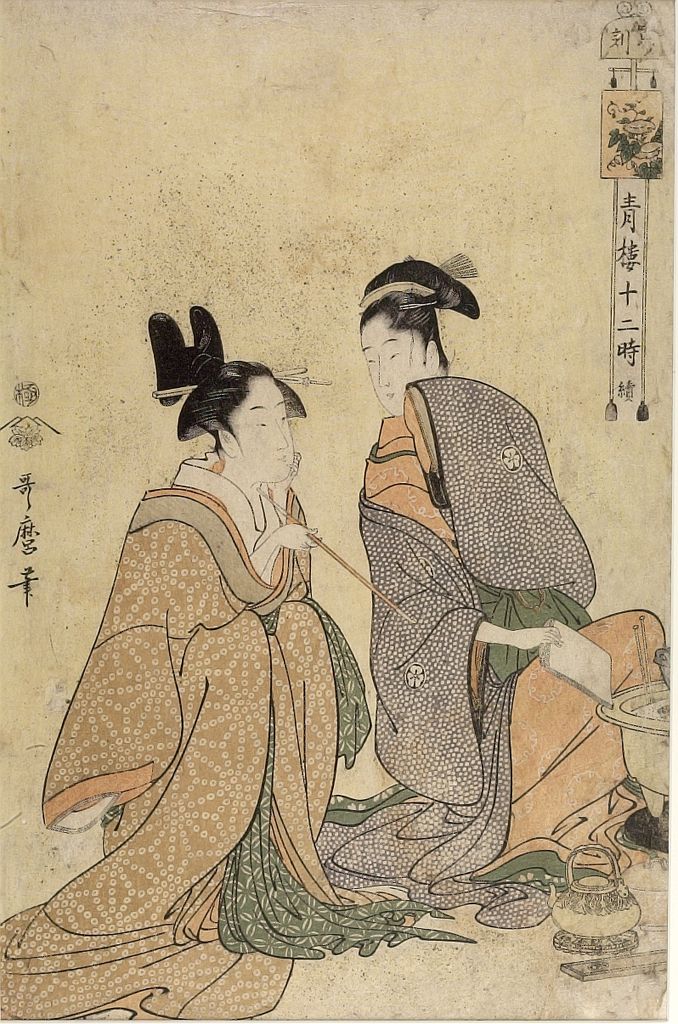
Hour of the Tiger (Tora no koku = 4 AM) from the series Twelve Hours in Yoshiwara (Seirô jûni toki tsuzuki), Late Edo period, circa 1794
Woodblock print
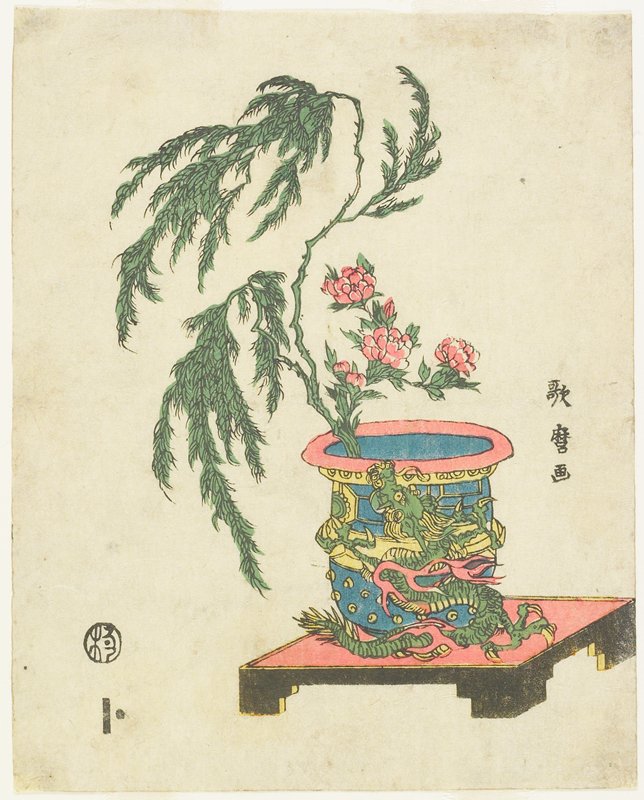
Ikebana arrangement of Peony and Willow in Dragon Pot
1781–1806
Woodblock print (nishiki-e), ink and color on paper
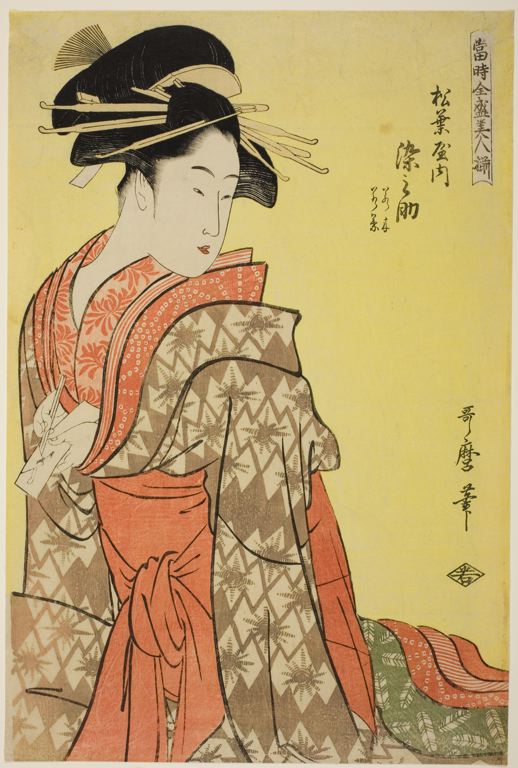
The Greatest Beauties of Our Time (Toji zensei bijin zoroe): Somenosuke of the Matsubaya with Attendants Wakagi and Wakaba
Woodblock print
Frequently Asked Questions
Lovers Parting in the Morning, from the series "Elegant Five-needled Pine (Furyu goyo no matsu)" was created by Kitagawa Utamaro (喜多川歌麿) in c. 1797/98.