
Mirror, from the series “Eight Views of Tea-stalls in Celebrated Places" ("Meisho koshikake hakkei")
- Date:
- c. 1795/96
- Medium:
- Color woodblock print; oban
- Source:
- Art Institute of Chicago
Description
Mirror, from the series Eight Views of Tea-stalls in Celebrated Places (Meisho koshikake hakkei), dated 1790 and held in the Art Institute of Chicago, is a witty meta-portrait by Kitagawa Utamaro that plays with the ukiyo-e convention of bijin-ga as a kind of public mirror. The series adapts the venerable Eight Views format, traditionally tied to landscape and Buddhist contemplation, to the more worldly setting of Edo's roadside tea stalls, replacing scenic vistas with vignettes of fashionable life. In this design, a young woman is seen in or with a hand mirror, her image doubled and observed simultaneously by the viewer and by herself. Utamaro uses the device of the mirror to literalize one of bijin-ga's central premises, that prints of women functioned as mirrors of contemporary style, and to invite reflection on who is looking at whom. Formally, the composition is built around contrasting curves: the round disk of the mirror, the swelling arc of the kimono sleeve, and the careful loop of the obi. The face itself, framed with the elongated proportions and slender features that define the artist's mature mode, anchors the design and exemplifies Edo bijin-ga at its most psychologically engaged. As part of the Art Institute of Chicago's important holdings of Kitagawa Utamaro and Tsutaya Juzaburo publications, the print connects late-eighteenth-century ukiyo-e to a longer tradition of meditative seriality while reframing it for the urban consumer.
More Prints by Kitagawa Utamaro
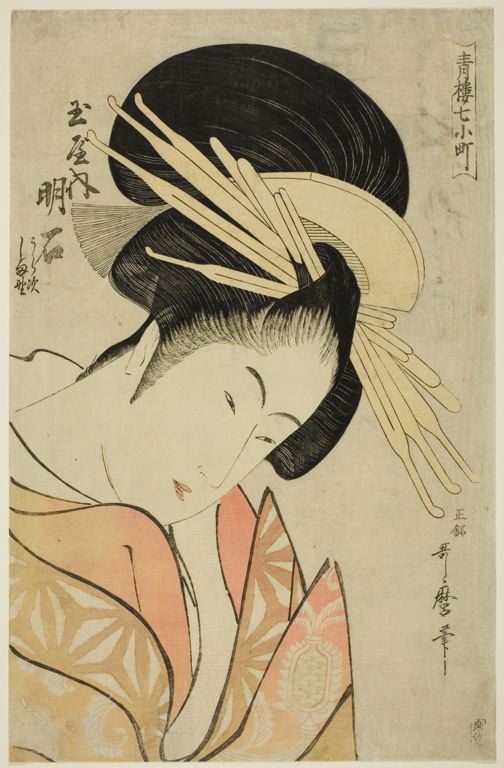
Akashi of the Tamaya, from the series Seven Komachis of Yoshiwara (Seiro nana Komachi) (Tamaya uchi Akashi, Uraji, Shimano)
Woodblock print
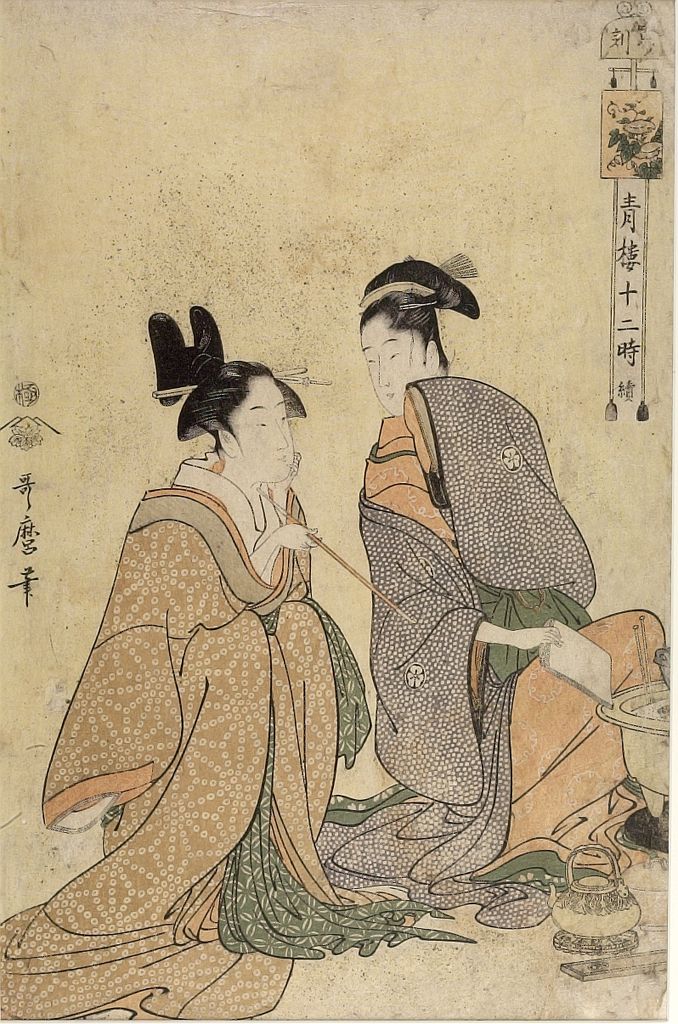
Hour of the Tiger (Tora no koku = 4 AM) from the series Twelve Hours in Yoshiwara (Seirô jûni toki tsuzuki), Late Edo period, circa 1794
Woodblock print
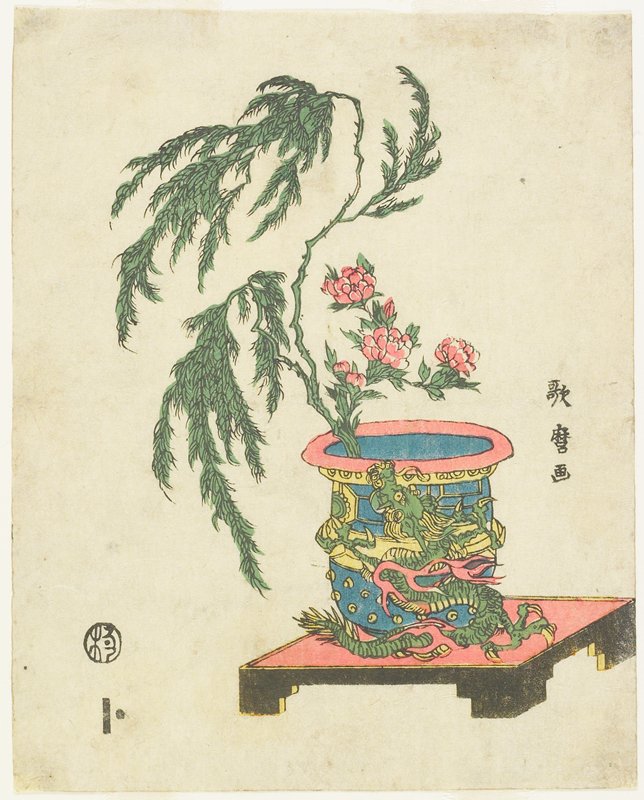
Ikebana arrangement of Peony and Willow in Dragon Pot
1781–1806
Woodblock print (nishiki-e), ink and color on paper
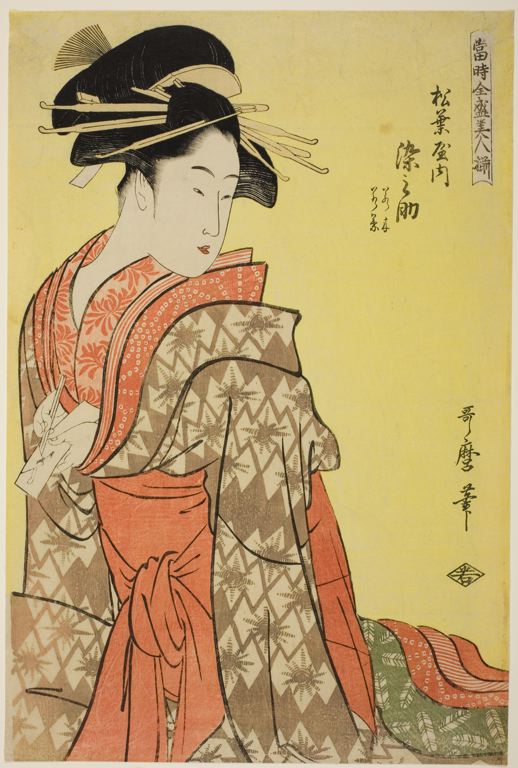
The Greatest Beauties of Our Time (Toji zensei bijin zoroe): Somenosuke of the Matsubaya with Attendants Wakagi and Wakaba
Woodblock print
Frequently Asked Questions
Mirror, from the series “Eight Views of Tea-stalls in Celebrated Places" ("Meisho koshikake hakkei") was created by Kitagawa Utamaro (喜多川歌麿) in c. 1795/96.