
Mother and Child, from the series Meisho fūkei bijin jūni sō
- Date:
- Late Edo period,
- Medium:
- Ukiyo-e woodblock print in "ōban" format; ink and color on paper, with printed signature reading "Utamaro hitsu"
- Source:
- Art Institute of Chicago
Description
Mother and Child, from Kitagawa Utamaro's c. 1798 series Meisho fukei bijin juni so (Twelve Physiognomies of Beautiful Women Representing Views of Famous Places), held by the Art Institute of Chicago, fuses two of his characteristic late-career interests: the typological survey and the domestic portrait. Each sheet of the series pairs a famous Edo locale with a type of woman whose physiognomy, manner, or activity is taken as emblematic; in this design the type is a mother attentive to her young child. Utamaro brings to the pair the same calibrated observation he gave to the courtesans of the Yoshiwara, here applied to maternal gesture, the angle of an inclined head, the way a small body leans against a larger one. The link to meisho (famous places) reminds the viewer that motherhood itself, in this conception, can be regarded as a feature of the urban landscape, as worthy of cataloguing as any landmark bridge or shrine. Within Edo bijin-ga, the print is a model of how ukiyo-e expanded its frame to include the daily intimacies of female life.
More Prints by Kitagawa Utamaro
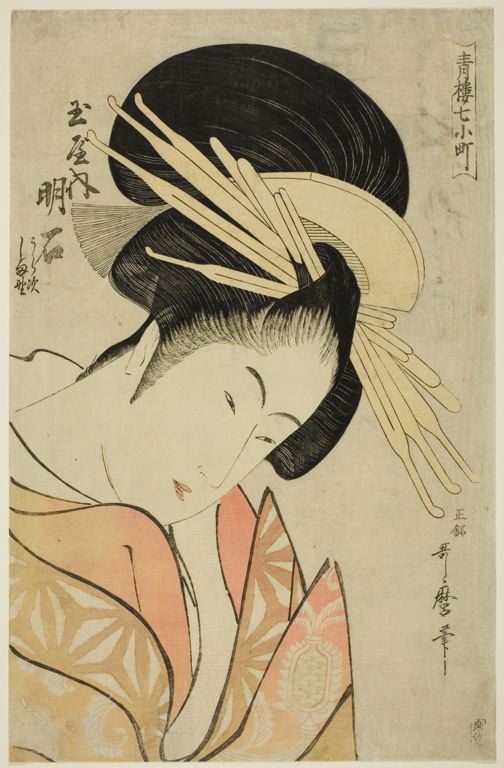
Akashi of the Tamaya, from the series Seven Komachis of Yoshiwara (Seiro nana Komachi) (Tamaya uchi Akashi, Uraji, Shimano)
Woodblock print
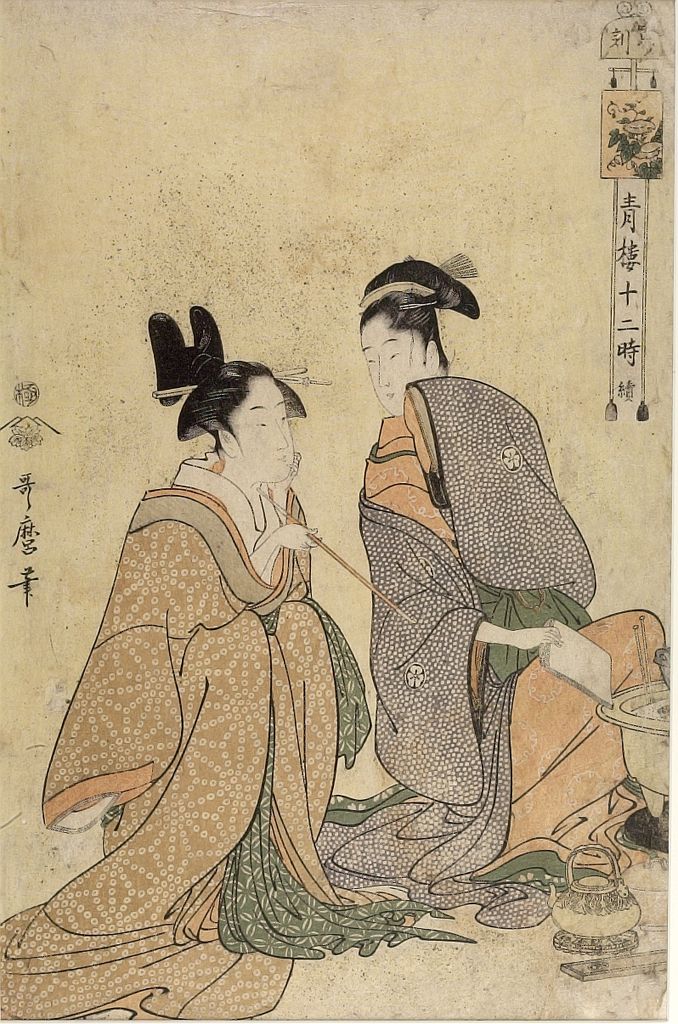
Hour of the Tiger (Tora no koku = 4 AM) from the series Twelve Hours in Yoshiwara (Seirô jûni toki tsuzuki), Late Edo period, circa 1794
Woodblock print
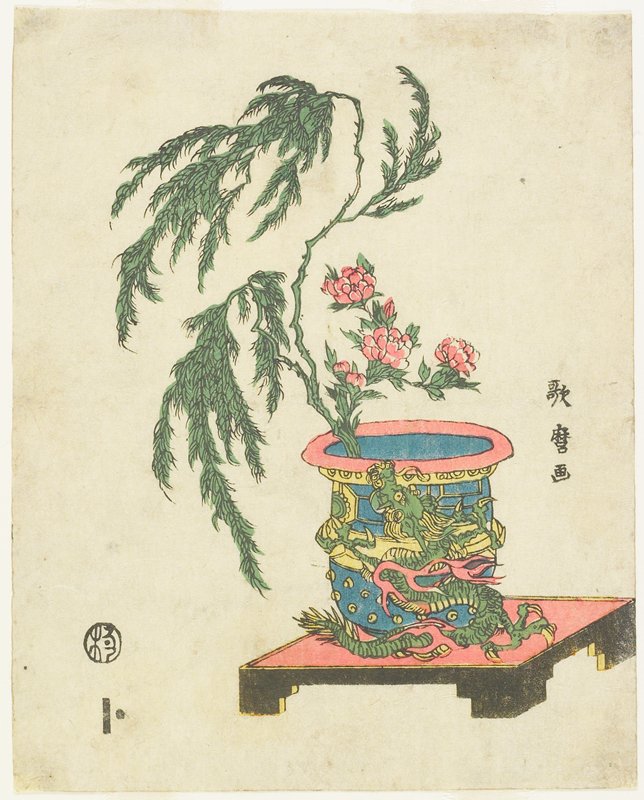
Ikebana arrangement of Peony and Willow in Dragon Pot
1781–1806
Woodblock print (nishiki-e), ink and color on paper
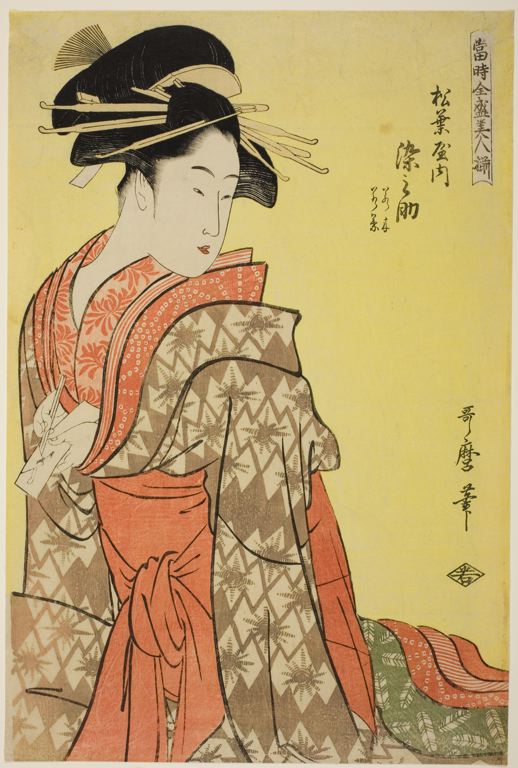
The Greatest Beauties of Our Time (Toji zensei bijin zoroe): Somenosuke of the Matsubaya with Attendants Wakagi and Wakaba
Woodblock print
Frequently Asked Questions
Mother and Child, from the series Meisho fūkei bijin jūni sō was created by Kitagawa Utamaro (喜多川歌麿) in Late Edo period,.