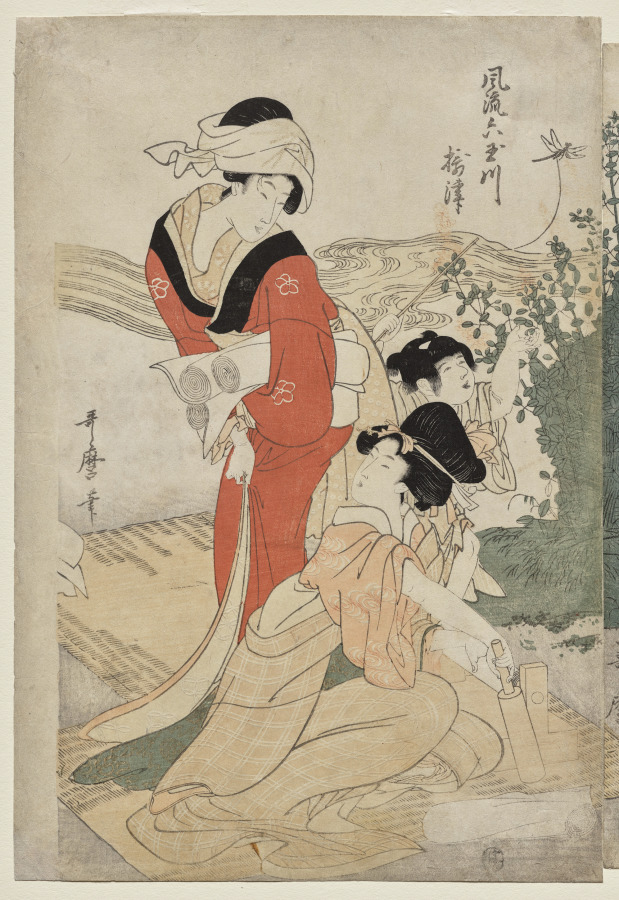
Musashi Province from the series Fashionable Six Jewel Rivers (Furyu Mu Tamagawa)
- Date:
- c. 1804
- Medium:
- polychrome woodblock print; ink and color on paper
- Source:
- Cleveland Museum of Art
Description
Musashi Province from the series Fashionable Six Jewel Rivers (Furyu Mu Tamagawa), designed by Kitagawa Utamaro around 1795 and held by the Cleveland Museum of Art, completes a trio of impressions in the same museum holding from the same celebrated series. Musashi was Edo's own province, so this sheet uses the Tamagawa-of-Musashi conceit to bring the poetic structure of the cycle home, dressing fashionable contemporary women in patterns and gestures appropriate to the local landscape. Utamaro's drawing of the figures is characteristic of his mid-1790s mastery: necks and shoulders are elongated within his Edo bijin-ga manner, while heads tilt at carefully judged angles that complement one another across the composition. The printers, working from his designs, exploit subtle bokashi gradation to suggest the river, with the figures floating on the bank in robes whose textile patterns evoke the imagery of waka about the Musashi Tamagawa. As an ukiyo-e cycle, the Furyu Mu Tamagawa exemplifies how the late eighteenth-century print market absorbed classical poetic geography into the world of contemporary fashion, advertising both the publisher's taste and the artist's command of literary reference. For collectors of Kitagawa Utamaro and students of mitate-e, the Cleveland Museum of Art's impression of the Musashi sheet offers an especially direct comparison with the Settsu and Omi sheets from the same series, showing how he varied figural composition while sustaining the cycle's overall mood.
More Prints by Kitagawa Utamaro
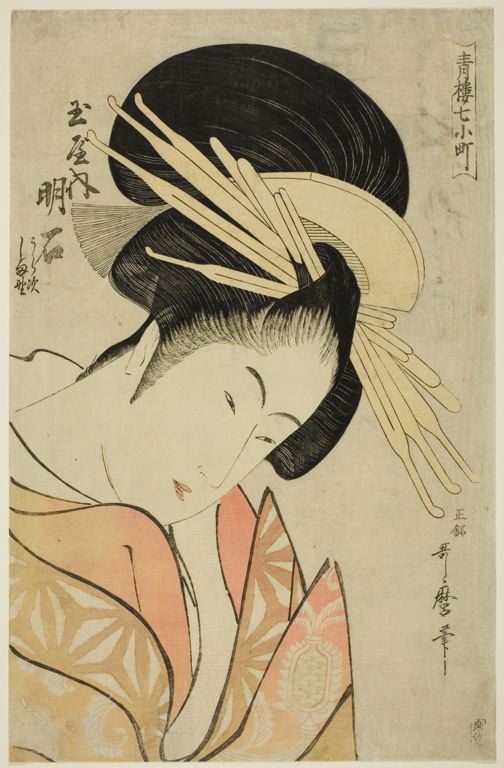
Akashi of the Tamaya, from the series Seven Komachis of Yoshiwara (Seiro nana Komachi) (Tamaya uchi Akashi, Uraji, Shimano)
Woodblock print
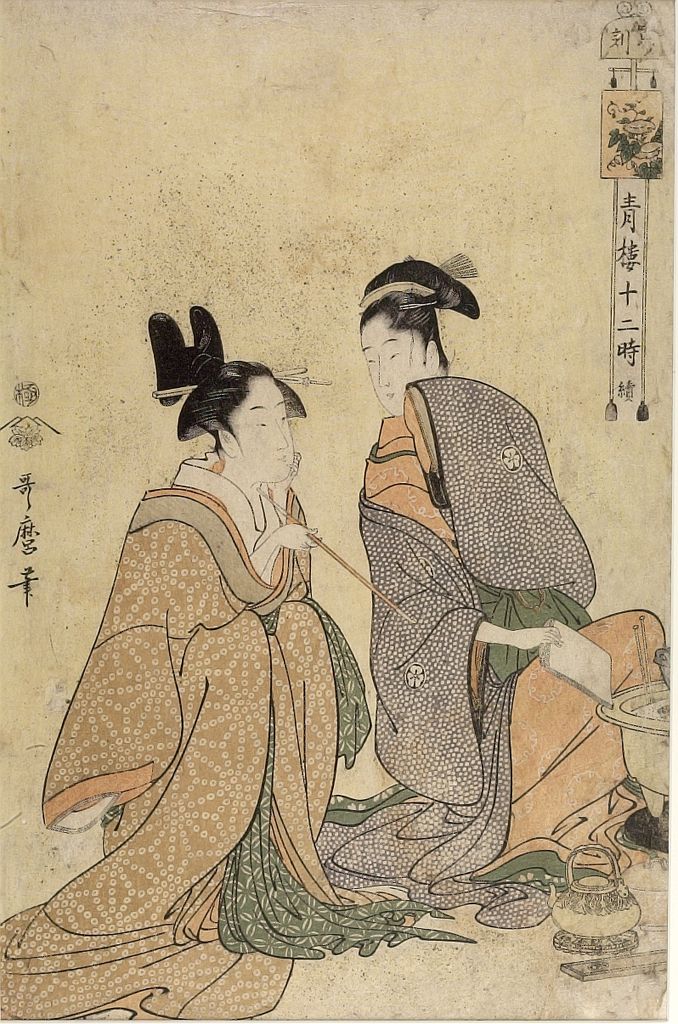
Hour of the Tiger (Tora no koku = 4 AM) from the series Twelve Hours in Yoshiwara (Seirô jûni toki tsuzuki), Late Edo period, circa 1794
Woodblock print
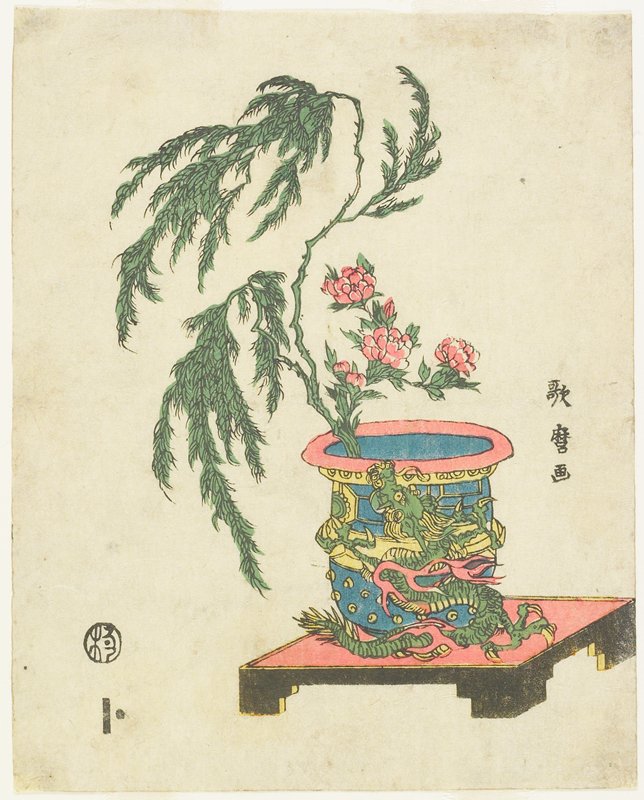
Ikebana arrangement of Peony and Willow in Dragon Pot
1781–1806
Woodblock print (nishiki-e), ink and color on paper
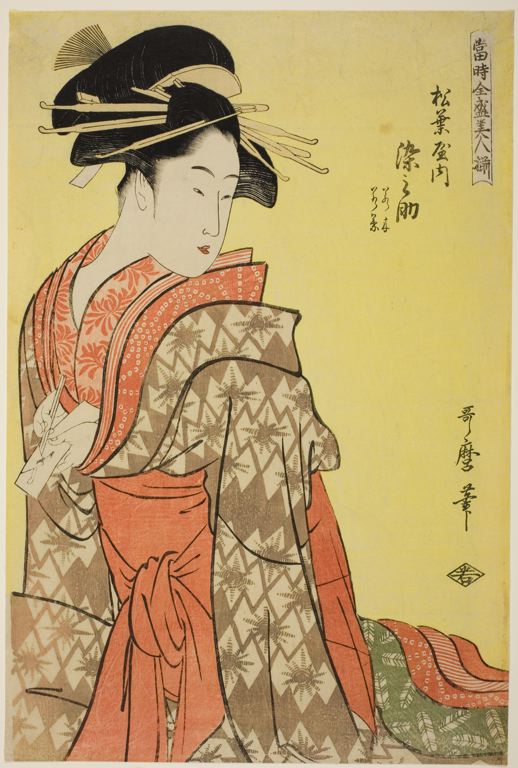
The Greatest Beauties of Our Time (Toji zensei bijin zoroe): Somenosuke of the Matsubaya with Attendants Wakagi and Wakaba
Woodblock print
Frequently Asked Questions
Musashi Province from the series Fashionable Six Jewel Rivers (Furyu Mu Tamagawa) was created by Kitagawa Utamaro (喜多川歌麿) in c. 1804.