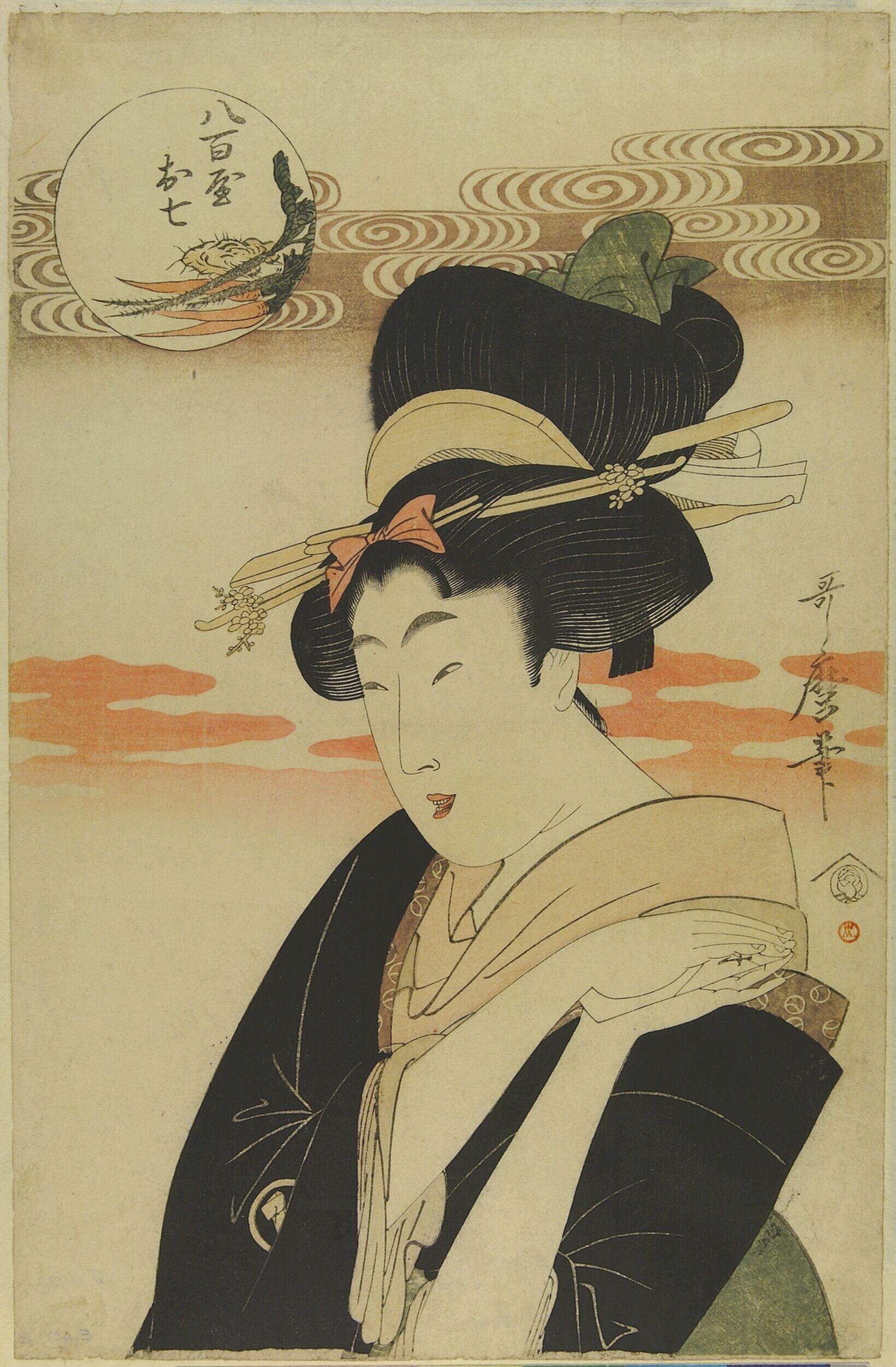
O-Shichi of the Yaoya House
- Date:
- 1801-1804
- Medium:
- Source:
- Victoria and Albert Museum
Description
O-Shichi of the Yaoya House is a color woodblock print designed by Kitagawa Utamaro around 1801 and held by the Victoria and Albert Museum. The subject is one of Edo's most enduring tragic heroines: the historical young woman O-Shichi, daughter of a greengrocer, whose desperate love story ended in execution and inspired generations of joruri plays, kabuki adaptations, and ukiyo-e prints. Utamaro reframes O-Shichi within his mature visual language of Edo bijin-ga, presenting her as a poised, individualized figure rather than as a moralized cautionary figure. As one of the central ukiyo-e designers of the period, Kitagawa Utamaro was attuned to the way familiar legends could be re-narrated through pose, gesture, and costume, and his O-Shichi reads less as a single dramatic moment than as a distilled portrait of a much-retold persona. The Yaoya, or greengrocer, association is preserved in the figure's identification, but Utamaro's interest is in the emotional weight of the character as filtered through a beauty print. The V&A's example offers a window onto the cross-pollination between Edo's theatrical and print cultures, where a real young woman from the seventeenth century became a recurring figure in eighteenth- and nineteenth-century imagination. For collectors of ukiyo-e, the print sits at the intersection of celebrity portraiture, theatrical fandom, and the steadily evolving formal language of Utamaro's late style.
More Prints by Kitagawa Utamaro
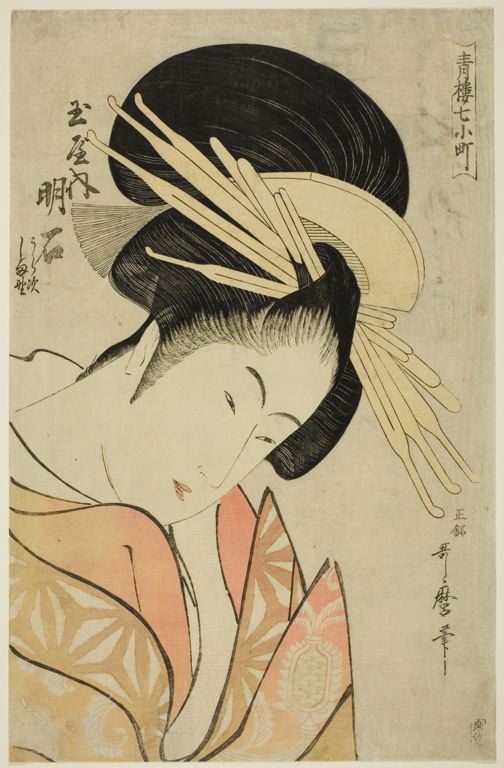
Akashi of the Tamaya, from the series Seven Komachis of Yoshiwara (Seiro nana Komachi) (Tamaya uchi Akashi, Uraji, Shimano)
Woodblock print
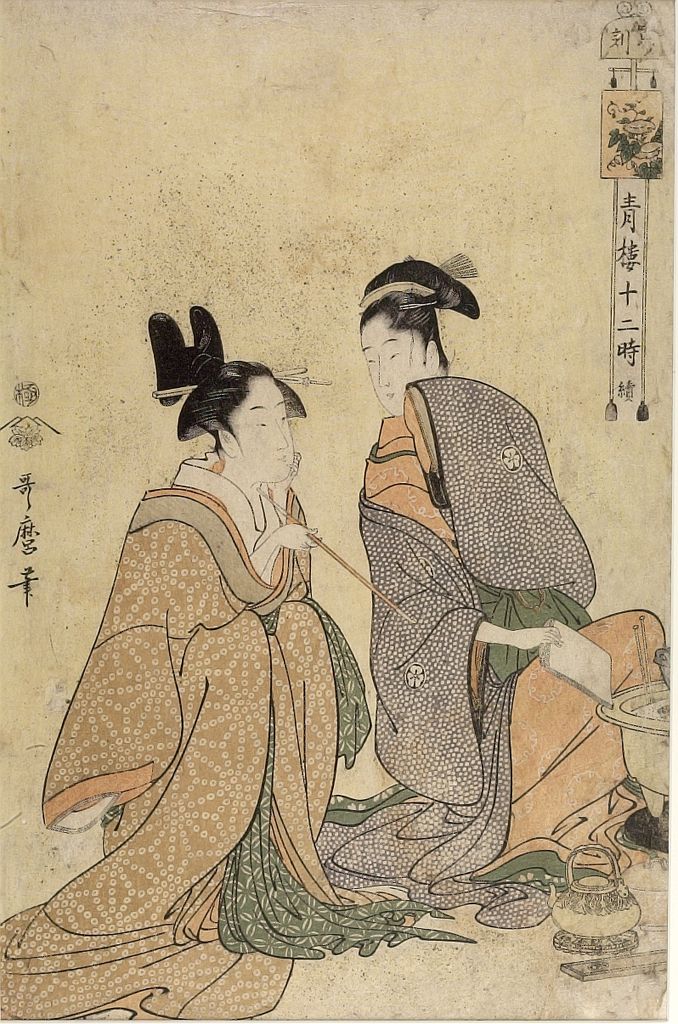
Hour of the Tiger (Tora no koku = 4 AM) from the series Twelve Hours in Yoshiwara (Seirô jûni toki tsuzuki), Late Edo period, circa 1794
Woodblock print
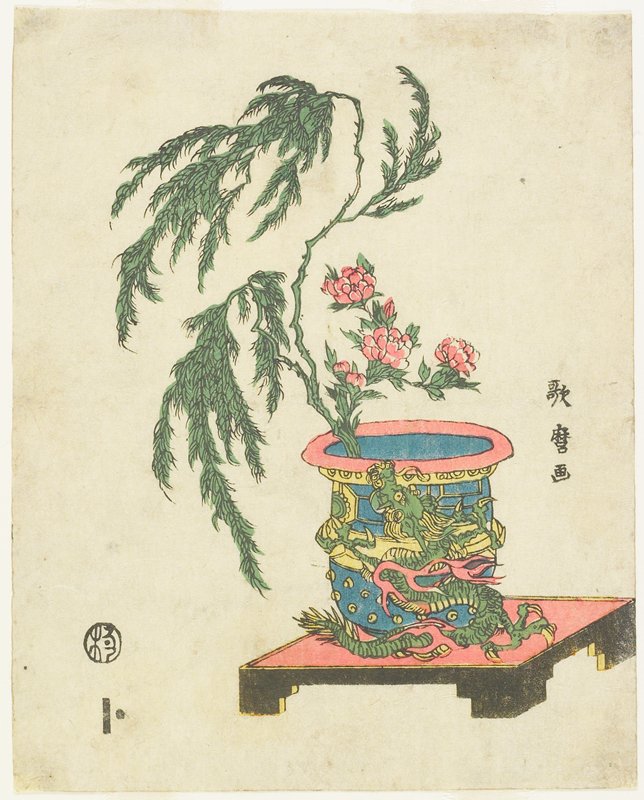
Ikebana arrangement of Peony and Willow in Dragon Pot
1781–1806
Woodblock print (nishiki-e), ink and color on paper
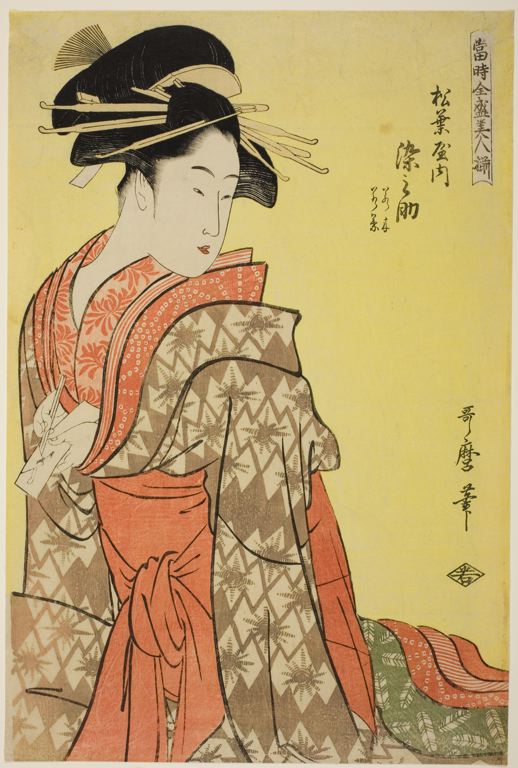
The Greatest Beauties of Our Time (Toji zensei bijin zoroe): Somenosuke of the Matsubaya with Attendants Wakagi and Wakaba
Woodblock print
Frequently Asked Questions
O-Shichi of the Yaoya House was created by Kitagawa Utamaro (喜多川歌麿) in 1801-1804.