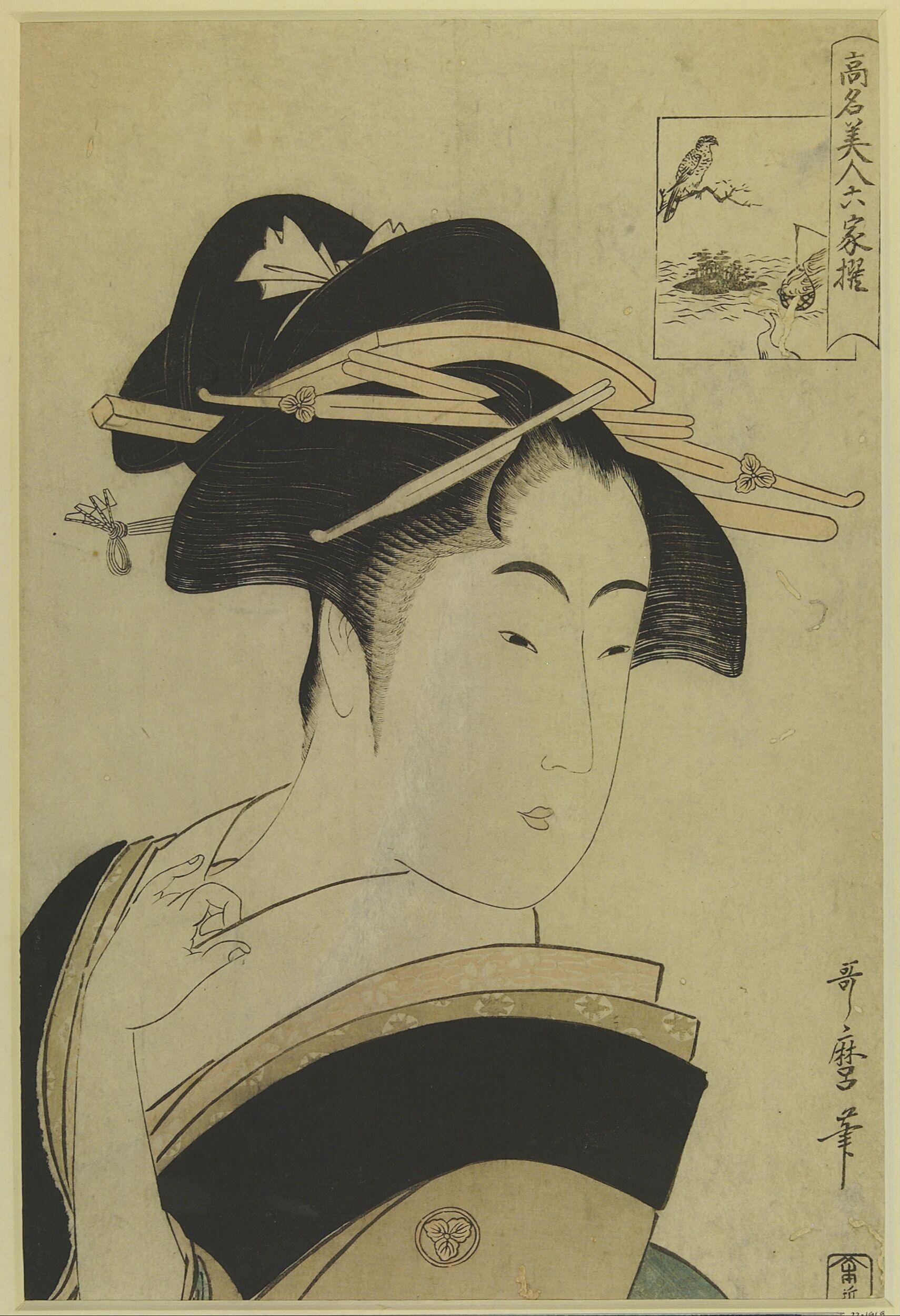
'Six Beauties of the Higest Renown'
- Date:
- ca.1789
- Medium:
- Source:
- Victoria and Albert Museum
Description
"Six Beauties of the Highest Renown," dated 1789 and held by the Victoria and Albert Museum, comes from one of Kitagawa Utamaro's early major series and an important step in his development as the leading portraitist of the Yoshiwara. The series belongs to a Tenmei-Kansei wave of celebrity prints that named individual courtesans of the licensed quarter and treated them as starring personalities. Utamaro and his publisher Tsutaya Juzaburo helped pioneer this approach, transforming Edo bijin-ga from a generic genre into a form of named portraiture that responded to and intensified the gossip economy of Edo. By 1789 Utamaro was developing the distinctive elongated faces and refined contour lines that would mature into his celebrated 1790s style. The V&A's impression speaks to the eagerness with which European and American collectors gathered Utamaro's prints in the late nineteenth and early twentieth centuries, when the rediscovery of ukiyo-e fed the broader Japoniste enthusiasm that influenced artists from Manet and Whistler to Mary Cassatt. Within Utamaro's own oeuvre, "Six Beauties of the Highest Renown" stands at the threshold between the studio's earlier multi-figure compositions and the half-length okubi-e that would define his peak achievements. The series remains a touchstone for studies of how named beauty became the central subject of Edo woodblock prints.
More Prints by Kitagawa Utamaro
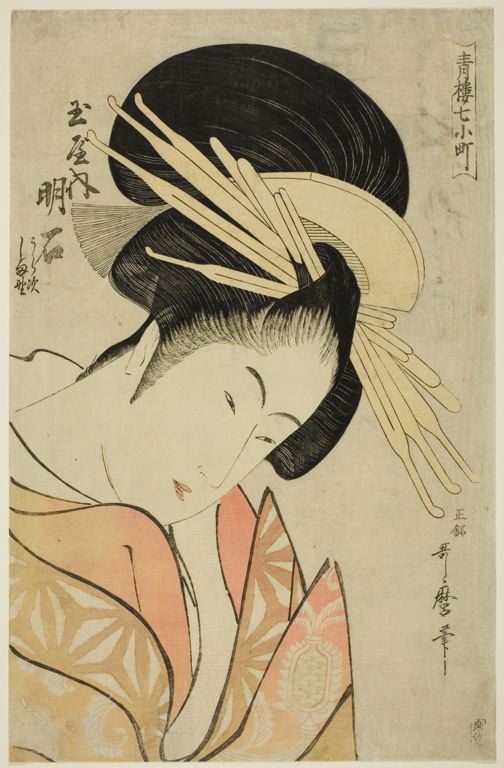
Akashi of the Tamaya, from the series Seven Komachis of Yoshiwara (Seiro nana Komachi) (Tamaya uchi Akashi, Uraji, Shimano)
Woodblock print
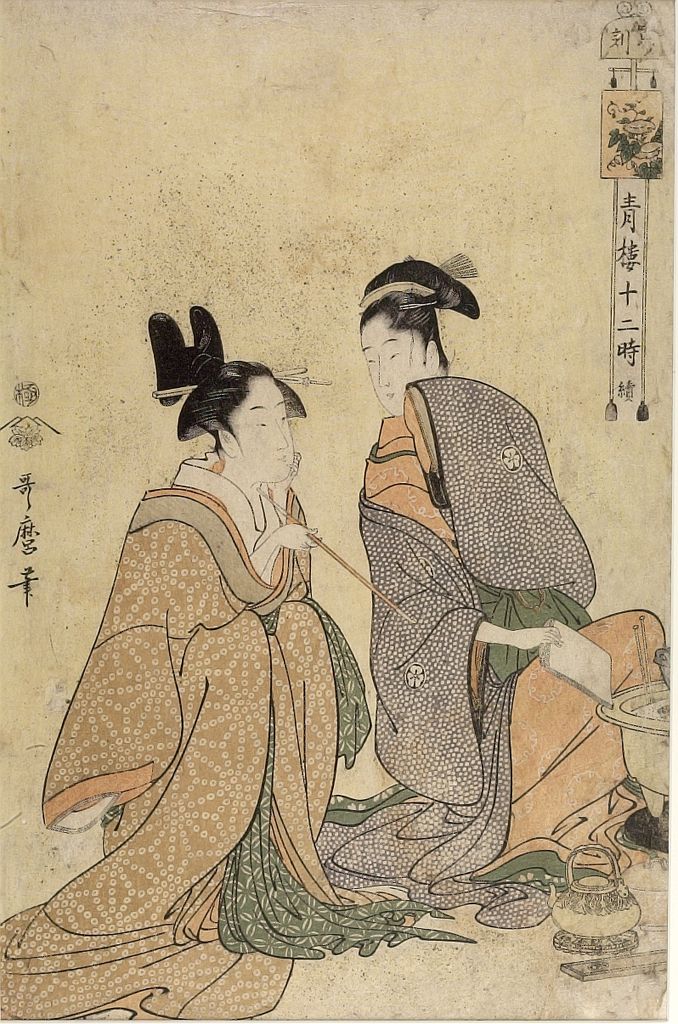
Hour of the Tiger (Tora no koku = 4 AM) from the series Twelve Hours in Yoshiwara (Seirô jûni toki tsuzuki), Late Edo period, circa 1794
Woodblock print
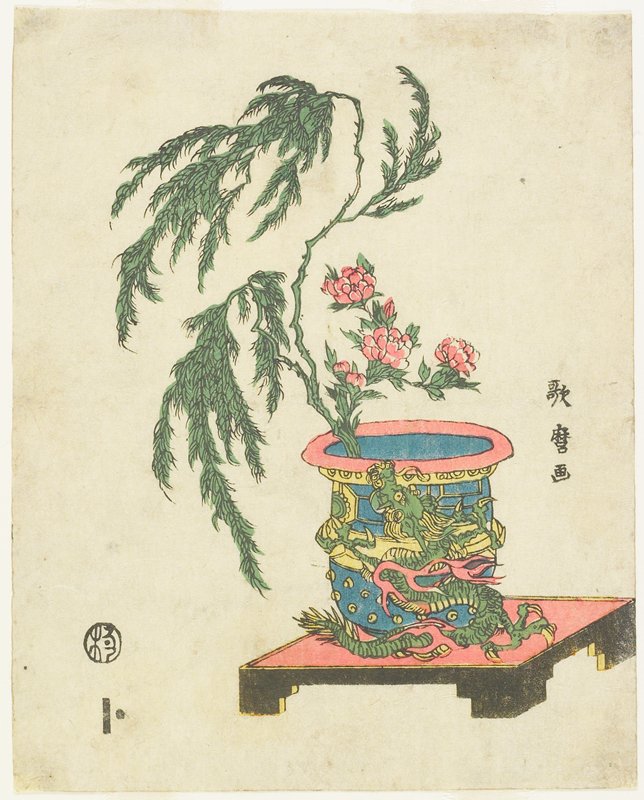
Ikebana arrangement of Peony and Willow in Dragon Pot
1781–1806
Woodblock print (nishiki-e), ink and color on paper
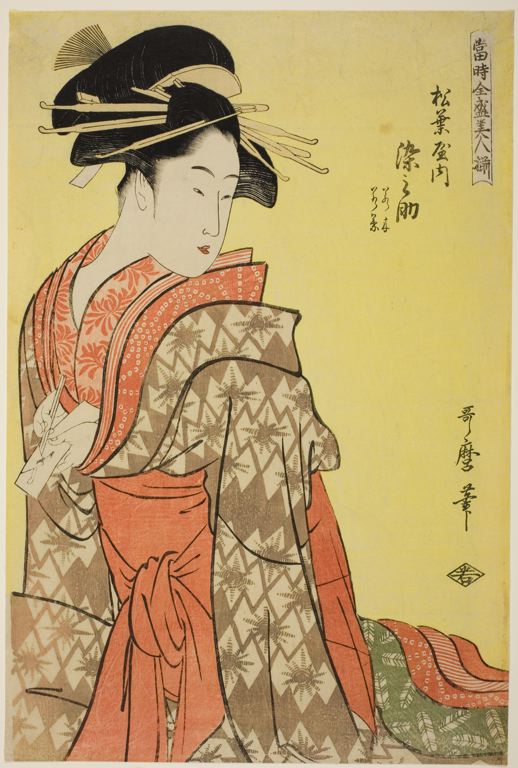
The Greatest Beauties of Our Time (Toji zensei bijin zoroe): Somenosuke of the Matsubaya with Attendants Wakagi and Wakaba
Woodblock print
Frequently Asked Questions
'Six Beauties of the Higest Renown' was created by Kitagawa Utamaro (喜多川歌麿) in ca.1789.