![Somenosuke of the Matsubaya, [whose attendants are] Wakagi, Wakaba (Matsubaya uchi Somenosuke, Wakagi, Wakaba), from the series “Array of Supreme Beauties of the Present Day" ("Toji zensei bijin-zoroe") by Kitagawa Utamaro — Japanese Color woodblock print; oban, 1794](https://www.artic.edu/iiif/2/8fe854e1-872d-3300-6983-fec3ddcc32e2/full/843,/0/default.jpg)
Somenosuke of the Matsubaya, [whose attendants are] Wakagi, Wakaba (Matsubaya uchi Somenosuke, Wakagi, Wakaba), from the series “Array of Supreme Beauties of the Present Day" ("Toji zensei bijin-zoroe")
- Date:
- 1794
- Medium:
- Color woodblock print; oban
- Source:
- Art Institute of Chicago
Description
Kitagawa Utamaro's Somenosuke of the Matsubaya, (whose attendants are) Wakagi, Wakaba, from the series Array of Supreme Beauties of the Present Day (Toji zensei bijin-zoroe), is held by the Art Institute of Chicago (artwork 23912). The series title proclaims its ambition: an array, zoroe, of the supreme bijin of the contemporary moment, all assembled in print for the Edo viewer. Utamaro's contribution to this project is, as elsewhere, named portraiture of leading Yoshiwara courtesans with their kamuro attendants identified. Here Somenosuke of the Matsubaya is paired with her young attendants Wakagi and Wakaba, members of one of the most prestigious Yoshiwara houses. The naming of attendants, as in other Utamaro Tamaya and Matsubaya sheets, anchors Somenosuke within the household hierarchy of the Yoshiwara and supports the multi-figure composition with a built-in interpretive scheme. Utamaro's mature drawing distinguishes the adult courtesan from her kamuro by face shape, hair arrangement, and the relative scale of figures across the sheet, while the patterned textiles function both as decoration and as social identifier. The Toji zensei bijin-zoroe is, in effect, Utamaro's catalogue of the leading women of late 1780s Yoshiwara, and it has remained an important reference for both art historians and historians of the Edo licensed quarter. The Art Institute of Chicago's holding preserves the sheet for the study of named Yoshiwara courtesans and the careful self-positioning of houses such as the Matsubaya within the print economy. For collectors of Edo bijin-ga, this design is representative of Utamaro's strongest period of multi-figure courtesan portraits.
More Prints by Kitagawa Utamaro
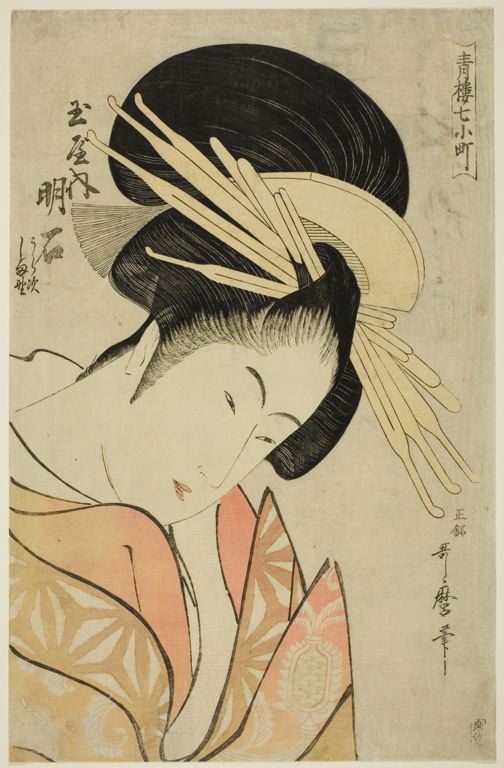
Akashi of the Tamaya, from the series Seven Komachis of Yoshiwara (Seiro nana Komachi) (Tamaya uchi Akashi, Uraji, Shimano)
Woodblock print
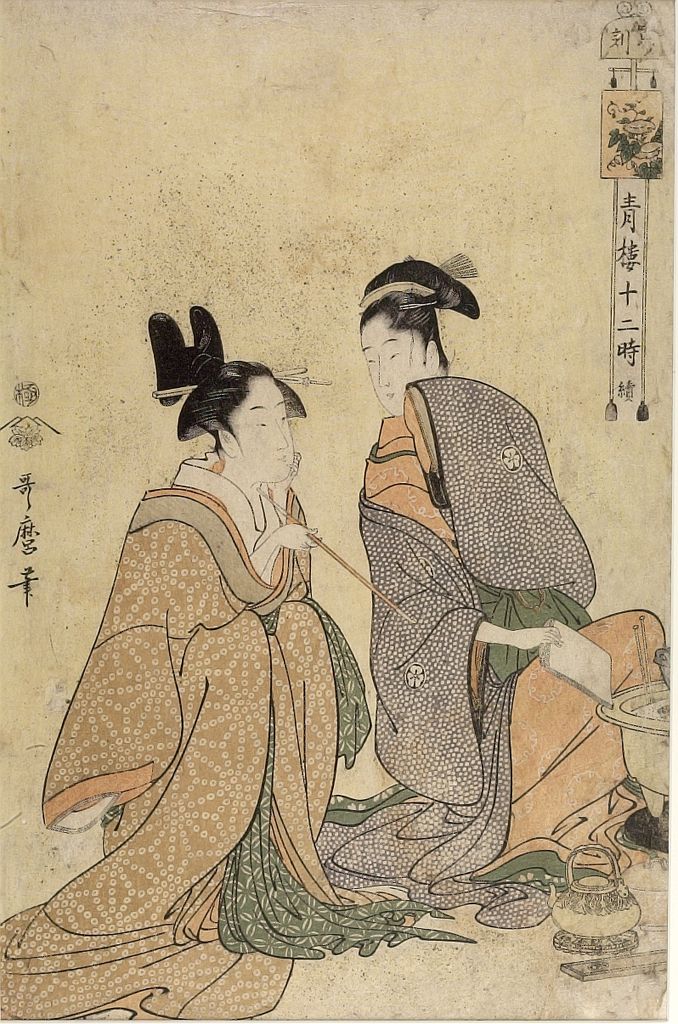
Hour of the Tiger (Tora no koku = 4 AM) from the series Twelve Hours in Yoshiwara (Seirô jûni toki tsuzuki), Late Edo period, circa 1794
Woodblock print
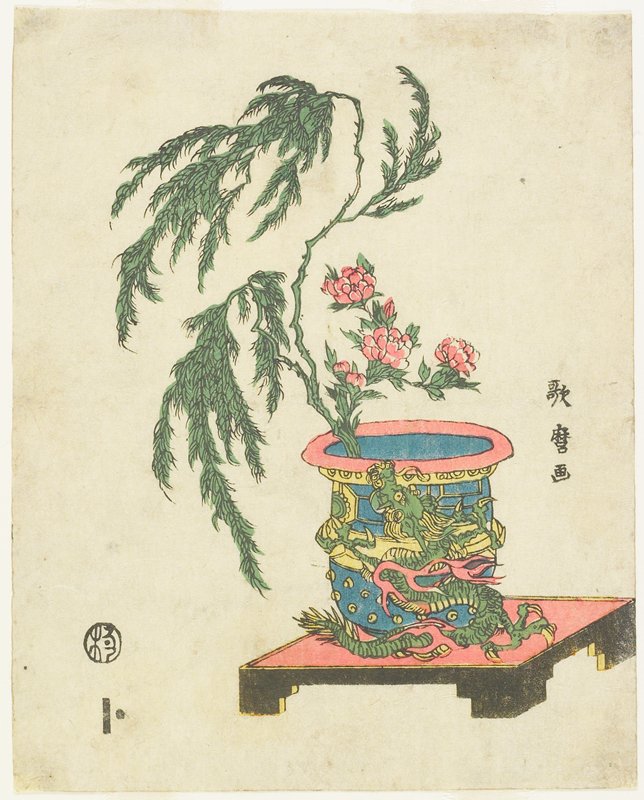
Ikebana arrangement of Peony and Willow in Dragon Pot
1781–1806
Woodblock print (nishiki-e), ink and color on paper
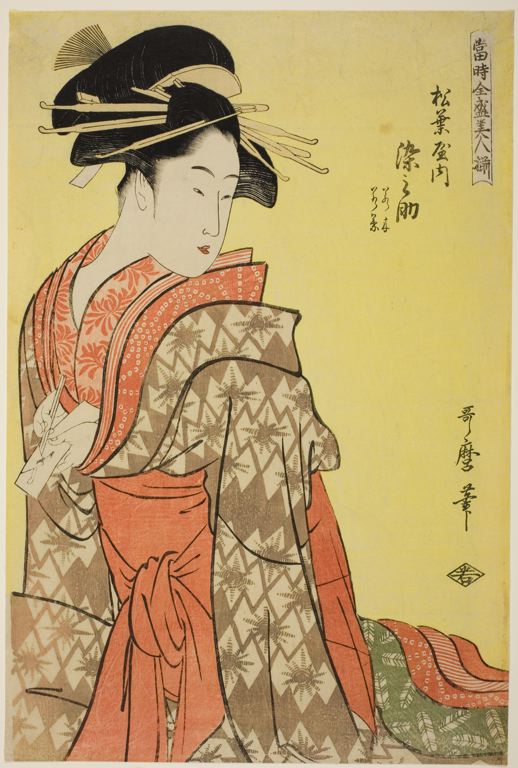
The Greatest Beauties of Our Time (Toji zensei bijin zoroe): Somenosuke of the Matsubaya with Attendants Wakagi and Wakaba
Woodblock print
Frequently Asked Questions
Somenosuke of the Matsubaya, [whose attendants are] Wakagi, Wakaba (Matsubaya uchi Somenosuke, Wakagi, Wakaba), from the series “Array of Supreme Beauties of the Present Day" ("Toji zensei bijin-zoroe") was created by Kitagawa Utamaro (喜多川歌麿) in 1794.