Standing Man and Kneeling Woman
- Date:
- 18th-19th century
- Medium:
- Ukiyo-e woodblock print in "ōban" format; ink and color on paper
- Source:
- Harvard Art Museums
Description
Standing Man and Kneeling Woman is a Kitagawa Utamaro design at the Harvard Art Museums showing the close interaction of two figures arranged in contrasting postures: a male figure upright, a female figure kneeling at his side or feet. Such compositional pairings - one figure standing, one bent or seated below - appear frequently in Utamaro's Edo bijin-ga and shunga-adjacent imagery, where the difference in posture is used to convey relationship, status and emotional charge. The drawing of bodies and faces follows Utamaro's mature manner: long contoured robes, elongated necks and refined features that mark this as part of his late-eighteenth-century beauty corpus. Patterned textiles, rendered through the careful colour separations of nishiki-e printing, identify the figures' social standing while keeping the composition legible. By stripping away background detail, the artist concentrates attention on the geometry of upright and bent forms and on the small interactions between the two figures - a gesture, a glance, an offered cup or fan that often becomes the dramatic centre of such prints. As preserved at Harvard, the design illustrates how Utamaro used spatial economy to lend interpretive depth to seemingly simple two-figure compositions within the larger world of Edo ukiyo-e.
More Prints by Kitagawa Utamaro
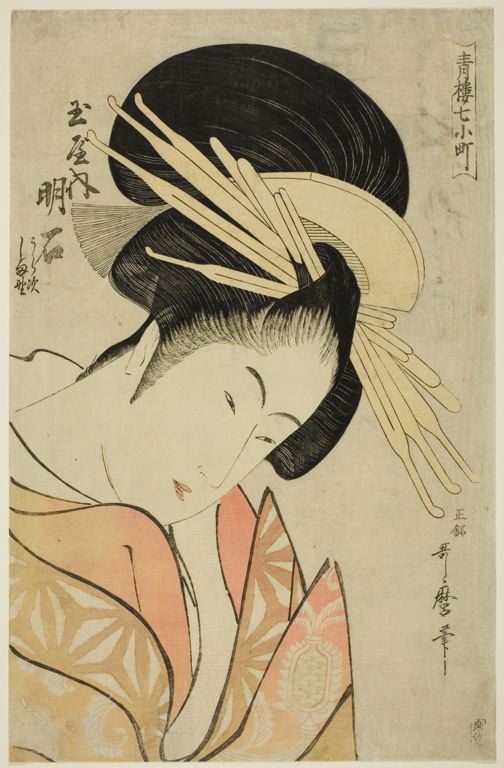
Akashi of the Tamaya, from the series Seven Komachis of Yoshiwara (Seiro nana Komachi) (Tamaya uchi Akashi, Uraji, Shimano)
Woodblock print
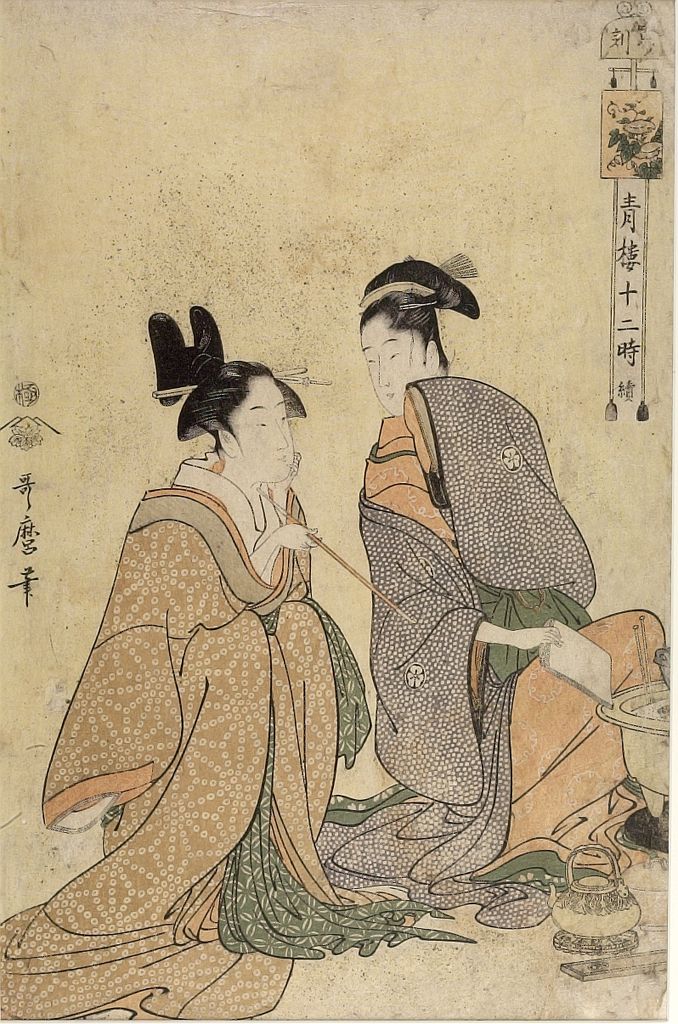
Hour of the Tiger (Tora no koku = 4 AM) from the series Twelve Hours in Yoshiwara (Seirô jûni toki tsuzuki), Late Edo period, circa 1794
Woodblock print
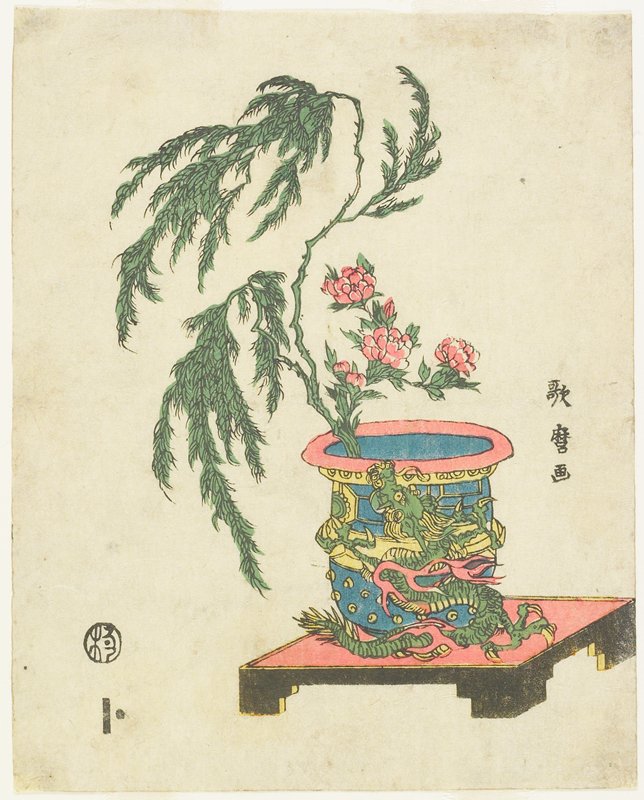
Ikebana arrangement of Peony and Willow in Dragon Pot
1781–1806
Woodblock print (nishiki-e), ink and color on paper
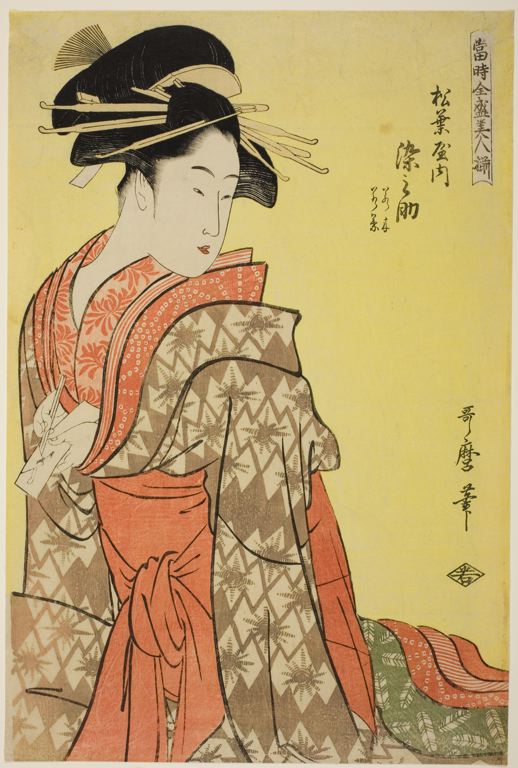
The Greatest Beauties of Our Time (Toji zensei bijin zoroe): Somenosuke of the Matsubaya with Attendants Wakagi and Wakaba
Woodblock print
Frequently Asked Questions
Standing Man and Kneeling Woman was created by Kitagawa Utamaro (喜多川歌麿) in 18th-19th century.