Standing Woman in Court Dress with a Seated Woman and Child
- Date:
- 18th-19th century
- Medium:
- Ukiyo-e woodblock print in large "ōban" format; ink and color on paper, with printed signature reading "Utamaro hitsu"
- Source:
- Harvard Art Museums
Description
In this ukiyo-e print Kitagawa Utamaro pairs a standing woman in elaborate court dress with a seated woman and a child, building a three-figure composition that bridges his Edo bijin-ga and the world of historical or mitate imagery. Court-style robes, with their long trailing trains and multiple-layered junihitoe construction, had ceased to be everyday wear by the late Edo period but continued to signal nobility, antiquity, and ceremonial gravity in popular prints. By placing such a figure beside a more contemporary seated woman and a child, Utamaro produces a small scene whose meaning hovers between portrait and analogue, perhaps alluding to a Heian-period episode or to a literary recasting of the present in classical guise. The artist's drawing exploits the contrast between the standing woman's stiffer, more architectural silhouette and the supple curves of the seated pair, while patterned textiles balanced against unprinted paper sustain visual interest across the sheet. The child's compact body anchors the lower register and softens the formal mood, recalling Utamaro's affectionate treatment of mothers and children across his career. The Harvard Art Museums preserves this impression (object 208742), where it documents the artist's appetite for compositions that drew on both ceremony and intimacy.
More Prints by Kitagawa Utamaro
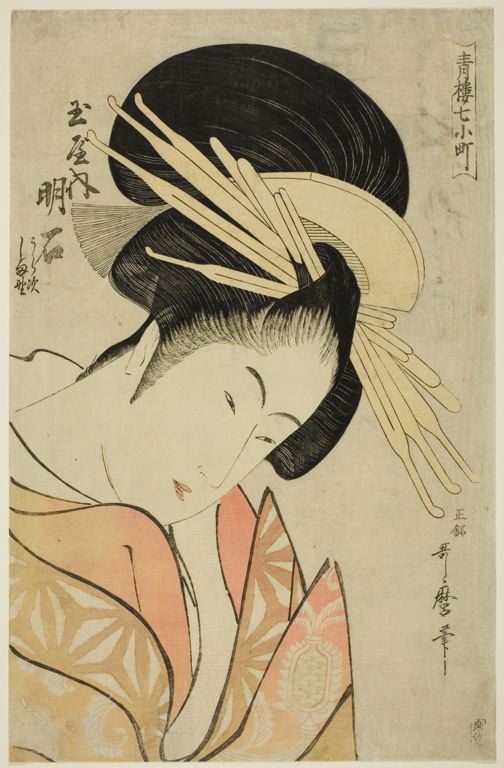
Akashi of the Tamaya, from the series Seven Komachis of Yoshiwara (Seiro nana Komachi) (Tamaya uchi Akashi, Uraji, Shimano)
Woodblock print
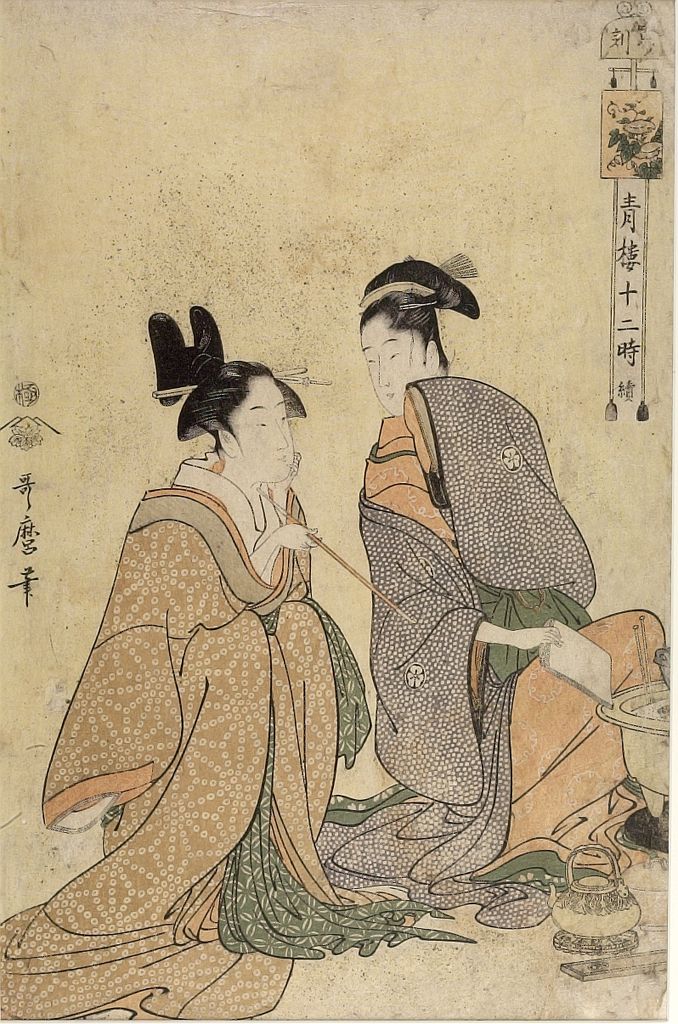
Hour of the Tiger (Tora no koku = 4 AM) from the series Twelve Hours in Yoshiwara (Seirô jûni toki tsuzuki), Late Edo period, circa 1794
Woodblock print
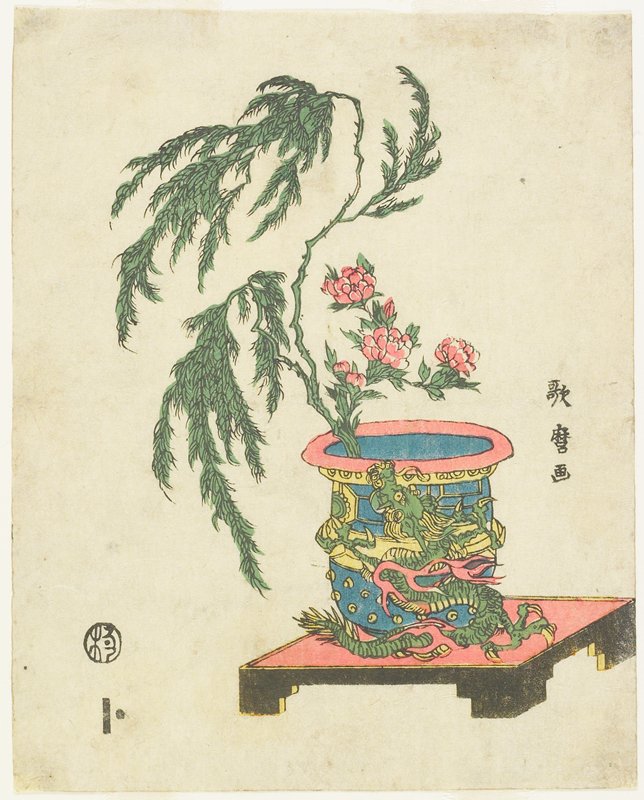
Ikebana arrangement of Peony and Willow in Dragon Pot
1781–1806
Woodblock print (nishiki-e), ink and color on paper
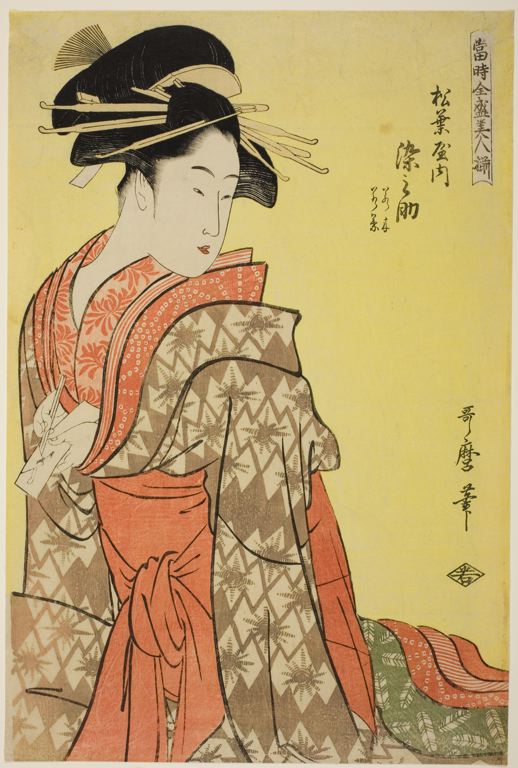
The Greatest Beauties of Our Time (Toji zensei bijin zoroe): Somenosuke of the Matsubaya with Attendants Wakagi and Wakaba
Woodblock print
Frequently Asked Questions
Standing Woman in Court Dress with a Seated Woman and Child was created by Kitagawa Utamaro (喜多川歌麿) in 18th-19th century.