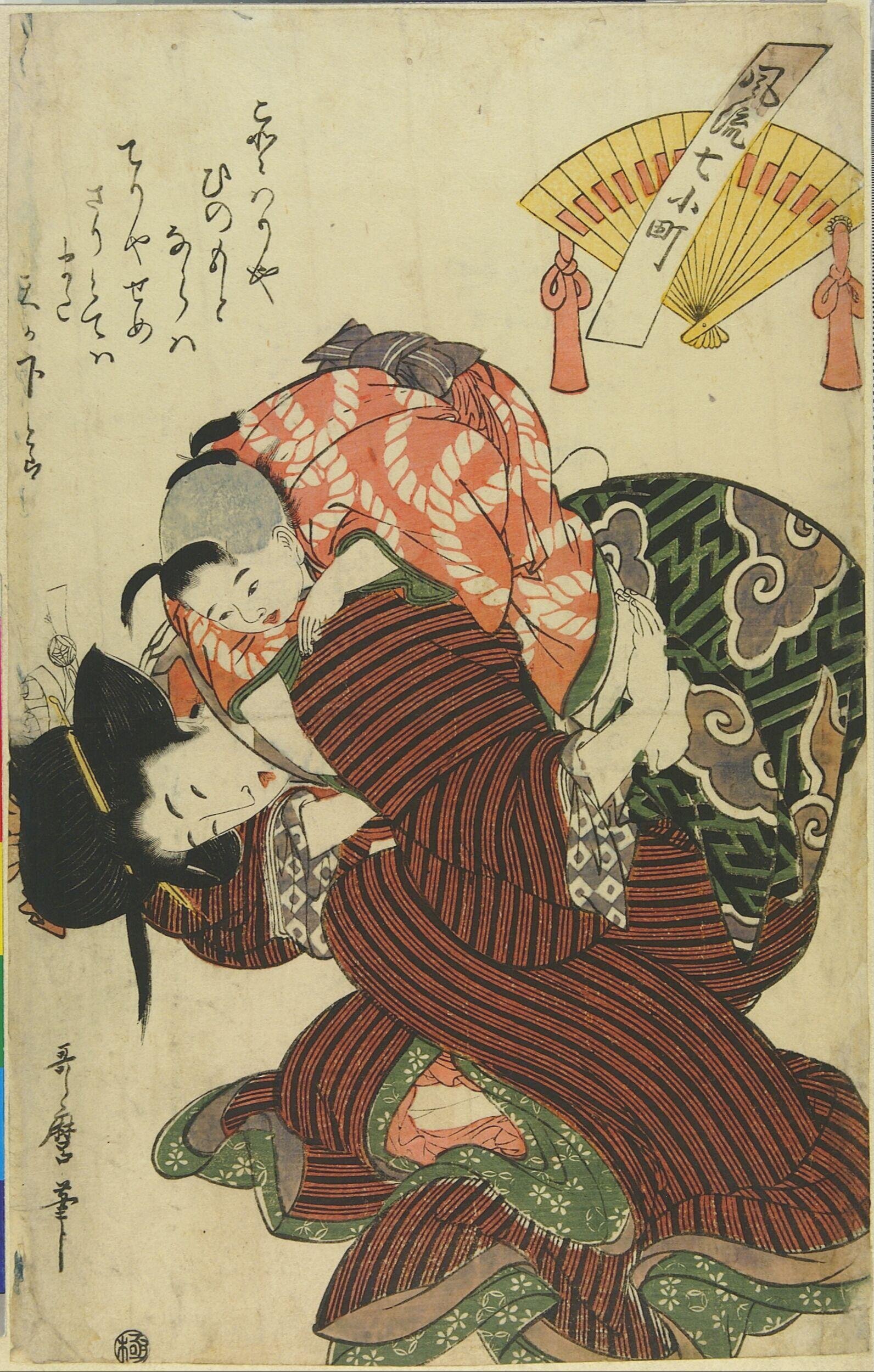
'The Eleven Elegant Aspects of Komachi'
- Medium:
- Source:
- Victoria and Albert Museum
Description
Kitagawa Utamaro's The Eleven Elegant Aspects of Komachi, an undated ukiyo-e print in the Victoria and Albert Museum (museum number O421984), belongs to the long Edo tradition of dedicating series to Ono no Komachi, the legendary ninth-century female poet who became a touchstone of feminine beauty, talent, and pathos in classical Japanese literature. Komachi's life was conventionally divided into a fixed set of episodes, the so-called Seven Komachi or other numbered cycles, that fed paintings, no plays, and ukiyo-e. By titling his series The Eleven Elegant Aspects of Komachi, Utamaro adopts and extends this iconography, providing his Edo audience with a numbered set of beauties each associated with a moment, gesture, or quality of Komachi. The series is therefore a literary bijin-ga: a sequence in which contemporary women, drawn in Utamaro's mature manner, stand in for episodes from the life of a legendary poet. This kind of mitate was central to Utamaro's practice. It elevated the genre of ukiyo-e bijin-ga above pure portraiture, attaching prestige and narrative reference to the depiction of fashionable Edo women, and it gave publishers a serial framework that encouraged collecting across multiple sheets. Stylistically the design shows Utamaro's hallmark attention to face, hair, and patterned textile, against a relatively spare ground that throws the figure forward. The V&A's record preserves the print as part of a broad reference collection of ukiyo-e and Edo bijin-ga, allowing the design to be studied alongside related Komachi cycles by other artists. For collectors, the series is useful evidence of how Utamaro positioned himself as both a painter of beauties and a knowledgeable participant in classical Japanese literary culture.
More Prints by Kitagawa Utamaro
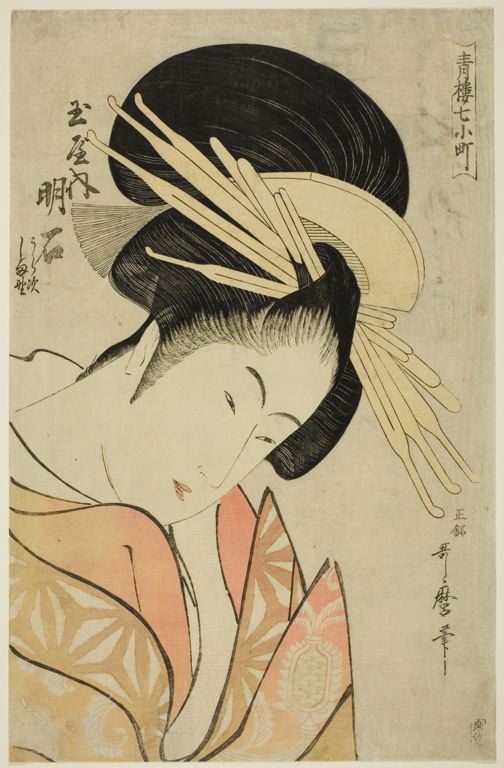
Akashi of the Tamaya, from the series Seven Komachis of Yoshiwara (Seiro nana Komachi) (Tamaya uchi Akashi, Uraji, Shimano)
Woodblock print
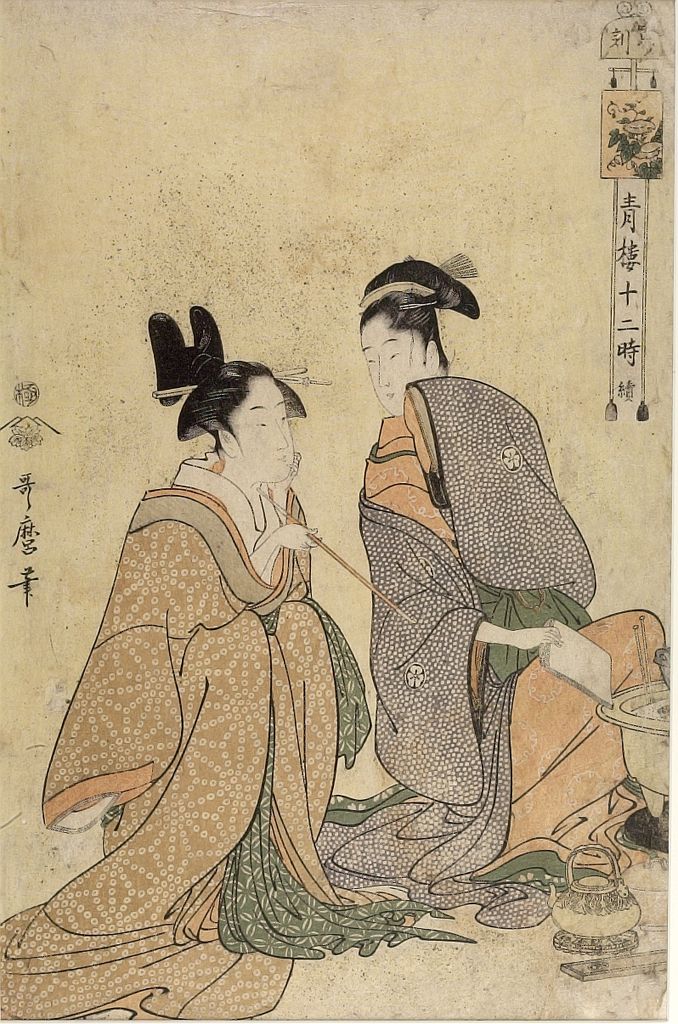
Hour of the Tiger (Tora no koku = 4 AM) from the series Twelve Hours in Yoshiwara (Seirô jûni toki tsuzuki), Late Edo period, circa 1794
Woodblock print
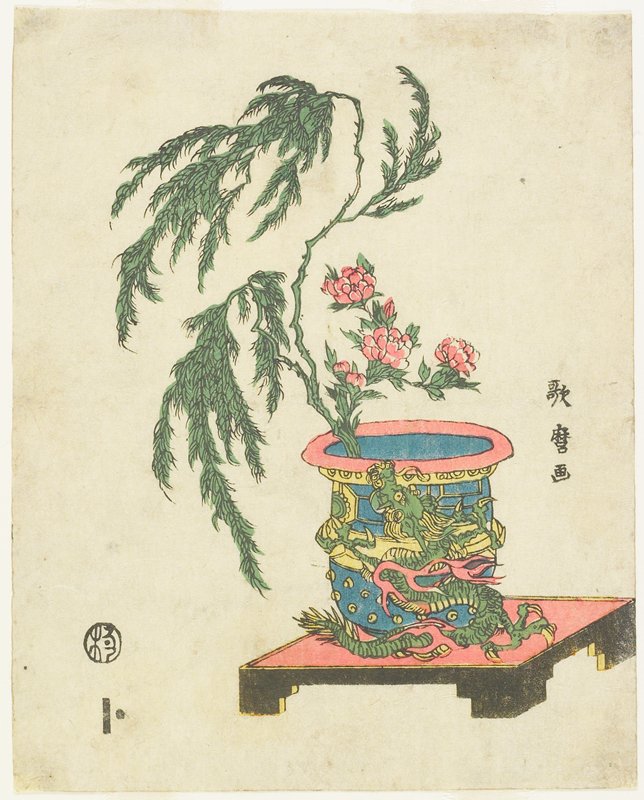
Ikebana arrangement of Peony and Willow in Dragon Pot
1781–1806
Woodblock print (nishiki-e), ink and color on paper
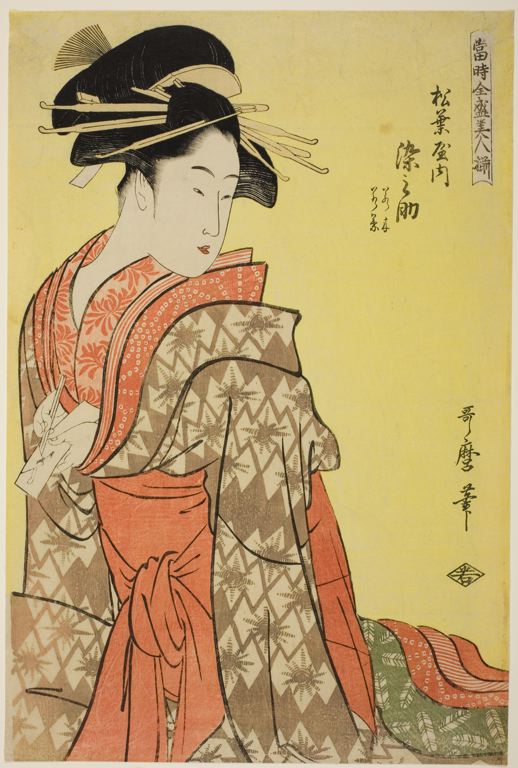
The Greatest Beauties of Our Time (Toji zensei bijin zoroe): Somenosuke of the Matsubaya with Attendants Wakagi and Wakaba
Woodblock print
Frequently Asked Questions
'The Eleven Elegant Aspects of Komachi' was created by Kitagawa Utamaro (喜多川歌麿).