
Tsukioka of the Hyogoya (Hyogoya uchi tsukioka), from the series "Seiro bijin meika awase"
- Date:
- c. 1801
- Medium:
- Color woodblock print; oban
- Source:
- Art Institute of Chicago
Description
Published around 1796 and now in the Art Institute of Chicago, Tsukioka of the Hyōgoya (Hyōgoya uchi Tsukioka) is part of Kitagawa Utamaro's series Seirō bijin meika awase, a comparison of celebrated Yoshiwara courtesans matched with verses or attributes. By the late 1790s Utamaro had become the de facto portraitist of the licensed quarter, and prints such as this one functioned simultaneously as fashion advertisement, fan club image, and connoisseur's keepsake. Tsukioka, named after the moon (tsuki), is presented in a refined half-length pose with the courtesan's identifying brothel cartouche prominently placed; collectors of Edo bijin-ga used such cartouches to assemble portrait galleries of the most fashionable women of the quarter. Utamaro's line, by this stage, was unmistakable: a single sustained brushstroke for the curve of the cheek, finer hatched strokes for the hair near the temple, and contrastingly broader contours for the kimono and obi. The composition relies on emptied space behind the figure, sometimes burnished with mica or printed in flat color to throw her silhouette forward. As ukiyo-e historians have long noted, Utamaro's named-courtesan series were a key vehicle through which the celebrity culture of Edo Yoshiwara reached a mass urban audience, and individual sheets like this Tsukioka portrait remain crucial documents both of his graphic invention and of the social geography of the late Edo licensed quarter.
More Prints by Kitagawa Utamaro
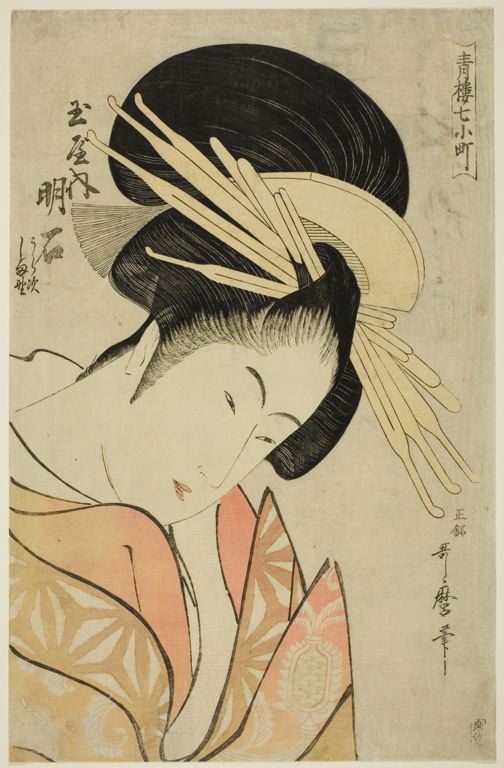
Akashi of the Tamaya, from the series Seven Komachis of Yoshiwara (Seiro nana Komachi) (Tamaya uchi Akashi, Uraji, Shimano)
Woodblock print
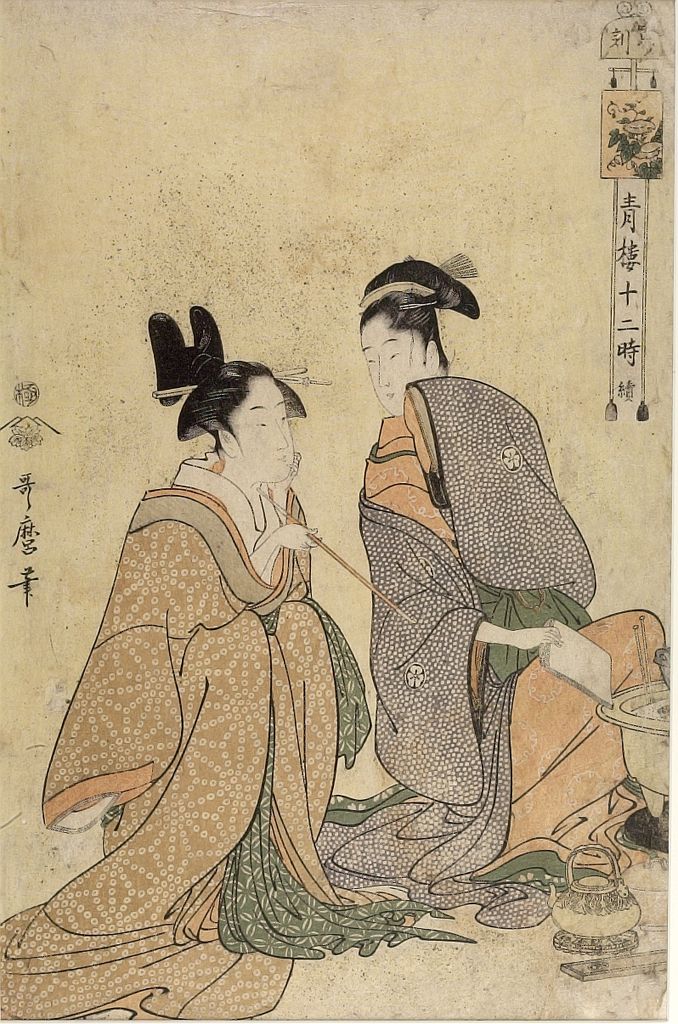
Hour of the Tiger (Tora no koku = 4 AM) from the series Twelve Hours in Yoshiwara (Seirô jûni toki tsuzuki), Late Edo period, circa 1794
Woodblock print
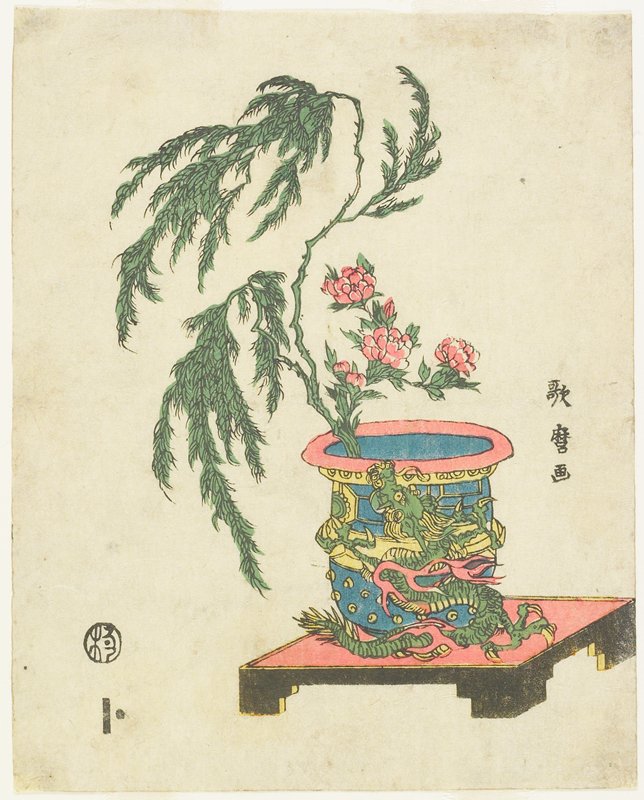
Ikebana arrangement of Peony and Willow in Dragon Pot
1781–1806
Woodblock print (nishiki-e), ink and color on paper
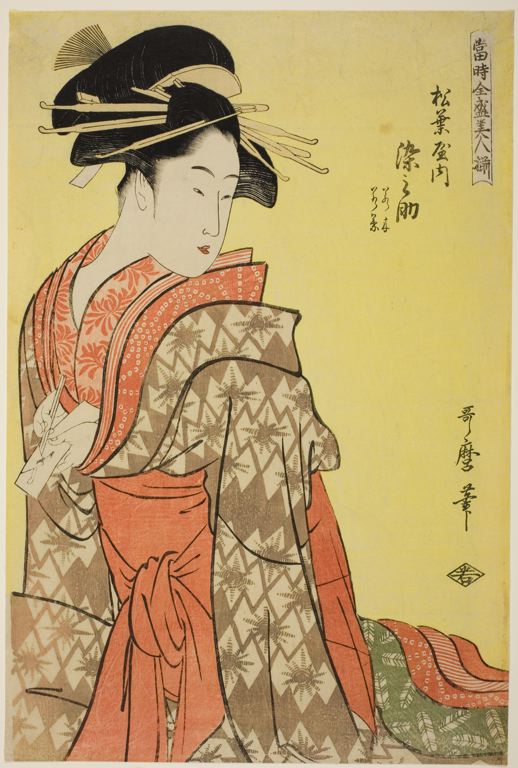
The Greatest Beauties of Our Time (Toji zensei bijin zoroe): Somenosuke of the Matsubaya with Attendants Wakagi and Wakaba
Woodblock print
Frequently Asked Questions
Tsukioka of the Hyogoya (Hyogoya uchi tsukioka), from the series "Seiro bijin meika awase" was created by Kitagawa Utamaro (喜多川歌麿) in c. 1801.