TWO WOMEN
- Date:
- 19th century
- Medium:
- Ink on paper
- Source:
- Harvard Art Museums
Description
Two Women, at the Harvard Art Museums, is a Kitagawa Utamaro print that distills his Edo bijin-ga practice into a tightly framed encounter between two female figures whose specific names are not now identified. The lack of textual identification turns the picture into a study in pure pictorial relations: two bodies, two faces, two clusters of textile pattern, and the negotiation between them. Utamaro takes maximum advantage of this structure. He renders one figure slightly larger or more frontal than the other, signaling either rank, age, or simple framing, while their gestures, perhaps an offered cup, an adjusted sleeve, a turned head, create a quiet interaction whose specific narrative remains tantalizingly open. The composition relies on his hallmark elongated necks, finely modeled oval faces, and a confident command of kimono outlines that allows the rich interior pattern of each garment to read clearly against the spare background. By the late 1790s and early 1800s, this economy of means had become a hallmark of Utamaro's bijin-ga production, distinguishing him from earlier Edo print designers who had often relied on more elaborate spatial settings. As a result, the Harvard impression of Two Women provides a typical and instructive example of how Utamaro and his publishers used minimally captioned pairings to keep collectors engaged in a continuing visual conversation about contemporary femininity in the licensed quarter and beyond.
More Prints by Kitagawa Utamaro
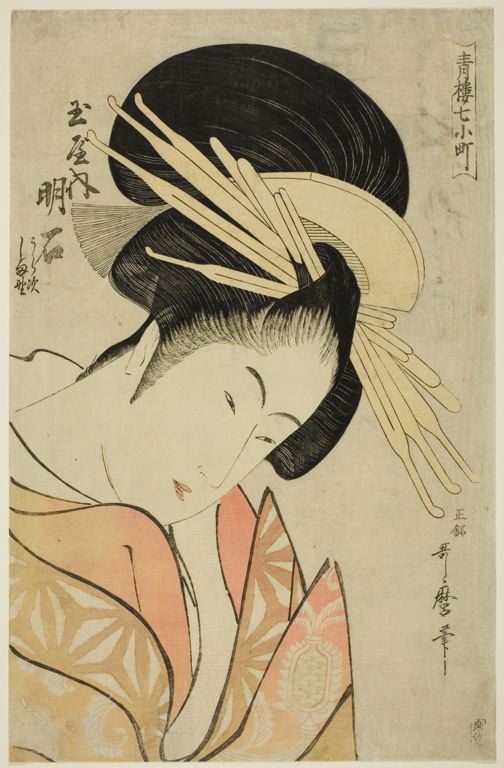
Akashi of the Tamaya, from the series Seven Komachis of Yoshiwara (Seiro nana Komachi) (Tamaya uchi Akashi, Uraji, Shimano)
Woodblock print
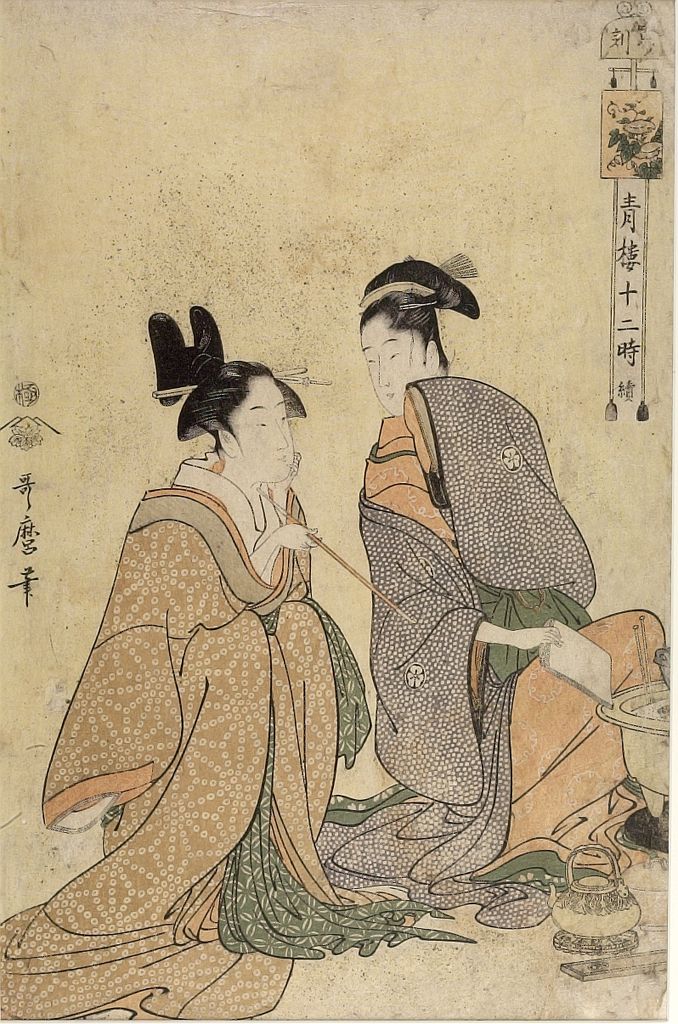
Hour of the Tiger (Tora no koku = 4 AM) from the series Twelve Hours in Yoshiwara (Seirô jûni toki tsuzuki), Late Edo period, circa 1794
Woodblock print
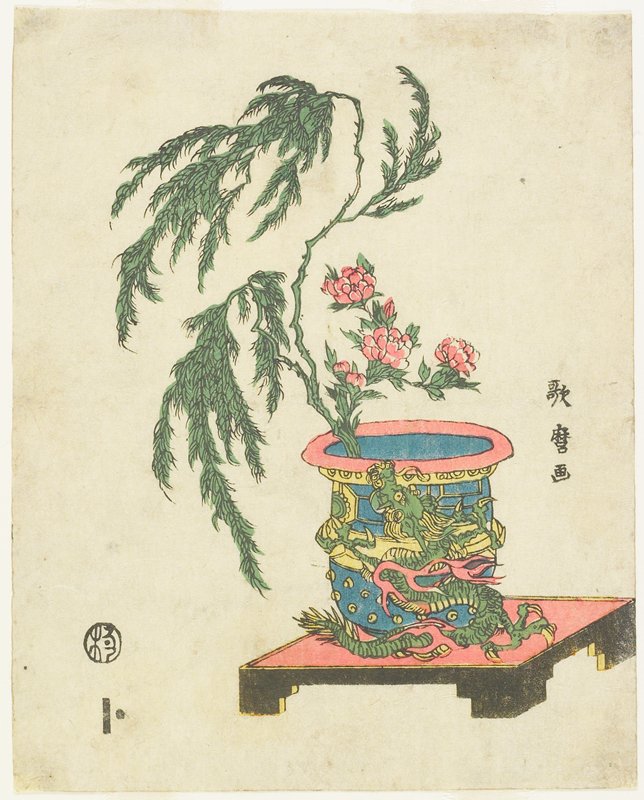
Ikebana arrangement of Peony and Willow in Dragon Pot
1781–1806
Woodblock print (nishiki-e), ink and color on paper
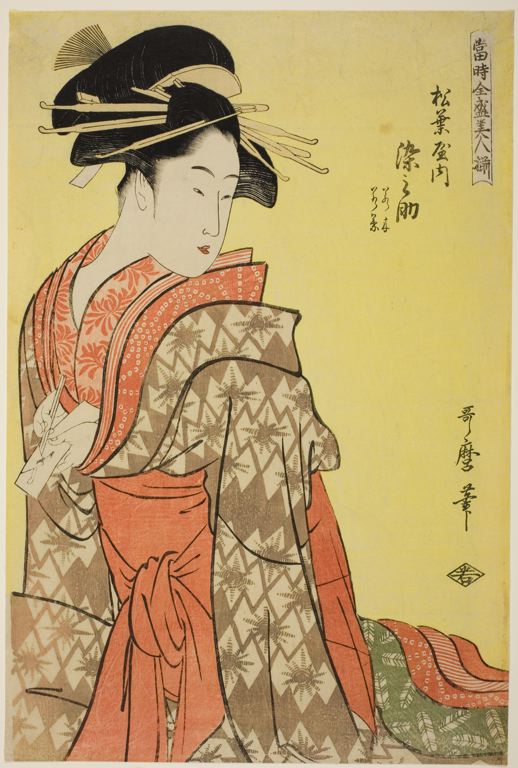
The Greatest Beauties of Our Time (Toji zensei bijin zoroe): Somenosuke of the Matsubaya with Attendants Wakagi and Wakaba
Woodblock print
Frequently Asked Questions
TWO WOMEN was created by Kitagawa Utamaro (喜多川歌麿) in 19th century.