
Two Young Women after a Bath
- Date:
- c. 1803
- Medium:
- Color woodblock print; oban
- Source:
- Art Institute of Chicago
Description
Dated to 1798 and held by the Art Institute of Chicago, Two Young Women after a Bath is a Kitagawa Utamaro print in the genre of post-bath bijin-ga, a sub-tradition of Edo ukiyo-e devoted to women in the unsettled moments after leaving the public bath. The bathhouse setting allowed Utamaro to capture his subjects in lightweight cotton yukata or with their hair only partly arranged, providing visual access to bodies and faces normally concealed under the elaborate kimono and coiffure of the Yoshiwara. Two figures lean toward one another, the older perhaps adjusting the younger's collar, while strands of damp hair fall across exposed napes and shoulders. Utamaro's drawing leans on his trademark elongated lines for the neck and arms, balanced by softer, more compressed marks for cheeks and fingertips. The interaction between the two figures, alternately tender and businesslike, gives the print the quietly observational character that has long made his domestic-genre work prized by collectors of Edo bijin-ga. The print is also notable as part of his shift away from named Yoshiwara stars toward more generic but specific scenes of everyday womanhood under the increasingly restrictive censorship of the late 1790s. The Art Institute's impression, with its calm palette and careful registration, illustrates how Utamaro continued to develop the bijin-ga tradition during this transitional moment, finding in the bathhouse a sustaining motif for his vision of urban femininity.
More Prints by Kitagawa Utamaro
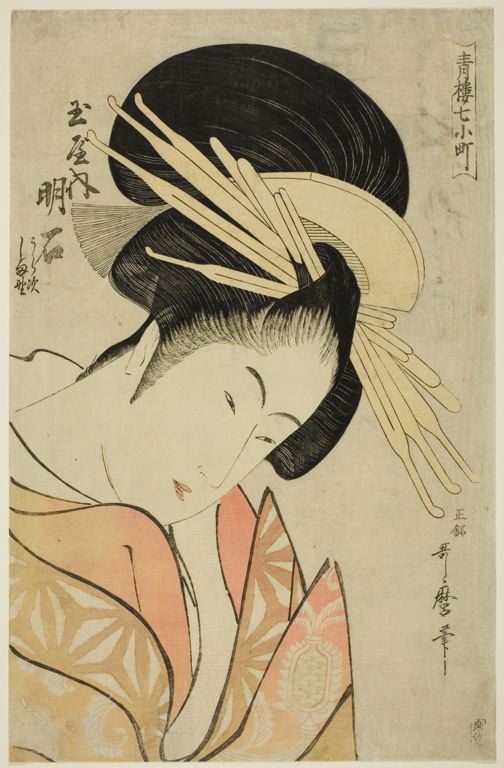
Akashi of the Tamaya, from the series Seven Komachis of Yoshiwara (Seiro nana Komachi) (Tamaya uchi Akashi, Uraji, Shimano)
Woodblock print
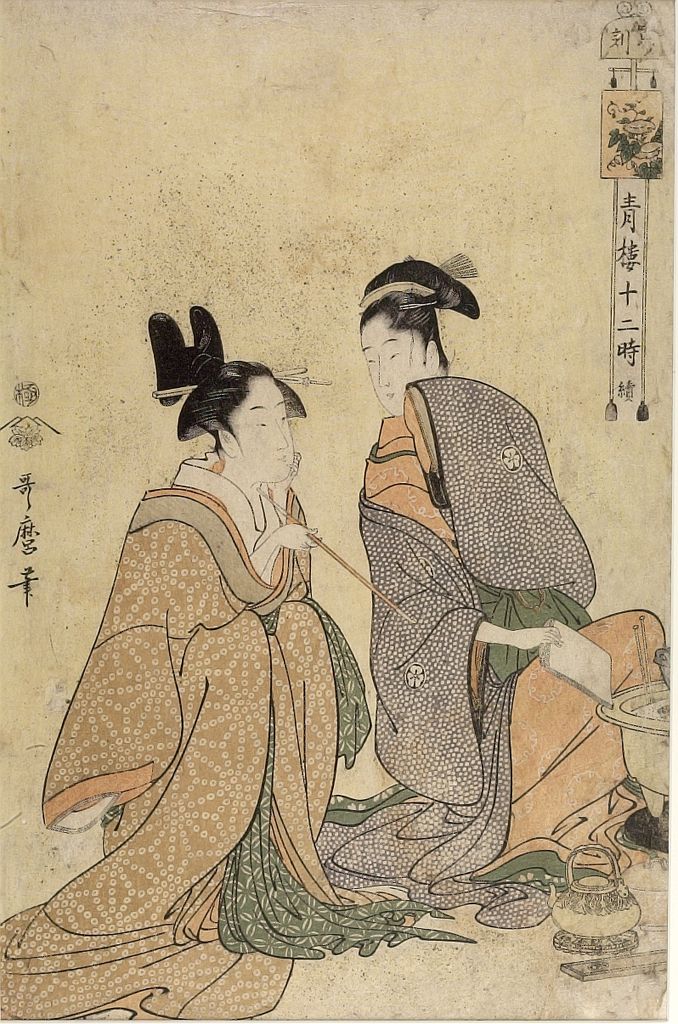
Hour of the Tiger (Tora no koku = 4 AM) from the series Twelve Hours in Yoshiwara (Seirô jûni toki tsuzuki), Late Edo period, circa 1794
Woodblock print
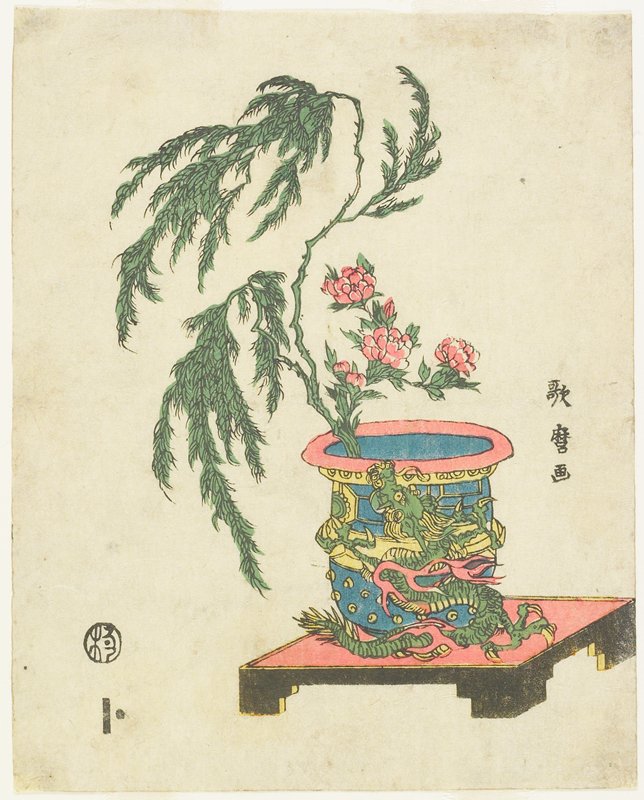
Ikebana arrangement of Peony and Willow in Dragon Pot
1781–1806
Woodblock print (nishiki-e), ink and color on paper
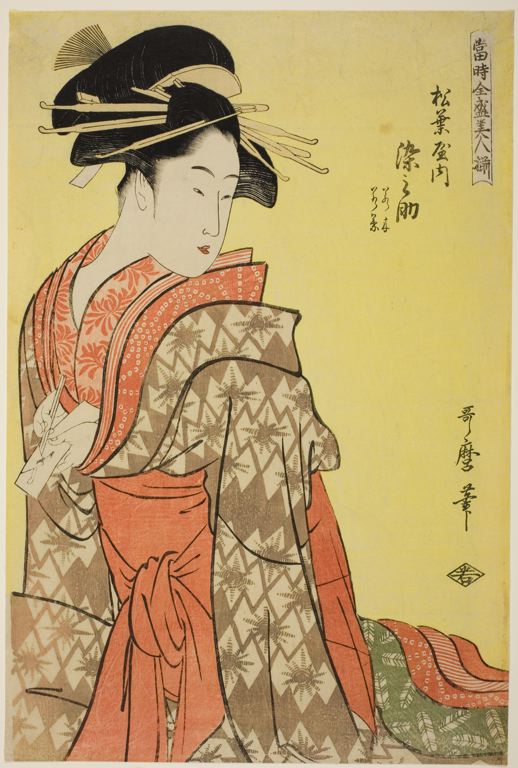
The Greatest Beauties of Our Time (Toji zensei bijin zoroe): Somenosuke of the Matsubaya with Attendants Wakagi and Wakaba
Woodblock print
Frequently Asked Questions
Two Young Women after a Bath was created by Kitagawa Utamaro (喜多川歌麿) in c. 1803.