Umegawa and Chūbei, from the series An Elegant Comparison of Affections (Fūryū aikyō kurabe)
- Date:
- c. 1803 (Kyōwa 3)
- Medium:
- Woodblock print; ink and color on paper
- Source:
- Harvard Art Museums
Description
Umegawa and Chubei, from the series An Elegant Comparison of Affections (Furyu aikyo kurabe), is dated about 1798 in the Harvard Art Museums record and represents Kitagawa Utamaro's engagement with one of the most beloved lover pairings of the Edo theater. Umegawa, a courtesan, and Chubei, a young clerk who embezzles to redeem her contract, were the protagonists of Chikamatsu Monzaemon's jōruri drama Meido no hikyaku and its many later adaptations on the kabuki stage. The series Furyu aikyo kurabe lined up such famous lovers from the popular theater for connoisseurial comparison, and Utamaro contributed a sheet to it that exemplifies his late style. As Edo bijin-ga, the print attends closely to Umegawa, whose robes and posture mark her status as a refined courtesan caught between her professional world and the young man who has compromised himself for her. Chubei, rendered with the slender, ambiguous male physiognomy typical of the genre's romantic heroes, mirrors her with subtle echoes of pose. As ukiyo-e, the work feeds off the theater's narrative power while substituting visual elegance for stage realism, giving readers a portable token of a frequently revived play. Color is handled with the restraint of high-grade printing from the late 1790s, and the keyblock keeps the figures crisp against the muted ground. The Harvard impression remains a useful example of how Utamaro mediated between theater, fiction and the floating world.
More Prints by Kitagawa Utamaro
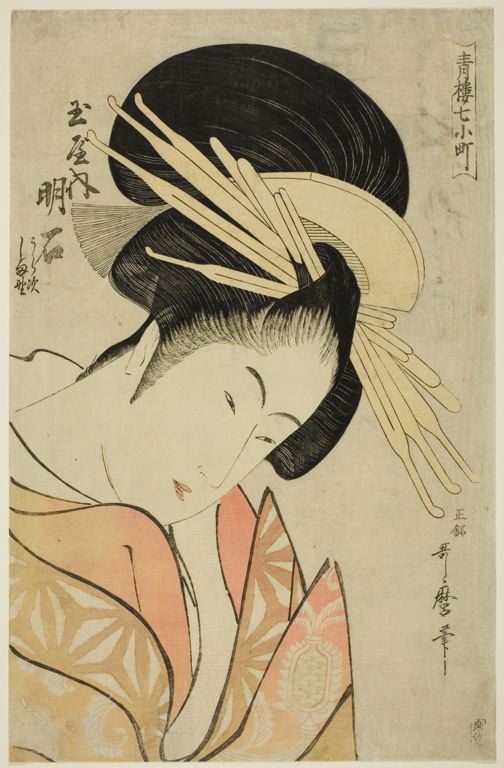
Akashi of the Tamaya, from the series Seven Komachis of Yoshiwara (Seiro nana Komachi) (Tamaya uchi Akashi, Uraji, Shimano)
Woodblock print
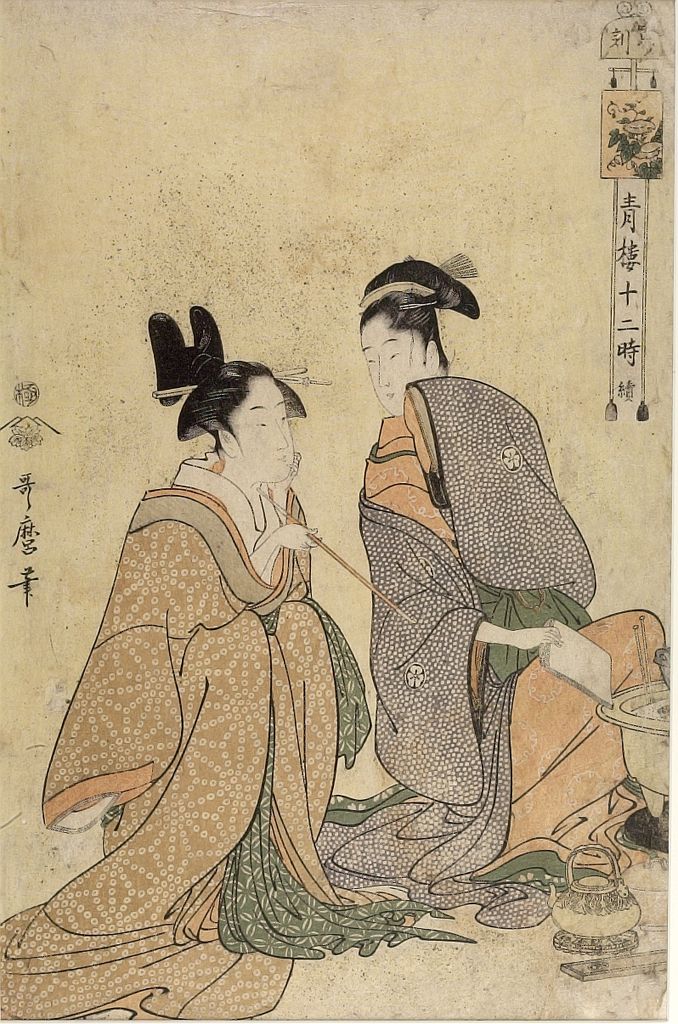
Hour of the Tiger (Tora no koku = 4 AM) from the series Twelve Hours in Yoshiwara (Seirô jûni toki tsuzuki), Late Edo period, circa 1794
Woodblock print
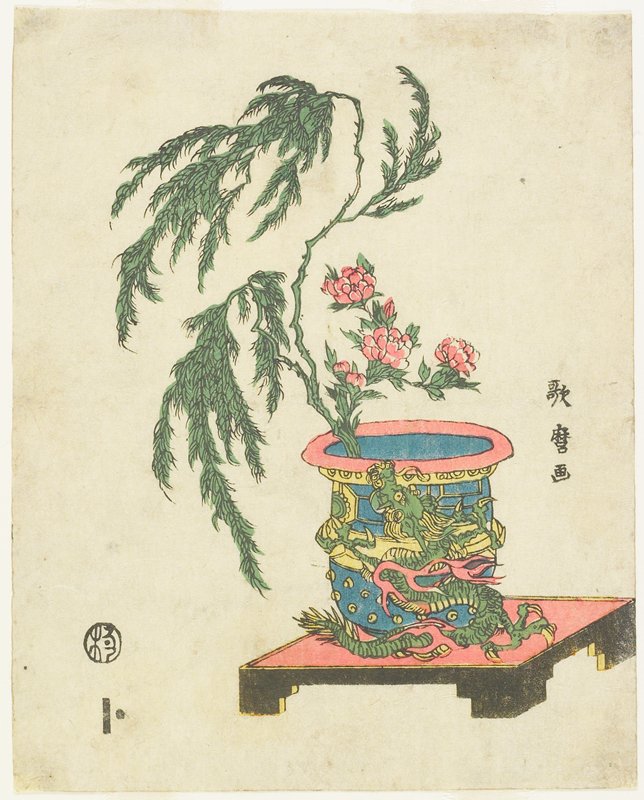
Ikebana arrangement of Peony and Willow in Dragon Pot
1781–1806
Woodblock print (nishiki-e), ink and color on paper
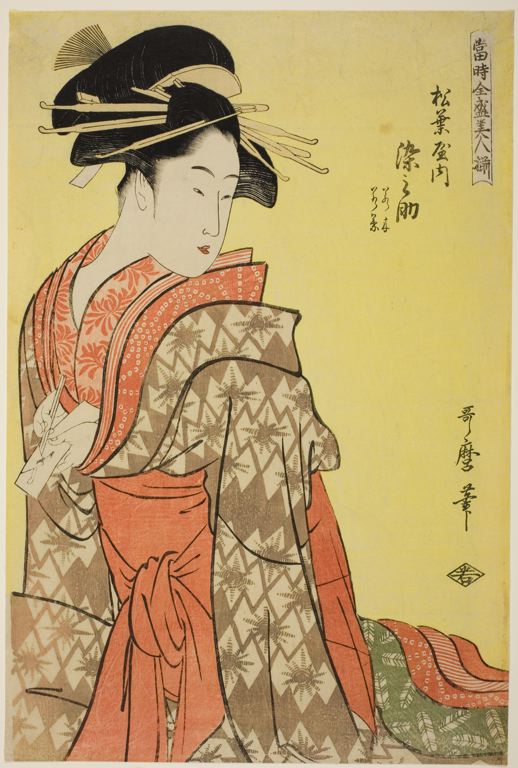
The Greatest Beauties of Our Time (Toji zensei bijin zoroe): Somenosuke of the Matsubaya with Attendants Wakagi and Wakaba
Woodblock print
Frequently Asked Questions
Umegawa and Chūbei, from the series An Elegant Comparison of Affections (Fūryū aikyō kurabe) was created by Kitagawa Utamaro (喜多川歌麿) in c. 1803 (Kyōwa 3).