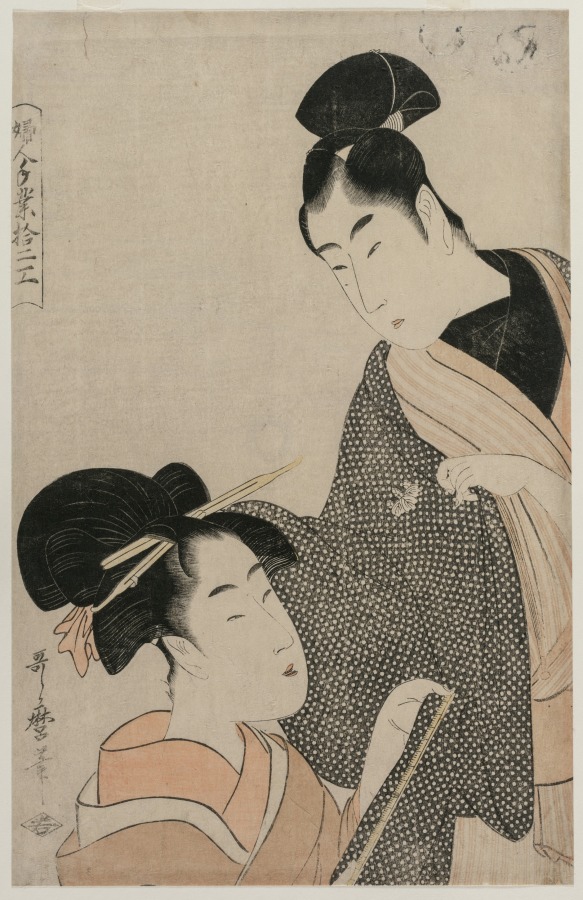
Woman Measuring a Man's Gown (from the series Twelve Occupations of Women)
- Date:
- late 1790s
- Medium:
- color woodblock print
- Source:
- Cleveland Museum of Art
Description
Woman Measuring a Man's Gown, from the series Twelve Occupations of Women, is a color woodblock print designed by Kitagawa Utamaro around 1797 and held by the Cleveland Museum of Art. The series belongs to a category of Edo bijin-ga in which Utamaro catalogued the working activities of women rather than confining them to the parlor or boudoir. Here, a beauty leans forward over an outstretched man's gown, her hands extended along the textile as she takes its dimensions; the cloth ripples across the floor, organizing the picture into broad zones of pattern and ground. As an ukiyo-e artist, Kitagawa Utamaro had an exceptional sensitivity to the way labor inflected pose, and this print transforms a tailoring task into a delicate sculptural arrangement of head, shoulders, and outstretched arm. The subject also reflects the ordinary craft economy that ran beneath the glamour of the floating world, in which women's hands maintained the wardrobes that ukiyo-e so often depicted on others. By focusing on the gown itself, Utamaro nods to the importance of textile design in his medium: kimono patterning is one of his most expressive devices, and a print about measuring cloth becomes implicitly a print about the look of cloth. Within Twelve Occupations of Women, this sheet illustrates how Edo bijin-ga could expand from idealized portraits into closely observed scenes of women at work without sacrificing the genre's distinctive elegance.
More Prints by Kitagawa Utamaro
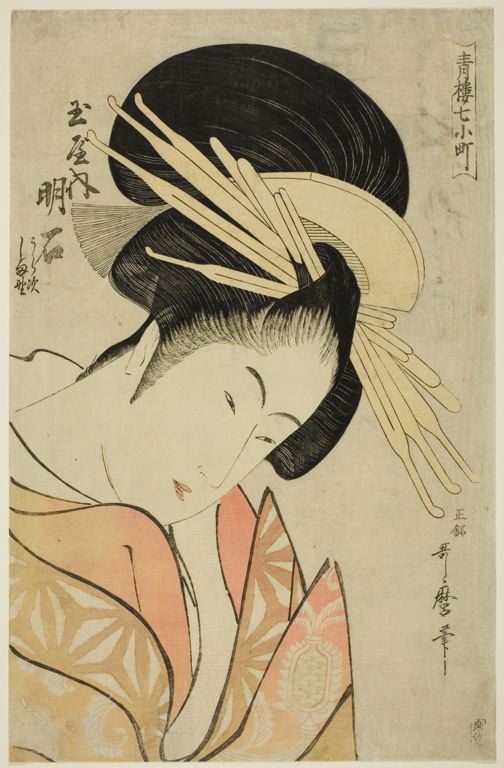
Akashi of the Tamaya, from the series Seven Komachis of Yoshiwara (Seiro nana Komachi) (Tamaya uchi Akashi, Uraji, Shimano)
Woodblock print
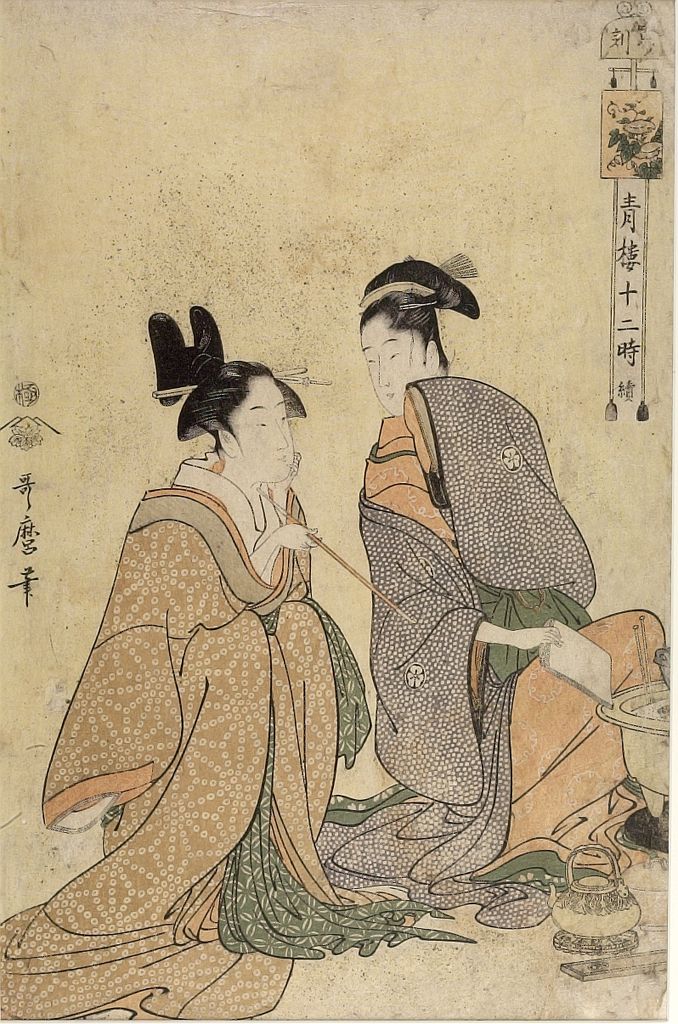
Hour of the Tiger (Tora no koku = 4 AM) from the series Twelve Hours in Yoshiwara (Seirô jûni toki tsuzuki), Late Edo period, circa 1794
Woodblock print
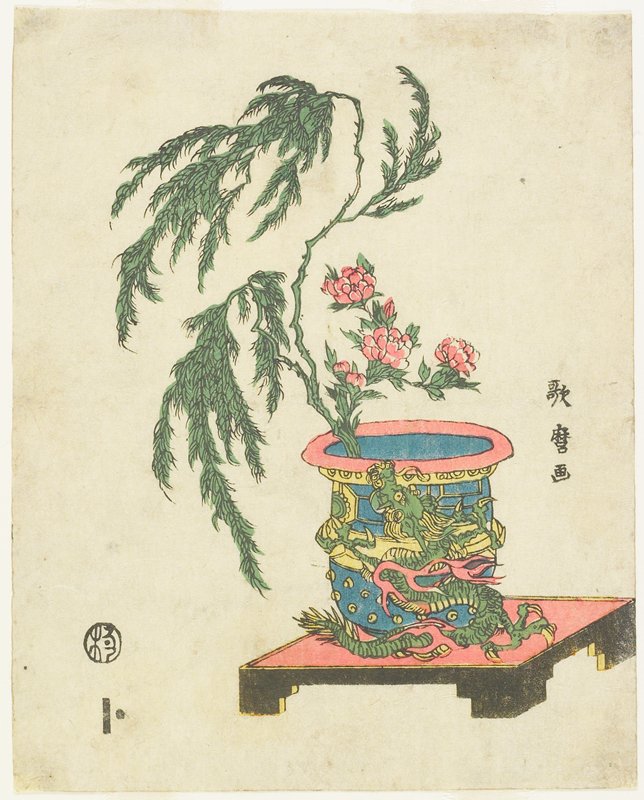
Ikebana arrangement of Peony and Willow in Dragon Pot
1781–1806
Woodblock print (nishiki-e), ink and color on paper
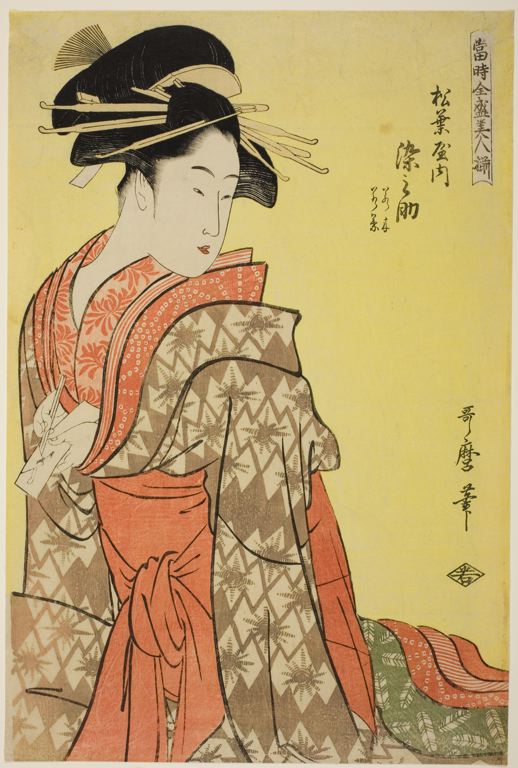
The Greatest Beauties of Our Time (Toji zensei bijin zoroe): Somenosuke of the Matsubaya with Attendants Wakagi and Wakaba
Woodblock print
Frequently Asked Questions
Woman Measuring a Man's Gown (from the series Twelve Occupations of Women) was created by Kitagawa Utamaro (喜多川歌麿) in late 1790s.