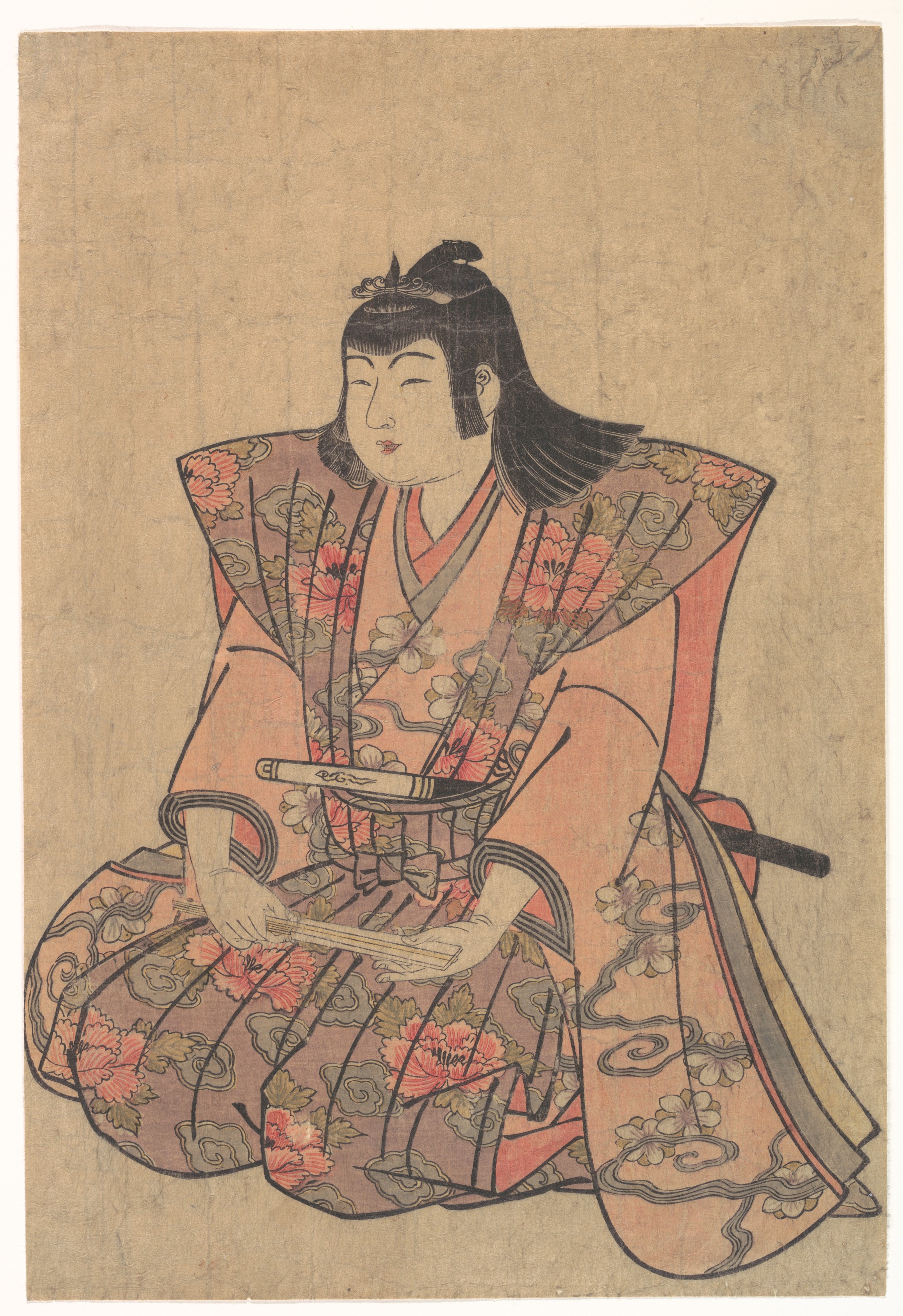
A Boy Singer
- Medium:
- Woodblock print; ink and color on paper
- Source:
- Metropolitan Museum of Art
Description
A Boy Singer, attributed to Kitao Shigemasa in the Metropolitan Museum of Art, captures a youthful male performer in mid-song, his head slightly tilted and mouth open in a focused expression. The museum's date of 1739 is a generic cataloging marker rather than a precise year of design; like other Shigemasa works in the collection, the print belongs to his career across the late eighteenth and early nineteenth centuries, when boy singers known as kagema or as koshō and shōnen entertainers occupied a specific niche in the world of Edo theater and the pleasure quarters. Shigemasa renders the figure with the gentle, slightly idealized facial type characteristic of his bijinga, applying that vocabulary to a male rather than female subject and thereby underscoring the way Edo ukiyo-e treated youth and performance as related sites of beauty. The boy's robes, hair, and posture all communicate a particular social role, with attention to the details of costume that would have allowed contemporary viewers to identify the type. The Metropolitan Museum of Art preserves the print as part of its larger holdings of Japanese figural prints. As founder of the Kitao school, Shigemasa contributed substantially to the way late eighteenth-century Edo audiences imagined the everyday performers of their city, including those who occupied ambiguous gender and erotic positions in the period's entertainment economy. A Boy Singer is therefore both an aesthetic object, a finely drawn figural print, and a historical document that illuminates the sociology of music, performance, and youthful beauty in the urban culture that gave rise to ukiyo-e.
More Prints by Kitao Shigemasa

Women Holding Boy who is Reaching Out to Young Man Below
c. 1776
Color woodblock print; hashira-e

Priest Saigyo Contemplating Mount Fuji
c. 1770s
Color woodblock print; hashira-e

Autumn Moon over Sumida River (Sumida aki zuki), from the series "Eight Views of the Sumida River (Sumidagawa hakkei)"
early 1760s
Color woodblock print; hosoban, mizu-e

Crossing the Bridge at Sano
c. 1774
Color woodblock print; koban
More Children Prints
Frequently Asked Questions
A Boy Singer was created by Kitao Shigemasa (北尾重政).
A Boy Singer depicts children.