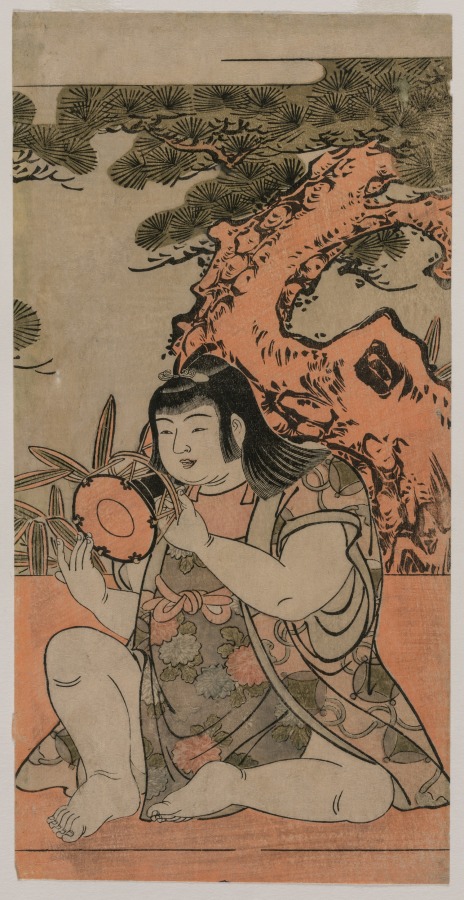
Doll Playing a Hand Drum
- Date:
- 1770s
- Medium:
- color woodblock print
- Source:
- Cleveland Museum of Art
Description
Doll Playing a Hand Drum, dated to around 1770, is a charming small print by Kitao Shigemasa held in the Cleveland Museum of Art. The composition features a karakuri-style doll in elaborate costume, holding a tsuzumi hand drum in a performative pose that mimics the gestures of a kabuki or noh musician. The image taps into Edo audiences' fascination with mechanical and decorative dolls, which played a role in seasonal festivals such as Hinamatsuri as well as in the entertainments of wealthy urban households. Shigemasa's choice of a doll rather than a living musician transforms the image into a quiet meditation on artifice and performance, themes that resonate throughout Edo ukiyo-e and its constant engagement with the staged, theatrical, and crafted dimensions of city life. The Cleveland Museum of Art's strong holdings of eighteenth-century Japanese prints situate this work alongside more conventional bijinga and yakusha-e and help illustrate the variety of subjects available to Edo print buyers. As founder of the Kitao school, Shigemasa was at home in such miniature genre studies, and his line work here is precise and assured, balancing the heavy patterning of the doll's robes with the smooth curves of its face and the rounded body of the drum. The print also relates to his five musicians series and to broader Edo ukiyo-e interest in figures performing music, dance, and ritual gestures. Together with his other works in Cleveland, Doll Playing a Hand Drum demonstrates how Kitao Shigemasa quietly expanded the boundaries of figural printmaking in late eighteenth-century Edo, layering visual humor with serious craftsmanship.
More Prints by Kitao Shigemasa

Women Holding Boy who is Reaching Out to Young Man Below
c. 1776
Color woodblock print; hashira-e

Priest Saigyo Contemplating Mount Fuji
c. 1770s
Color woodblock print; hashira-e

Autumn Moon over Sumida River (Sumida aki zuki), from the series "Eight Views of the Sumida River (Sumidagawa hakkei)"
early 1760s
Color woodblock print; hosoban, mizu-e

Crossing the Bridge at Sano
c. 1774
Color woodblock print; koban
Frequently Asked Questions
Doll Playing a Hand Drum was created by Kitao Shigemasa (北尾重政) in 1770s.