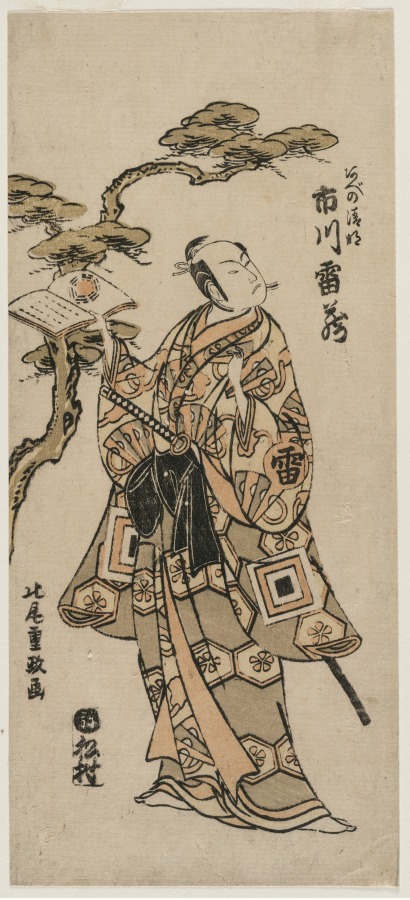
Ichikawa Raizo as Abe no Seimei
- Date:
- early 1760s
- Medium:
- color woodblock print
- Source:
- Cleveland Museum of Art
Description
Ichikawa Raizo as Abe no Seimei, dated 1760, is an early actor print by Kitao Shigemasa in the collection of the Cleveland Museum of Art. The work depicts the celebrated kabuki performer Ichikawa Raizo in the role of Abe no Seimei, the legendary Heian period onmyōji or master of yin-yang divination who became a popular subject in folklore, theater, and visual culture. Shigemasa designed this image in the early years of his career, before the full flowering of the nishiki-e multicolor print, and the work belongs to a transitional period of Edo ukiyo-e in which benizuri-e techniques and limited color palettes still dominated the genre of yakusha-e, or actor portraiture. The Cleveland Museum of Art preserves the print as part of its strong holdings of eighteenth-century Japanese prints. Shigemasa's handling of Raizo's costume, mudra-like gesture, and intent expression reflects close attention to the conventions of stage performance and to the iconography associated with Abe no Seimei, including the five-pointed star and references to esoteric ritual. Although Shigemasa is more often remembered today for his elegant bijinga of the Yoshiwara and his refined book illustrations, his actor prints from the 1750s and 1760s are an important record of the kabuki stage during a formative decade and document his earliest experiments with figural drawing. As founder of the Kitao school, he established a vocabulary of strong contour, controlled posture, and balanced composition that subsequent students would adapt to bijinga and warrior subjects. This print stands as evidence of his early engagement with theatrical portraiture and of the broader interweaving of stage, literature, and printmaking in mid-eighteenth-century Edo ukiyo-e.
More Prints by Kitao Shigemasa

Women Holding Boy who is Reaching Out to Young Man Below
c. 1776
Color woodblock print; hashira-e

Priest Saigyo Contemplating Mount Fuji
c. 1770s
Color woodblock print; hashira-e

Autumn Moon over Sumida River (Sumida aki zuki), from the series "Eight Views of the Sumida River (Sumidagawa hakkei)"
early 1760s
Color woodblock print; hosoban, mizu-e

Crossing the Bridge at Sano
c. 1774
Color woodblock print; koban
Frequently Asked Questions
Ichikawa Raizo as Abe no Seimei was created by Kitao Shigemasa (北尾重政) in early 1760s.