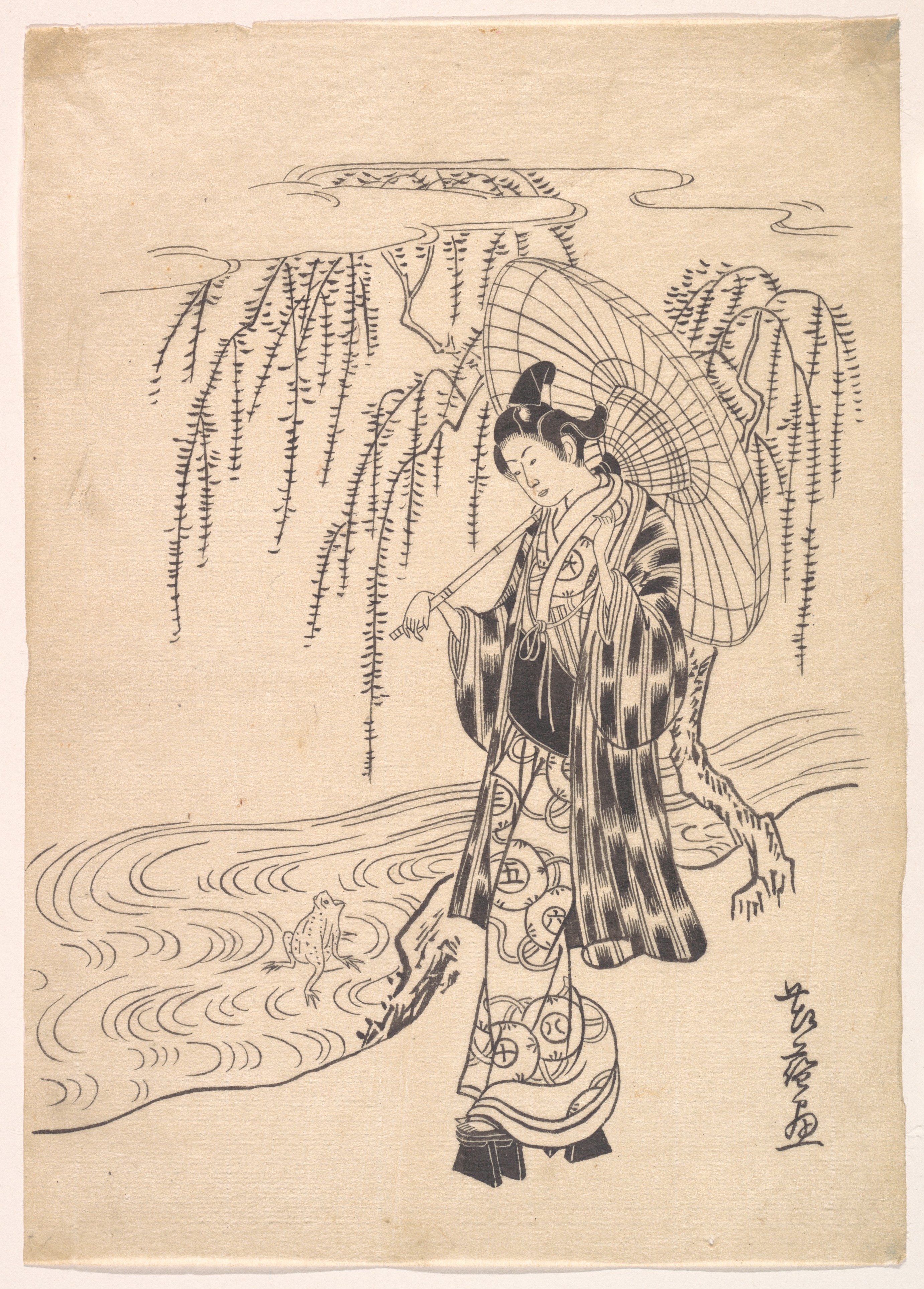
Ono no Dofu as a Young Man Watching a Frog Jumping at a Willow Branch
- Medium:
- Monochrome woodblock print; ink on paper
- Source:
- Metropolitan Museum of Art
Description
Ono no Dōfū as a Young Man Watching a Frog Jumping at a Willow Branch, attributed to Kitao Shigemasa in the Metropolitan Museum of Art, draws on one of the most beloved didactic stories in Japanese cultural memory. The Heian period calligrapher Ono no Tōfū, often spelled Dōfū, is said to have despaired of mastering his art until he observed a frog attempting again and again to leap onto a willow branch, finally succeeding and inspiring him to persist with his own studies. The story became a moral exemplar of perseverance and was depicted in painting, print, and decorative arts for centuries. The museum's date of 1739 reflects a cataloging convention rather than a precise design year, but the print sits firmly within Shigemasa's career as a designer of figural and historical subjects in Edo ukiyo-e. The composition focuses on the youthful Ono no Tōfū watching the frog with intent concentration, with the willow branch arching above to frame both the human and animal subjects. The Metropolitan Museum of Art preserves the image as part of its broad collection of Japanese figural prints and historical subjects. As founder of the Kitao school, Shigemasa was well prepared for narrative work of this kind, with a clear understanding of how to use posture, costume, and setting to communicate a recognizable story to a contemporary print audience. The work also illustrates the porous boundary between literary illustration and ukiyo-e, since the same anecdote appears in school primers, anthologies, and ethical handbooks throughout the Edo period and continues to shape Japanese conceptions of patience, training, and the value of careful observation.
More Prints by Kitao Shigemasa

Women Holding Boy who is Reaching Out to Young Man Below
c. 1776
Color woodblock print; hashira-e

Priest Saigyo Contemplating Mount Fuji
c. 1770s
Color woodblock print; hashira-e

Autumn Moon over Sumida River (Sumida aki zuki), from the series "Eight Views of the Sumida River (Sumidagawa hakkei)"
early 1760s
Color woodblock print; hosoban, mizu-e

Crossing the Bridge at Sano
c. 1774
Color woodblock print; koban
Frequently Asked Questions
Ono no Dofu as a Young Man Watching a Frog Jumping at a Willow Branch was created by Kitao Shigemasa (北尾重政).