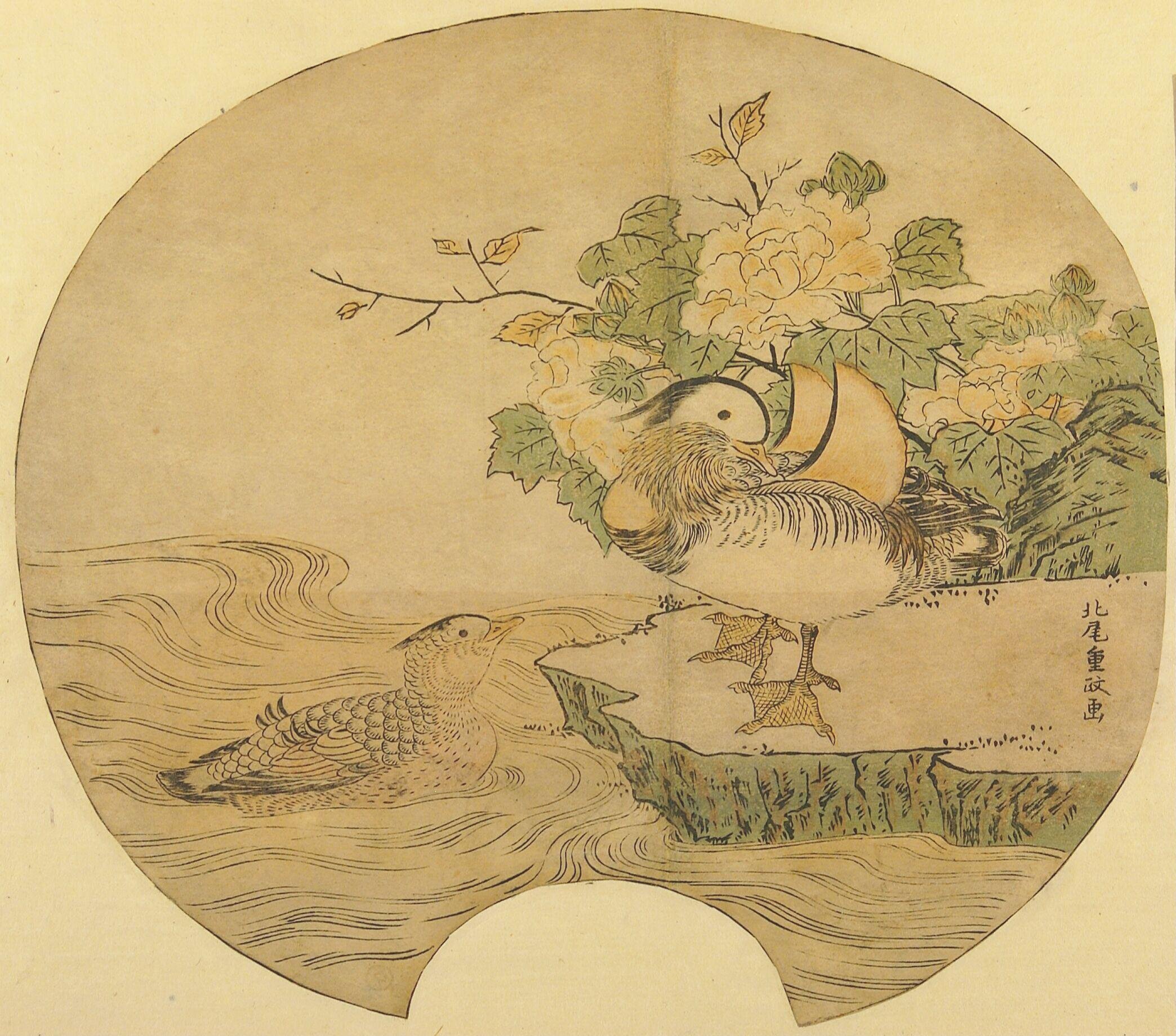
Pair of Mandarin Ducks
- Date:
- ca. 1770
- Medium:
- Source:
- Victoria and Albert Museum
Description
Pair of Mandarin Ducks, produced around 1770, exemplifies Kitao Shigemasa's elegant handling of kachō-e, the genre of bird and flower imagery that flourished alongside actor and bijin prints in Edo ukiyo-e. Held in the Victoria and Albert Museum in London, this work depicts the male and female mandarin duck, oshidori, a pair traditionally understood in Japanese and Chinese visual culture as an emblem of marital harmony and lifelong devotion. Shigemasa builds the composition around the contrasting plumage of the two birds, with the male's ornate crest and brightly patterned wings set against the more muted but no less carefully observed feathers of the female. The drawing is direct, with finely modulated outlines that follow the curve of the back and the layering of feathers, and the composition relies on negative space to suggest water and the surrounding pond environment. As founder of the Kitao school, Shigemasa worked across many genres, but his kachō-e demonstrate a particular sensitivity to the conventions of Chinese painting models that had been absorbed into Japanese pictorial practice through earlier Kano and Rinpa traditions. The Victoria and Albert Museum holds this work as part of its broader collection of Japanese prints assembled across the late nineteenth and twentieth centuries. Within the trajectory of Edo ukiyo-e, prints such as Pair of Mandarin Ducks confirm that bird and flower compositions could carry the same craft refinement as more famous figural subjects, and they illustrate Shigemasa's role in transmitting the kachō-e idiom to later artists. The print rewards quiet contemplation, its emblematic content carried by an economy of line and color characteristic of the Kitao school at its best.
More Prints by Kitao Shigemasa

Women Holding Boy who is Reaching Out to Young Man Below
c. 1776
Color woodblock print; hashira-e

Priest Saigyo Contemplating Mount Fuji
c. 1770s
Color woodblock print; hashira-e

Autumn Moon over Sumida River (Sumida aki zuki), from the series "Eight Views of the Sumida River (Sumidagawa hakkei)"
early 1760s
Color woodblock print; hosoban, mizu-e

Crossing the Bridge at Sano
c. 1774
Color woodblock print; koban
Frequently Asked Questions
Pair of Mandarin Ducks was created by Kitao Shigemasa (北尾重政) in ca. 1770.