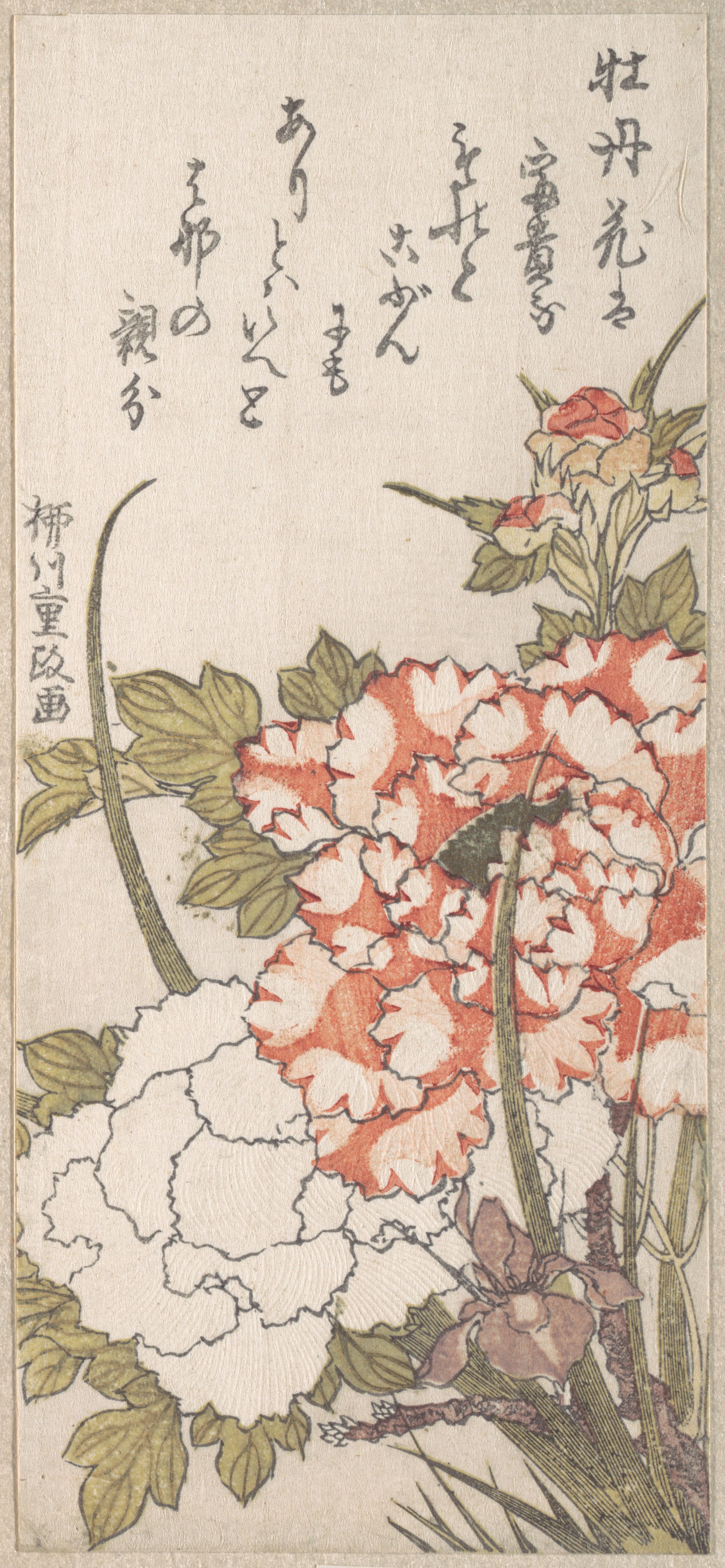
Peonies and Iris
- Date:
- 18th–19th century
- Medium:
- Woodblock print (surimono); ink and color on paper
- Source:
- Metropolitan Museum of Art
Description
Peonies and Iris, attributed to Kitao Shigemasa in the Metropolitan Museum of Art, brings together two of the most celebrated flowers of the Japanese seasonal calendar in a single composition. The museum's date of 1700 should be understood as a general cataloging assignment rather than a strict date of design, since Shigemasa was born in 1739, but the work nonetheless sits squarely within the kachō-e tradition that he carried forward as founder of the Kitao school of Edo ukiyo-e. Peonies, with their voluminous heads and ruffled petals, were treasured as botanical and symbolic markers of late spring and early summer, while iris, with their upright sword leaves and elegant flowers, evoked early summer rains and classical poetry, especially the famous Yatsuhashi passage from the Tales of Ise. By pairing them, Shigemasa offers viewers a compact garden of seasonal allusion, condensing weeks of natural change into a single page. The Metropolitan Museum of Art holds the work as part of its broader Japanese art collection. Shigemasa's drawing is firm and confident, with peony heads built up through carefully observed petal layers and iris flowers arranged on tall stems that frame the composition's sense of vertical movement. As with his other kachō-e, the print or painting reveals a designer aware of his predecessors in the Kano and Rinpa traditions yet committed to the brisk, legible idiom favored by Edo print audiences. The work thus participates in a long Japanese tradition of seasonal floral imagery while clearly belonging to Shigemasa's own Kitao school approach to the natural world.
More Prints by Kitao Shigemasa

Women Holding Boy who is Reaching Out to Young Man Below
c. 1776
Color woodblock print; hashira-e

Priest Saigyo Contemplating Mount Fuji
c. 1770s
Color woodblock print; hashira-e

Autumn Moon over Sumida River (Sumida aki zuki), from the series "Eight Views of the Sumida River (Sumidagawa hakkei)"
early 1760s
Color woodblock print; hosoban, mizu-e

Crossing the Bridge at Sano
c. 1774
Color woodblock print; koban
More Birds & Flowers Prints
Frequently Asked Questions
Peonies and Iris was created by Kitao Shigemasa (北尾重政) in 18th–19th century.
Peonies and Iris depicts birds & flowers.