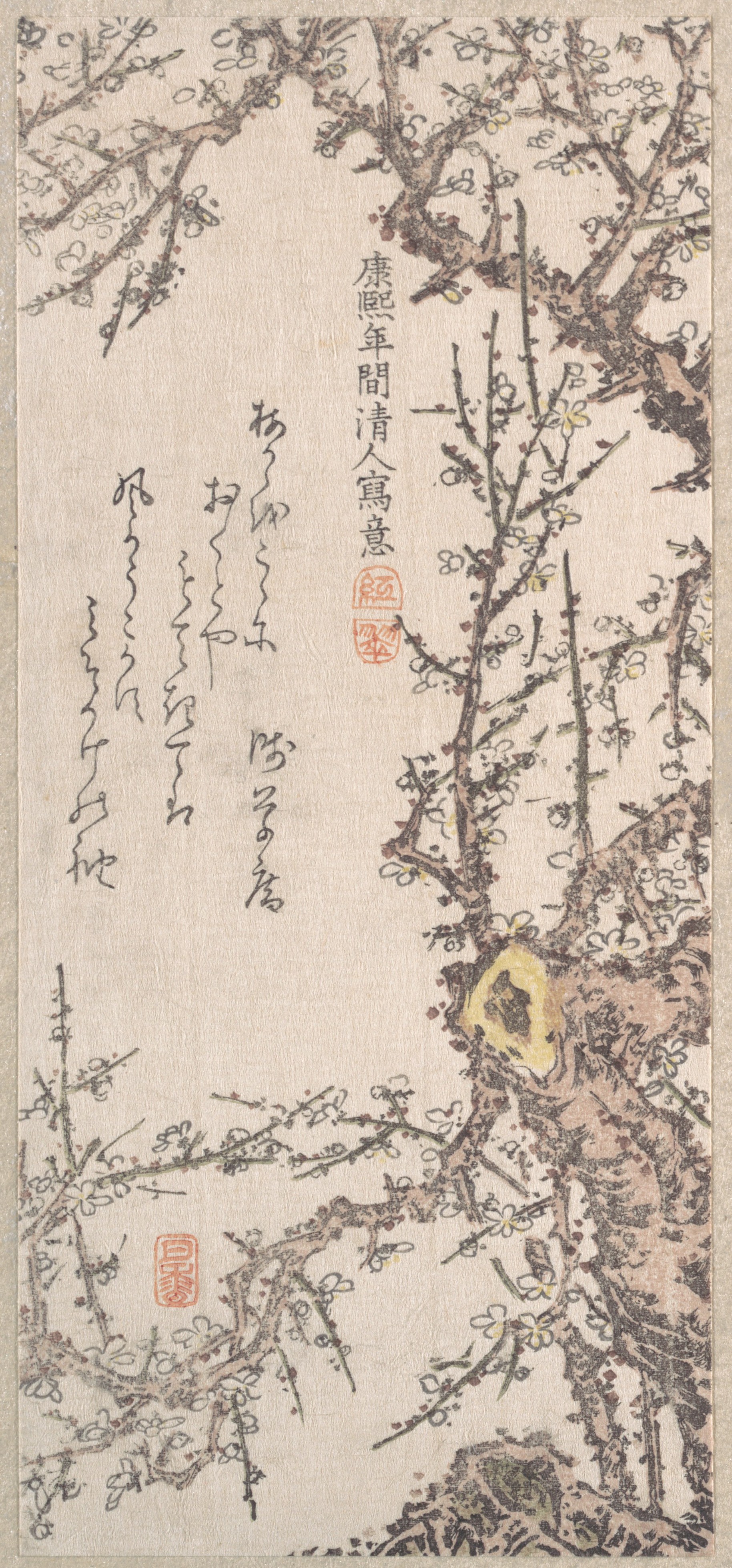
Plum Tree in Blossom
- Medium:
- Woodblock print (surimono); ink and color on paper
- Source:
- Metropolitan Museum of Art
Description
Plum Tree in Blossom is attributed to Kitao Shigemasa in the collection of the Metropolitan Museum of Art, where it appears in the museum's broad holdings of Japanese paintings and prints. While the museum records a year of 1739, the date may reflect a generalized cataloging convention or an early scholarly attribution rather than the precise moment of design; Shigemasa lived from 1739 to 1820, so the work in any case sits within his lifetime and within the broader life of the Kitao school he founded. The image presents a flowering plum tree, a subject with deep symbolic resonance in Japanese and Chinese visual culture, associated with the late winter and early spring, with perseverance through cold, and with the literary persona of the scholar. Shigemasa's drawing brings together the calligraphic energy of the trunk and branches with delicate accents of blossom, demonstrating the cross-pollination between ukiyo-e and the Kano and Rinpa traditions that had long claimed the plum tree as a signature motif. The Metropolitan Museum of Art preserves the work as part of its substantial Japanese art collection. Within the wider arc of Edo ukiyo-e, Shigemasa's plum compositions, whether on paper, in books, or as single-sheet prints, represent a respected dimension of his output that runs in parallel to his more famous bijinga and yakusha-e. They confirm the Kitao school's range and remind viewers that the world of eighteenth-century Edo print designers extended far beyond the pleasure quarters and kabuki theater into the seasonal botanical motifs that shaped the everyday visual environment of the city's residents and the wider Japanese cultural imagination.
More Prints by Kitao Shigemasa

Women Holding Boy who is Reaching Out to Young Man Below
c. 1776
Color woodblock print; hashira-e

Priest Saigyo Contemplating Mount Fuji
c. 1770s
Color woodblock print; hashira-e

Autumn Moon over Sumida River (Sumida aki zuki), from the series "Eight Views of the Sumida River (Sumidagawa hakkei)"
early 1760s
Color woodblock print; hosoban, mizu-e

Crossing the Bridge at Sano
c. 1774
Color woodblock print; koban
Frequently Asked Questions
Plum Tree in Blossom was created by Kitao Shigemasa (北尾重政).