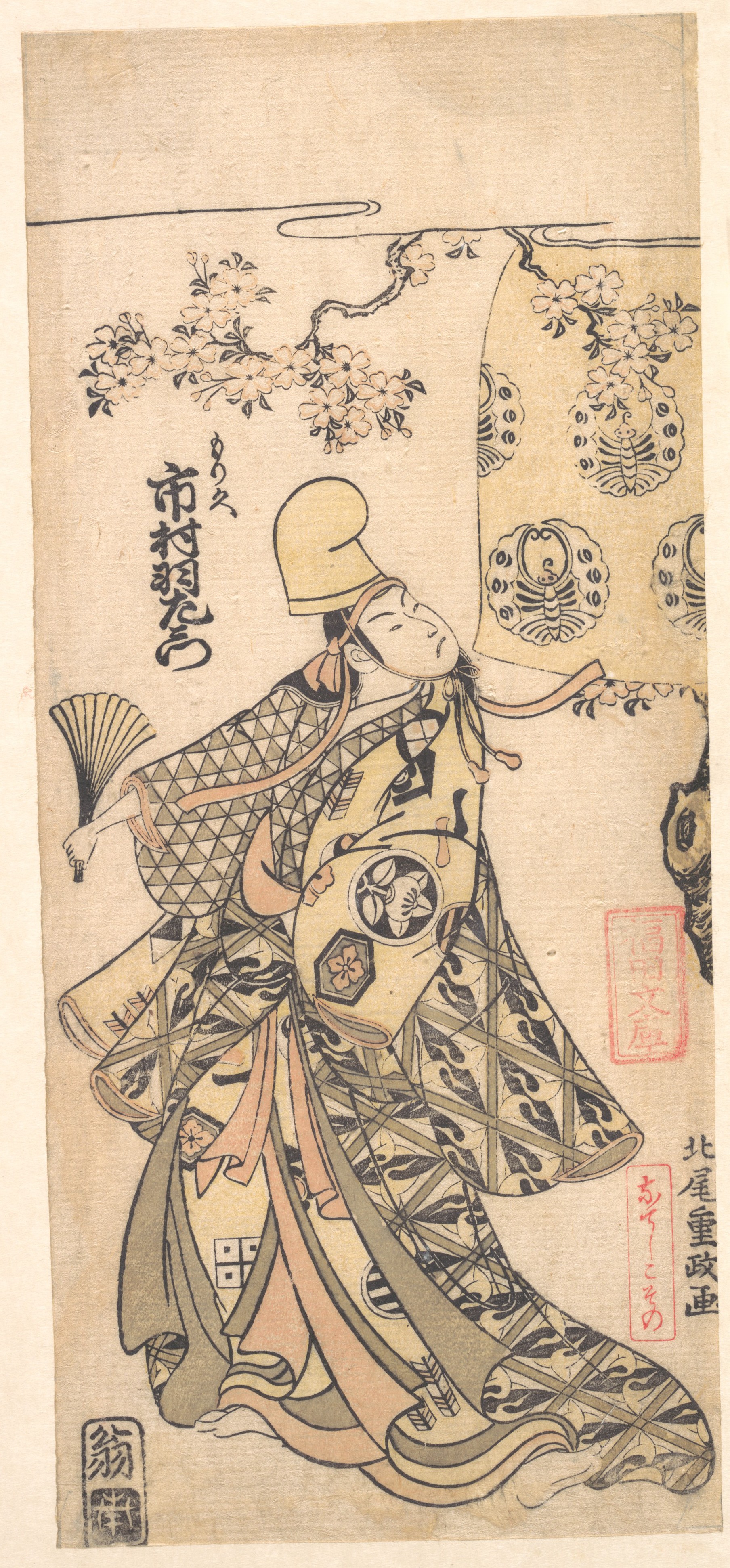
The Actor Ichimura Uzaemon IX
- Date:
- 1769 (early)
- Medium:
- Woodblock print; ink and color on paper
- Source:
- Metropolitan Museum of Art
Description
The Actor Ichimura Uzaemon IX, dated 1769, returns to a performer Kitao Shigemasa had already depicted earlier in his career and shows him in a mature yakusha-e idiom. Held in the Metropolitan Museum of Art, the print belongs to a moment of significant change in Edo ukiyo-e: by 1769 the full nishiki-e multicolor printing technique pioneered earlier in the decade had transformed the visual possibilities of the medium, allowing designers like Shigemasa to introduce subtler color harmonies and more elaborate patterning. The portrait of Ichimura Uzaemon IX captures the actor in a particular role, with costume, fan or prop, and pose contributing to the legibility of the character. Shigemasa renders the face with the slightly stylized features characteristic of mid-Edo yakusha-e, balancing recognizability with the conventions of the kabuki stage. As founder of the Kitao school, he occupied a distinctive position in actor portraiture, sometimes working in dialogue with the more strictly Torii school yakusha-e tradition while at other times exploring his own idioms in book illustration and bijinga. The Metropolitan Museum of Art preserves this print as part of its substantial holdings of eighteenth-century actor prints. Within Shigemasa's career, the 1769 portrait of Ichimura Uzaemon IX stands as evidence of his continued engagement with kabuki subjects even as his reputation increasingly rested on bijinga and book design. It also documents the long career of the Ichimura family of actors, which played a leading role in Edo theater throughout the period, and it offers a snapshot of how the Kitao school participated in the rapidly evolving visual culture surrounding kabuki performance in the late eighteenth century.
More Prints by Kitao Shigemasa

Women Holding Boy who is Reaching Out to Young Man Below
c. 1776
Color woodblock print; hashira-e

Priest Saigyo Contemplating Mount Fuji
c. 1770s
Color woodblock print; hashira-e

Autumn Moon over Sumida River (Sumida aki zuki), from the series "Eight Views of the Sumida River (Sumidagawa hakkei)"
early 1760s
Color woodblock print; hosoban, mizu-e

Crossing the Bridge at Sano
c. 1774
Color woodblock print; koban
Frequently Asked Questions
The Actor Ichimura Uzaemon IX was created by Kitao Shigemasa (北尾重政) in 1769 (early).