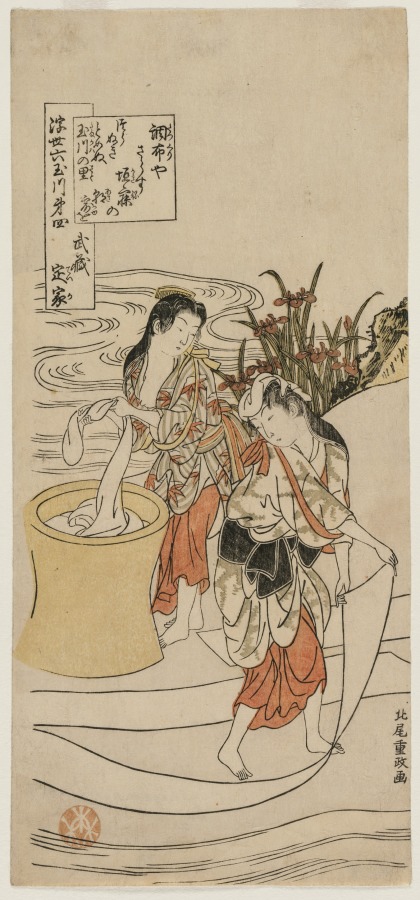
The Chofu Tama River in Musashi Province (from the series The Six Tama Rivers of the Floating World)
- Date:
- c. 1770
- Medium:
- color woodblock print
- Source:
- Cleveland Museum of Art
Description
The Chōfu Tama River in Musashi Province, from the series The Six Tama Rivers of the Floating World, is a refined sheet by Kitao Shigemasa held in the Cleveland Museum of Art and dated to around 1765. The six Tama rivers were a classical poetic conceit, six rivers of that name scattered across Japan, each associated with particular poems, sights, and emotional registers. The Chōfu river in Musashi Province, near Edo, was traditionally linked to imagery of women bleaching cloth on the riverbank, an activity that became a stock literary motif of seasonal labor and feminine grace. Shigemasa's contribution to a Six Tama Rivers series translates that classical theme into a contemporary bijinga register, an example of the mitate strategy that lay at the heart of much Edo ukiyo-e. The Cleveland Museum of Art preserves the work within its strong Japanese print collection. Shigemasa renders figures and setting with a confident understanding of how to balance landscape with bijin elements, allowing the eye to move from the women in the foreground to suggestions of the river and surrounding vegetation. By 1765, the year of the celebrated mid-decade nishiki-e revolution led by Suzuki Harunobu and his collaborators, Shigemasa was emerging as a leading designer of the new full-color prints, and as future founder of the Kitao school he was already developing the controlled, elegant idiom that would define his later work. The print thus illustrates both the literary depth of the Tama river theme and the early flowering of nishiki-e style in Edo ukiyo-e, with Shigemasa as one of its most accomplished practitioners.
More Prints by Kitao Shigemasa

Women Holding Boy who is Reaching Out to Young Man Below
c. 1776
Color woodblock print; hashira-e

Priest Saigyo Contemplating Mount Fuji
c. 1770s
Color woodblock print; hashira-e

Autumn Moon over Sumida River (Sumida aki zuki), from the series "Eight Views of the Sumida River (Sumidagawa hakkei)"
early 1760s
Color woodblock print; hosoban, mizu-e

Crossing the Bridge at Sano
c. 1774
Color woodblock print; koban
Frequently Asked Questions
The Chofu Tama River in Musashi Province (from the series The Six Tama Rivers of the Floating World) was created by Kitao Shigemasa (北尾重政) in c. 1770.