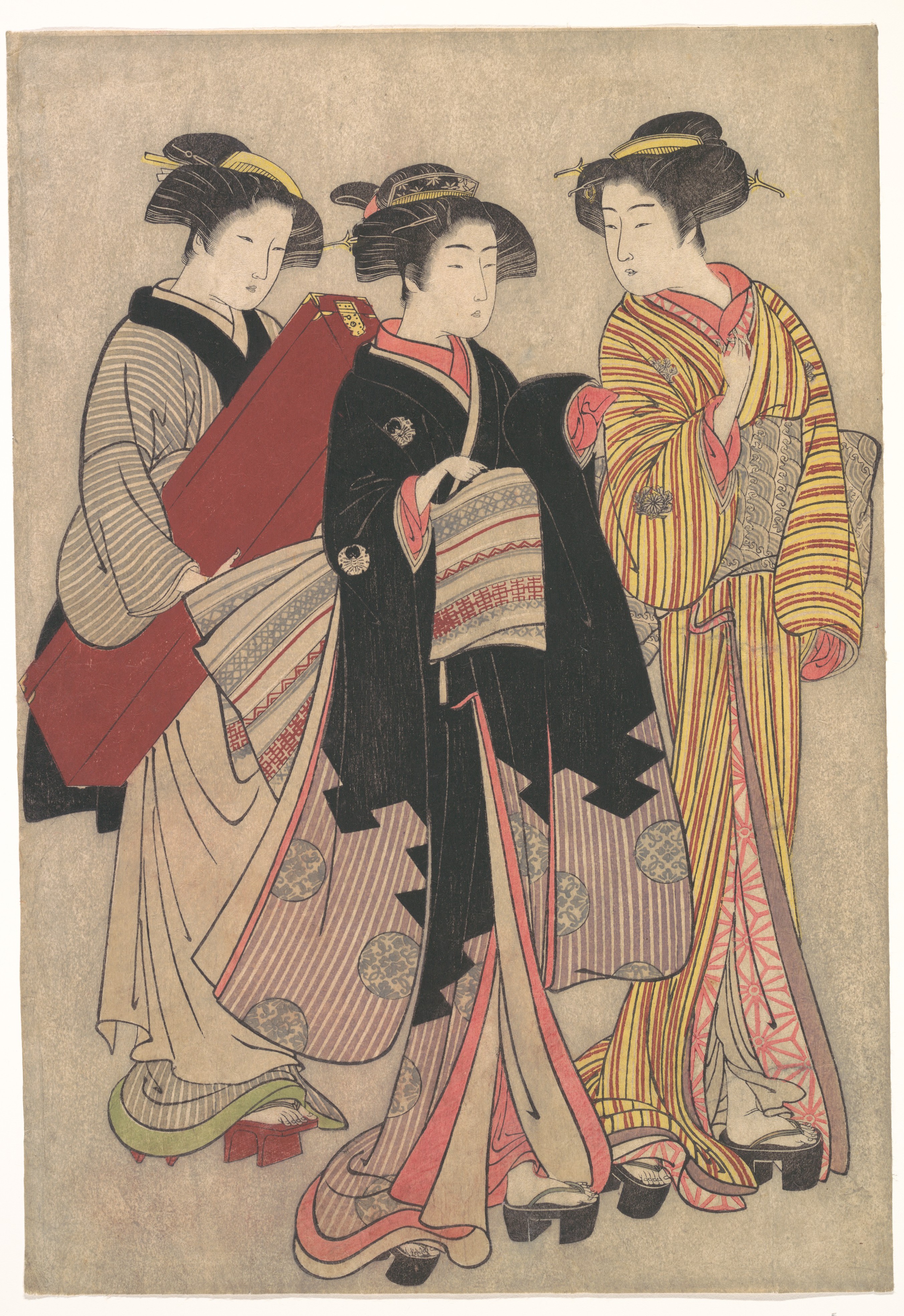
Two Geishas Out Walking
- Date:
- 1739–1820
- Medium:
- Woodblock print; ink and color on paper
- Source:
- Metropolitan Museum of Art
Description
Two Geishas Out Walking, attributed to Kitao Shigemasa in the Metropolitan Museum of Art, depicts a pair of professional female entertainers strolling together in an urban setting. The museum's date of 1739 reflects a generic cataloging marker rather than a sharp dating of the image; Shigemasa was born that year and worked into the early nineteenth century, so the print belongs within his career-long engagement with the bijinga genre of Edo ukiyo-e. Geishas, who emerged as a distinct professional class in the eighteenth century, became a recurring subject for Kitao school designers, and Shigemasa's treatment of them tends to emphasize composure, refined deportment, and an awareness of social codes communicated through robe choice, hair ornaments, and accessories such as fans and umbrellas. In this composition the two figures move together with synchronized rhythm, their bodies turned slightly toward one another so that the viewer reads them as companions rather than strangers. The Metropolitan Museum of Art preserves the image as part of its strong collection of Japanese figural prints. As founder of the Kitao school, Shigemasa was instrumental in shaping a visual idiom for geisha imagery that prized elegance over overt eroticism, an emphasis that contemporary observers in the An'ei and Tenmei eras would have found both fashionable and seemly. Within his broader career, Two Geishas Out Walking exemplifies the way he and the Kitao school used everyday urban subjects, walking, conversing, attending entertainments, to construct a flattering portrait of Edo as a cosmopolitan and culturally sophisticated city, a portrait that Edo ukiyo-e would refine through subsequent decades.
More Prints by Kitao Shigemasa

Women Holding Boy who is Reaching Out to Young Man Below
c. 1776
Color woodblock print; hashira-e

Priest Saigyo Contemplating Mount Fuji
c. 1770s
Color woodblock print; hashira-e

Autumn Moon over Sumida River (Sumida aki zuki), from the series "Eight Views of the Sumida River (Sumidagawa hakkei)"
early 1760s
Color woodblock print; hosoban, mizu-e

Crossing the Bridge at Sano
c. 1774
Color woodblock print; koban
Frequently Asked Questions
Two Geishas Out Walking was created by Kitao Shigemasa (北尾重政) in 1739–1820.