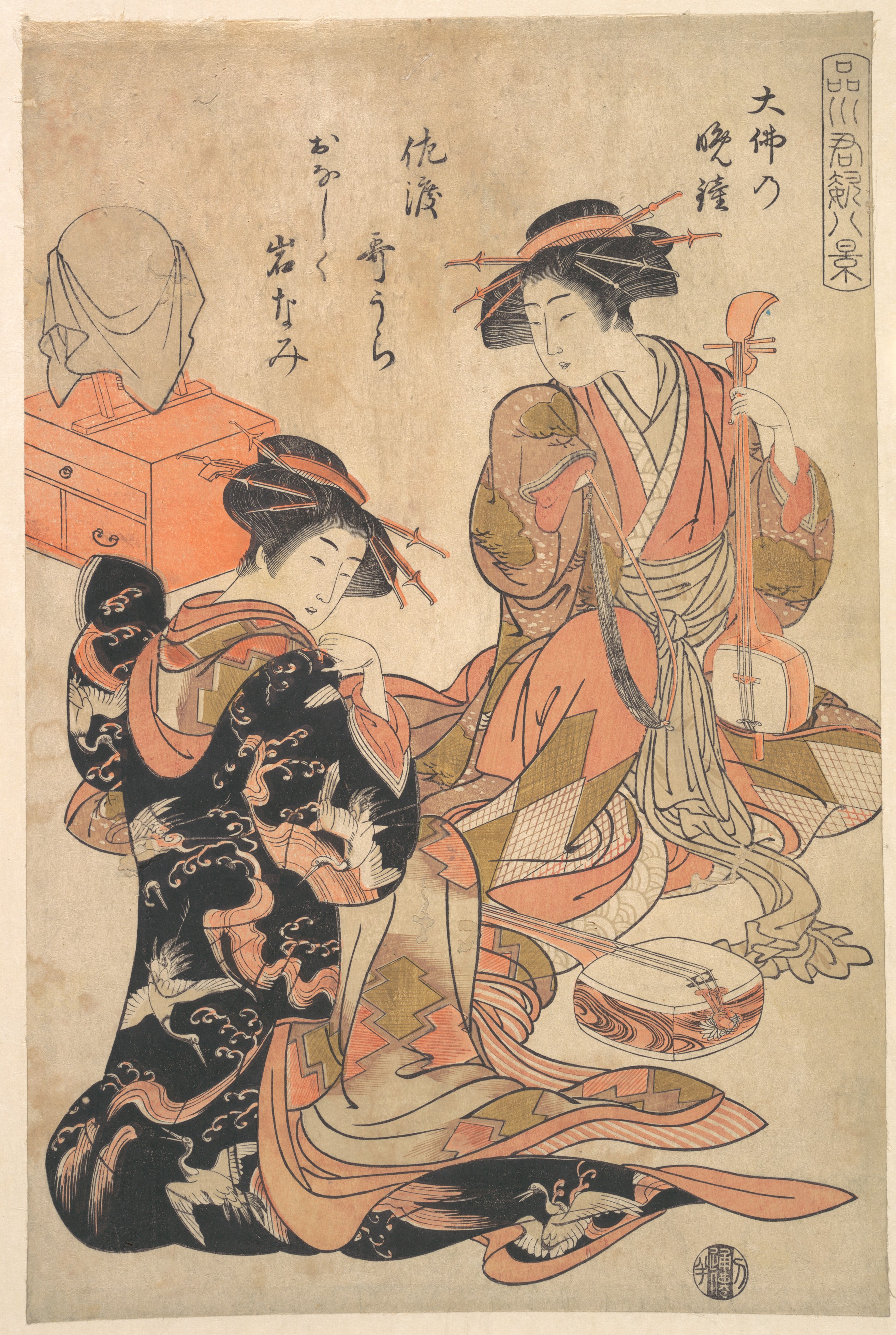
Vesper Bell of the Temple of Great Buddha
- Date:
- ca. 1778
- Medium:
- Woodblock print; ink and color on paper
- Source:
- Metropolitan Museum of Art
Description
Vesper Bell of the Temple of Great Buddha, dated 1768, is a quiet but resonant print by Kitao Shigemasa in the Metropolitan Museum of Art. The work belongs to a long Japanese visual tradition in which the great bells of major Buddhist temples figure as markers of time, devotion, and the passage of seasons. The temple of the Great Buddha referred to here is likely Tōdaiji in Nara, home of the colossal Buddha statue and an iconic site of pilgrimage, or another temple complex whose great bell had taken on similar cultural resonance. The vesper bell, sounded in the evening, was associated with the closing of the day, with the practice of nightly recollection, and with the famous Buddhist concept of impermanence symbolized in the opening lines of the Tale of the Heike. Shigemasa composes the scene to highlight the temple's architecture, the great bell within its housing, and figures at appropriate scale, allowing the viewer to feel the temple's monumentality without losing the human element. The Metropolitan Museum of Art preserves the print as part of its strong holdings of Edo ukiyo-e. As founder of the Kitao school, Shigemasa was at home in religious and architectural subjects, and his treatment of this scene reflects both his familiarity with temple iconography and his disciplined draftsmanship. The print also documents the ongoing popularity of pilgrimage and temple visits as a subject of Edo ukiyo-e, since printed images of famous sanctuaries circulated widely as both souvenirs and substitutes for travel. Within Shigemasa's career, Vesper Bell of the Temple of Great Buddha stands as a reminder of the Kitao school's range, encompassing devotional and contemplative subjects alongside its more famous treatments of fashion and theater.
More Prints by Kitao Shigemasa

Women Holding Boy who is Reaching Out to Young Man Below
c. 1776
Color woodblock print; hashira-e

Priest Saigyo Contemplating Mount Fuji
c. 1770s
Color woodblock print; hashira-e

Autumn Moon over Sumida River (Sumida aki zuki), from the series "Eight Views of the Sumida River (Sumidagawa hakkei)"
early 1760s
Color woodblock print; hosoban, mizu-e

Crossing the Bridge at Sano
c. 1774
Color woodblock print; koban
Frequently Asked Questions
Vesper Bell of the Temple of Great Buddha was created by Kitao Shigemasa (北尾重政) in ca. 1778.