
Wave and Pine
- Medium:
- Lithograph
- Image courtesy of
- Hanga Ten
Description
Wave and pine (matsu) are paired motifs with deep roots in Japanese visual culture — the pine signifying longevity and endurance, the wave its restless counterpart, together forming a coastal vocabulary that runs from byōbu screen painting through Edo-period meisho-e. Kojima translates this tradition into lithography, working in her customary black on warm cream, where the linear demands of pine needles and the curling crest of a wave both suit the medium's affinity for finely drawn line. The composition likely places the gnarled trunk and angular needle clusters of a shore pine against the rhythmic pattern of cresting water, a pairing she handles in flat planes rather than the layered registration of nishiki-e. Within her broader output — which more often pairs contemporary women with traditional motifs like hawks, peonies, and plum blossom — this seascape sits among the more austere nature studies, reducing her design vocabulary to two emblematic forms held in measured opposition.
More Prints by Kimiko Kojima


More Seascapes Prints
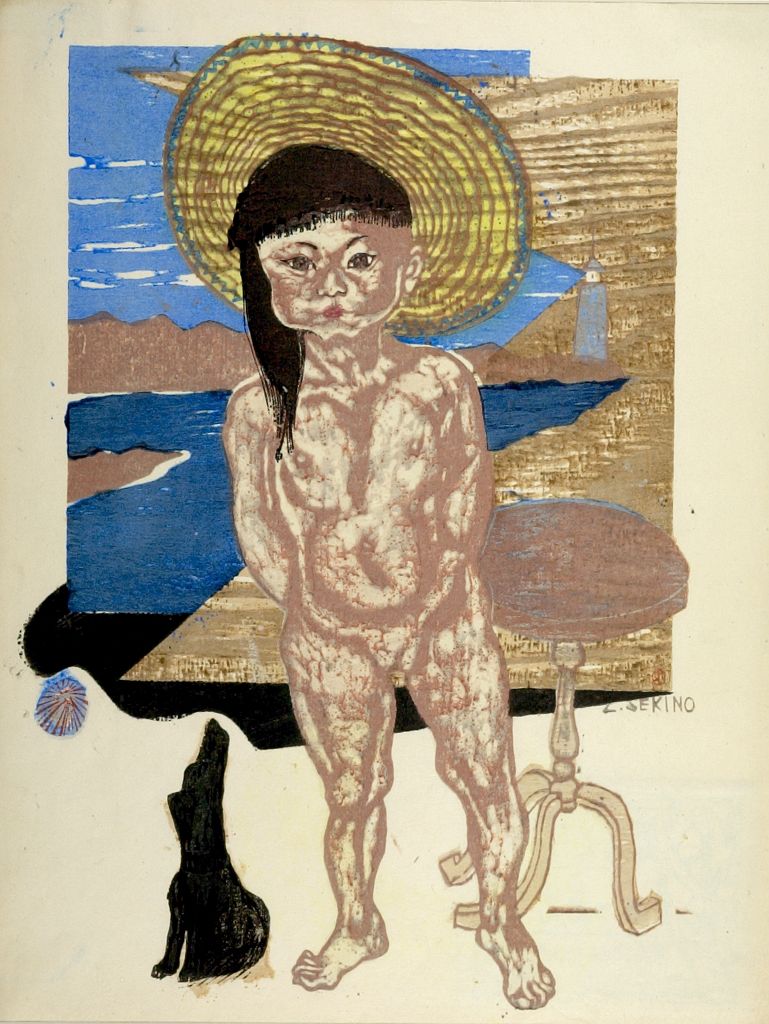
Child of the Sea
1940
Woodblock print

The Beach at Kaiganji in Sanuki Province (Sanuki Kaiganji no hama), from the series "Collection of Views of Japan II, Kansai Edition (Nihon fukei shu II Kansai hen)"
1934
Color woodblock print; oban

Pacific Ocean, Awa Province (Boshu Taikai), from the series "Souvenirs of Travel, Third Series (Tabi miyage dai sanshu)"
Boshu Taikai
1925
Color woodblock print; oban

Pine Beach at Miho (Miho no Matsubara), from the series "Selection of Views of the Tokaido (Tokaido fukei senshu)"
September 1931
Color woodblock print; oban
Frequently Asked Questions
Wave and Pine was created by Kimiko Kojima (小島 喜美子).
Wave and Pine depicts seascapes and trees.