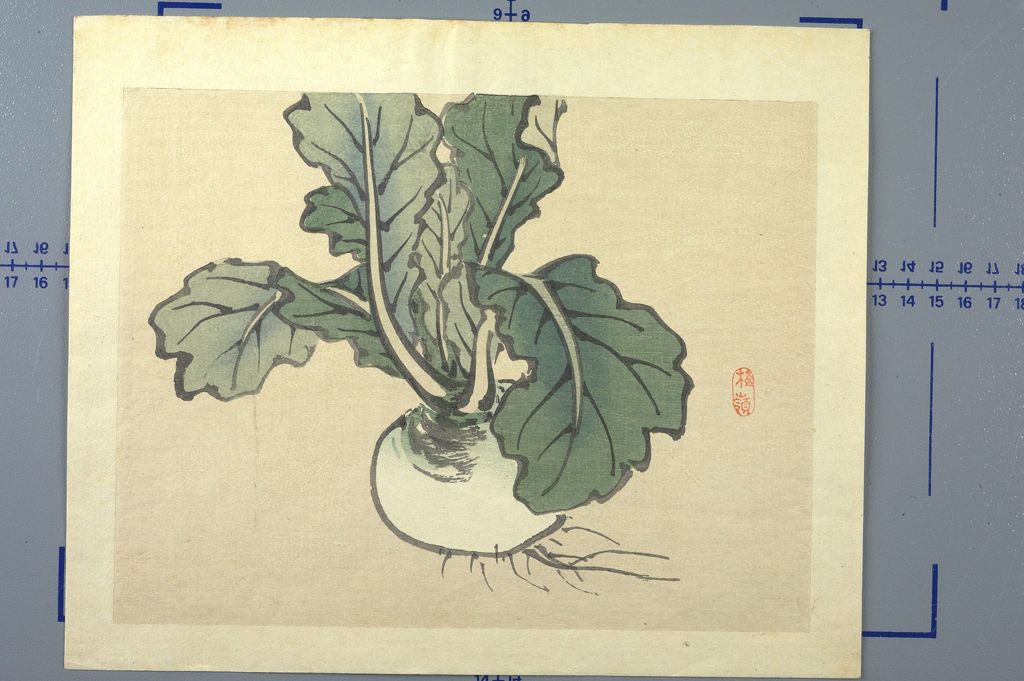
Japanese Radish
by Kōno Bairei
- Medium:
- Woodblock print
- Source:
- Harvard Art Museums
Description
Japanese Radish, held by the Harvard Art Museums, is a still-life study in which Kono Bairei applies his Kyoto Shijo school observational discipline to one of the most humble subjects of the Japanese seasonal calendar: the daikon radish, a winter staple of the Kyoto pickling tradition and of the rural farm garden. The daikon is a large, white-fleshed root vegetable with green leafy tops, and its visual interest for painters lies in the contrast between the long pale body and the feathery articulated foliage. Bairei's print renders both registers with the brushed ink line he inherited from his teachers Nakajima Raisho and Shiokawa Bunrin in the Maruyama-Shijo lineage of Okyo and Goshun, using soft graded color in pale green and ivory to give the leaves their stem-joint texture and the root its slightly translucent body. The choice of subject sits within a long tradition of vegetable still life in Kyoto painting — daikon, kabocha, satsumaimo, eggplant — that the Shijo school treated with the same observational seriousness as bird-and-flower pairings, reflecting the school's commitment to the everyday seasonal world as a legitimate painting subject. The composition uses high horizon and minimal background, the radish placed as a single observed object against open ground in the manner of a hanging scroll quoted on paper. The Harvard Art Museums catalogue the sheet (https://www.harvardartmuseums.org/art/201951) within their substantial Meiji nihonga print holdings, where Japanese Radish functions as a representative example of Bairei's extension of the kachō-ga vocabulary to seasonal still life. It is a clear instance of Kono Bairei's Kyoto Shijo school program translated into Meiji nihonga print form on a quiet domestic subject.
More Prints by Kōno Bairei


Frequently Asked Questions
Japanese Radish was created by Kōno Bairei (幸野楳嶺).