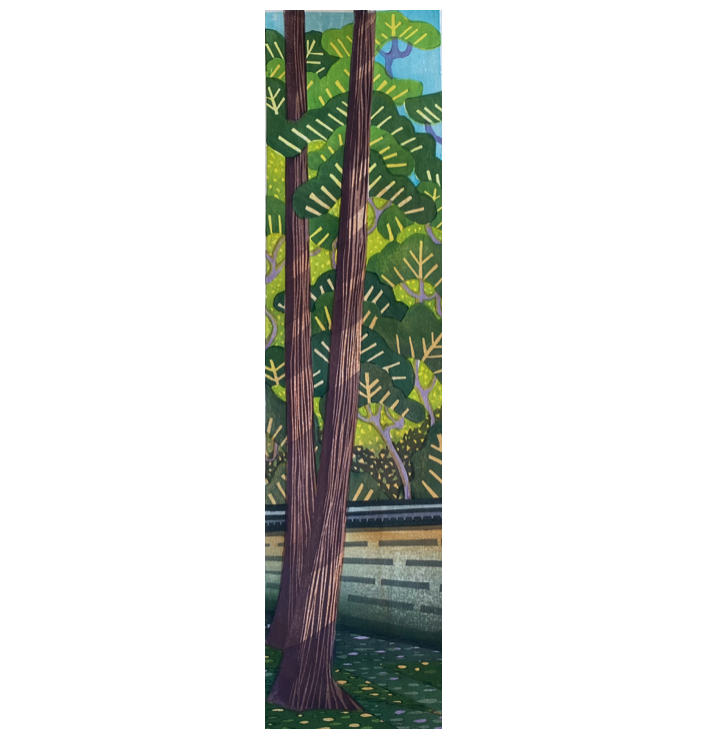
Nara Patterns
- Image courtesy of
- Artist website (Lynita Shimizu)
Description
Nara Patterns draws on the textile and architectural ornament associated with Japan's ancient capital, where the temple complexes of Todai-ji and Horyu-ji preserve some of the oldest surviving lattice work, kumiko joinery, and brocade fragments in the country. A subject of this kind suits mokuhanga because flat repeating motifs reward the precise registration achieved by kento marks and the even pressure of the baren on dampened washi. Shimizu trained under Tomikichiro Tokuriki, who maintained a working studio in Kyoto rooted in the Showa shin-hanga lineage, and patterning exercises of this sort reflect the disciplined block-cutting and color-layering she absorbed there. Unlike kacho-e or bijin-ga subjects, pattern prints rely on rhythm and interval rather than narrative, and they often depend on a restrained palette where small color shifts between adjacent shapes carry the composition. Within Shimizu's wider body of work, prints anchored in Japanese place names tend to function as quiet observational studies rather than commemorative meisho-e.
More Prints by Lynita Shimizu

Frequently Asked Questions
Nara Patterns was created by Lynita Shimizu.