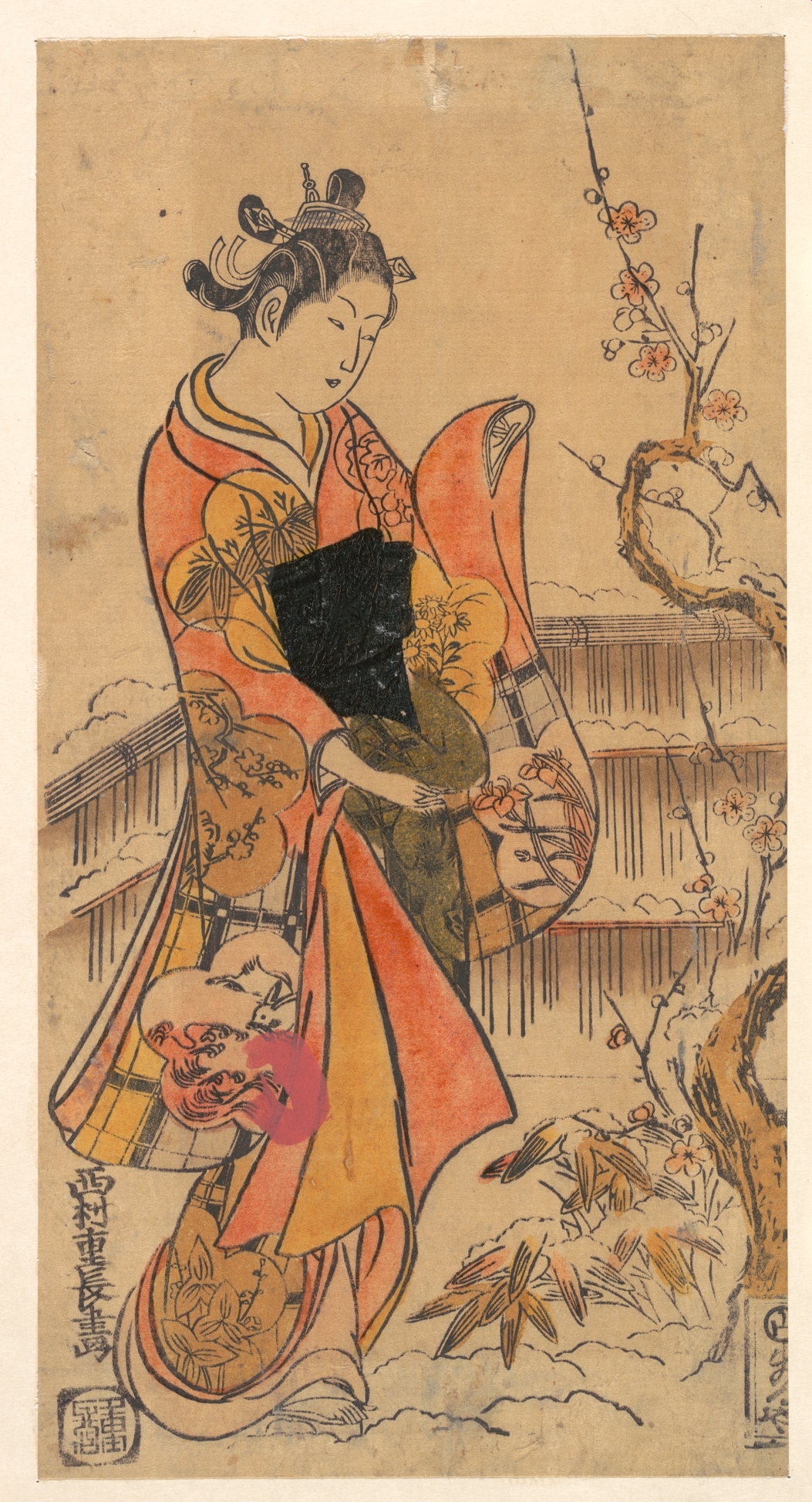
A Young Lady in a Garden
- Medium:
- Woodblock print; ink and color on paper
- Source:
- Metropolitan Museum of Art
Description
A Young Lady in a Garden, catalogued by the Metropolitan Museum of Art with an assigned date of 1697, presents a single standing female figure in a quiet garden setting, a subject that anticipates the bijin-ga (beautiful women) tradition that would dominate eighteenth-century ukiyo-e. Nishimura Shigenaga, active in Edo across the first half of the eighteenth century, was among the artists who carried the early Edo ukiyo-e idiom forward from its late seventeenth-century origins, adapting the format inherited from masters such as Hishikawa Moronobu and Torii Kiyonobu for an expanding townsman audience. The composition's emphasis on a slender, elegantly posed figure against minimal background details reflects the bold linear style typical of monochrome and hand-colored prints from the period, when most sheets relied on confident sumizuri-e outlines and selective manual coloring rather than the full-color nishiki-e techniques developed after Shigenaga's lifetime. The garden setting, indicated through a few stylized plants rather than illusionistic depth, allows the viewer to focus on the woman's costume and bearing, both of which carried subtle social and seasonal cues for contemporary collectors. Shigenaga's importance in this period rests partly on his role as a teacher; his pupils included Ishikawa Toyonobu and, indirectly, the broader generation that produced the first full-color prints in the 1760s. Although Shigenaga later became one of the principal experimenters with uki-e perspective prints derived from imported Western and Chinese sources, modest figural sheets like this one illustrate the workshop's parallel commitment to fashionable urban women as ongoing subjects. For students of early Edo ukiyo-e, the print documents how Nishimura Shigenaga shaped the figural conventions later refined by his successors.
More Prints by Nishimura Shigenaga

Eagle and Monkey
c. 1725
Hand-colored woodblock print; hosoban, urushi-e

Jurojin with crane and tortoise
18th century
Woodblock print; hashira-e, sumizuri-e

Yokihi (Chinese: Yang Guifei) with attendant
18th century
Woodblock print; hosoban, sumizuri-e

The Sumiyoshi Dance
18th century
Hand-colored woodblock print; hosoban, urushi-e
Frequently Asked Questions
A Young Lady in a Garden was created by Nishimura Shigenaga (西村重長).