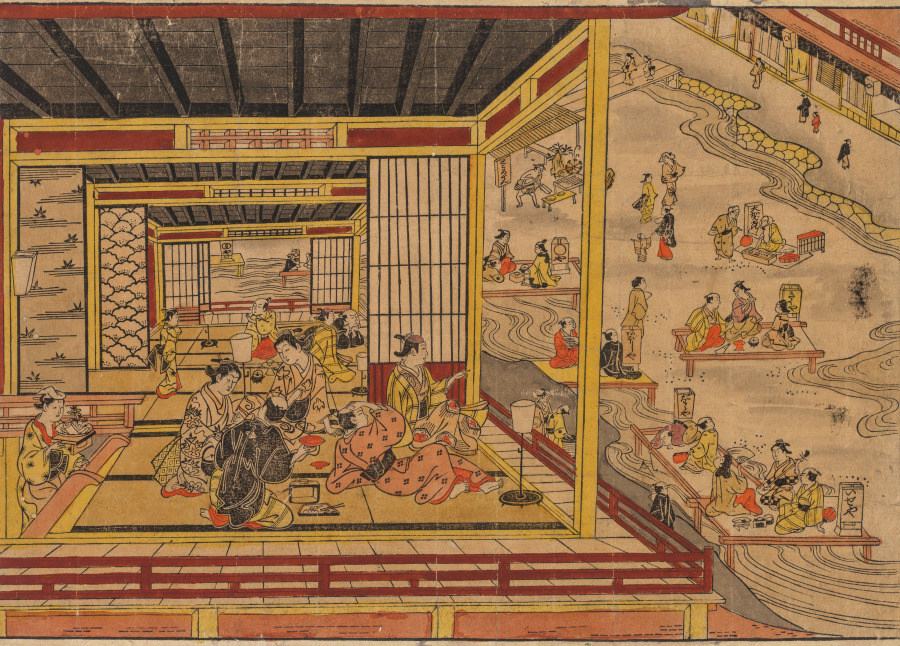
Tea House Beside the Kamo River in Kyoto
- Date:
- 1740s
- Medium:
- color woodblock print
- Source:
- Cleveland Museum of Art
Description
Tea House Beside the Kamo River in Kyoto, dated to 1740 and preserved in the Cleveland Museum of Art, is an outstanding example of the uki-e perspective prints with which Nishimura Shigenaga helped establish a new genre within early Edo ukiyo-e. Uki-e, literally floating or projecting pictures, used converging orthogonals derived from Western copperplate engravings and Chinese perspective images to create the illusion of recession into deep interior or street space. Shigenaga, working in Edo, was one of the earliest Japanese designers to apply these conventions systematically to popular printed sheets, often choosing crowded urban settings where the illusion would impress an audience accustomed to flatter pictorial conventions. The Kamo River in Kyoto, with its riverside teahouses, evening cooling platforms, and seasonal entertainments, was a celebrated landscape of leisure familiar to literate Edo audiences through poetry, guidebooks, and travel accounts. Shigenaga's composition organizes the architecture along strong receding lines, with patrons, servers, and entertainers staged in the recessed space so that the viewer seems to peer into the building from a slightly elevated vantage. The print thus combines two of the artist's preoccupations: the documentation of fashionable urban pleasure quarters and the technical experiment with perspectival depth that would influence later artists, including Okumura Masanobu and, eventually, Utagawa Toyoharu. For collectors and historians of Nishimura Shigenaga, sheets such as this one are essential, because they show the uki-e perspective prints in mature form rather than in their tentative earliest iterations. Surviving impressions in major museum collections such as Cleveland's confirm the print's status as a benchmark for the genre within early Edo ukiyo-e.
More Prints by Nishimura Shigenaga

Eagle and Monkey
c. 1725
Hand-colored woodblock print; hosoban, urushi-e

Jurojin with crane and tortoise
18th century
Woodblock print; hashira-e, sumizuri-e

Yokihi (Chinese: Yang Guifei) with attendant
18th century
Woodblock print; hosoban, sumizuri-e

The Sumiyoshi Dance
18th century
Hand-colored woodblock print; hosoban, urushi-e
Frequently Asked Questions
Tea House Beside the Kamo River in Kyoto was created by Nishimura Shigenaga (西村重長) in 1740s.