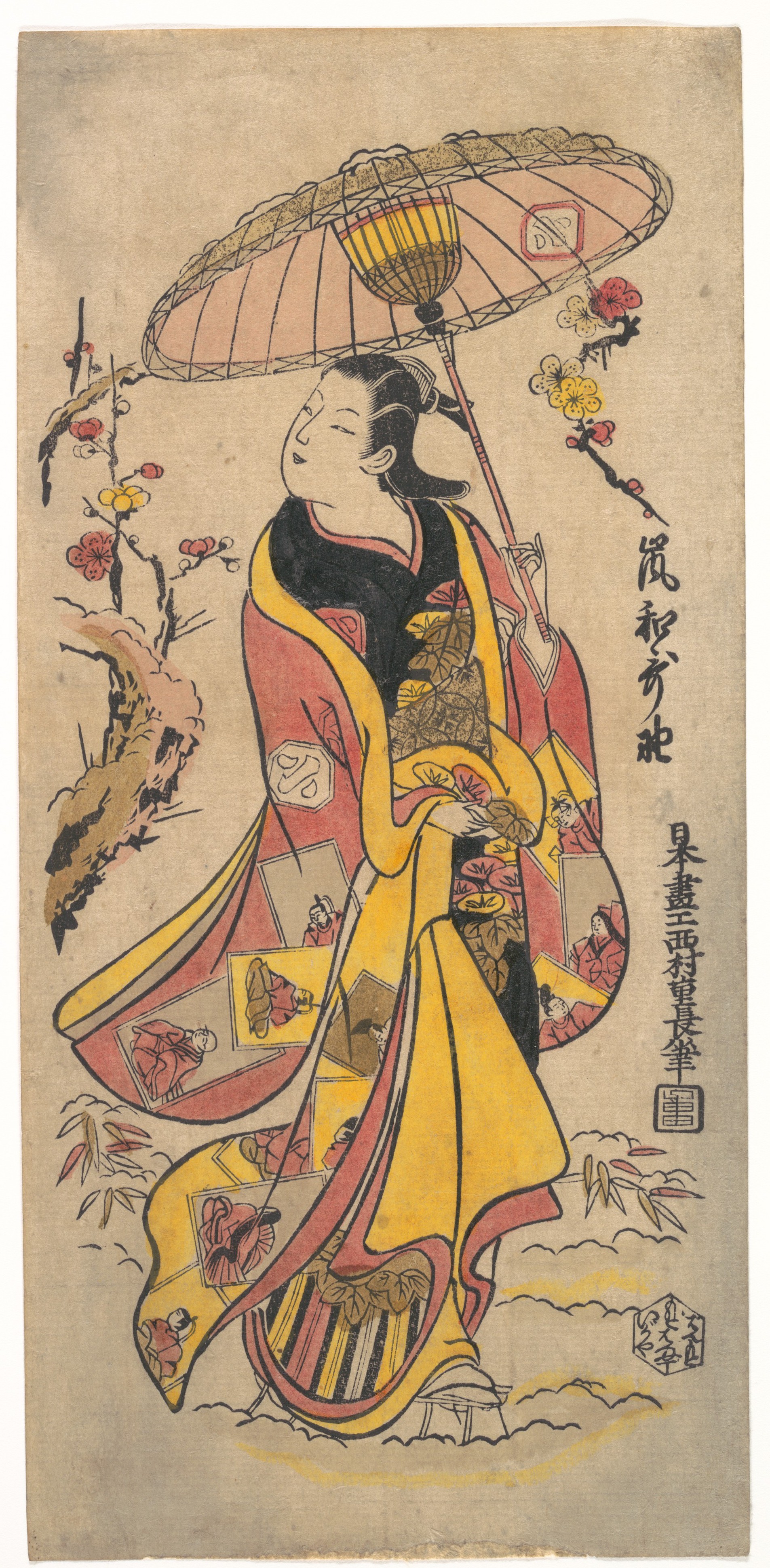
The Actor Arashi Wakano
- Date:
- ca. 1738
- Medium:
- Woodblock print; ink and color on paper
- Source:
- Metropolitan Museum of Art
Description
The Actor Arashi Wakano, dated to 1728 and held in the Metropolitan Museum of Art, is a kabuki portrait by Nishimura Shigenaga from the heart of his Edo career. Arashi Wakano was one of the female-role specialists active in the 1720s, a period when the Edo theaters were consolidating the star system that would dominate ukiyo-e production for the next century and a half. Shigenaga's print situates the actor as a single full-length figure, posed in a costume marked by distinctive patterns and details that contemporary playgoers would have recognized from a specific stage role. The bold contour lines, restrained palette, and attention to textile design are characteristic of early Edo ukiyo-e actor prints produced before the full development of polychrome nishiki-e techniques in the 1760s. Shigenaga occupies an important position in the history of yakusha-e (actor prints): trained in the orbit of the Torii school, which held the dominant position in theater billboards and programs, he extended its conventions and eventually transmitted them to his own pupils, including Ishikawa Toyonobu. The Arashi Wakano sheet thus belongs to a continuous lineage of kabuki portraiture that connects late seventeenth-century pioneers to the celebrated actor prints of Katsukawa Shunsho and Toshusai Sharaku later in the century. Although Nishimura Shigenaga is now perhaps best known among specialists for his role in developing uki-e perspective prints, his actor portraits remind us that his workshop participated fully in the central commercial subjects of the period. Surviving impressions in collections such as the Metropolitan Museum of Art document this dimension of his output and offer a clear example of his contribution to early Edo ukiyo-e portraiture.
More Prints by Nishimura Shigenaga

Eagle and Monkey
c. 1725
Hand-colored woodblock print; hosoban, urushi-e

Jurojin with crane and tortoise
18th century
Woodblock print; hashira-e, sumizuri-e

Yokihi (Chinese: Yang Guifei) with attendant
18th century
Woodblock print; hosoban, sumizuri-e

The Sumiyoshi Dance
18th century
Hand-colored woodblock print; hosoban, urushi-e
Frequently Asked Questions
The Actor Arashi Wakano was created by Nishimura Shigenaga (西村重長) in ca. 1738.