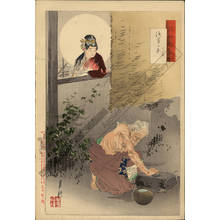
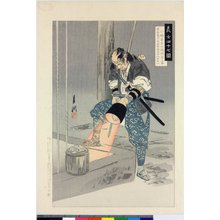
The house at Asajigahara
by Ogata Gekko
- Medium:
- Woodblock print
- Source:
- Museum of Applied Arts Vienna
- Image courtesy of
- Museum of Applied Arts Vienna
Description
Ogata Gekkō's depiction of the house at Asajigahara draws on the legend of Adachigahara, one of the most enduring narratives in Japanese oral and theatrical tradition. In the tale—adapted for noh theater as Kurozuka and for Kabuki—a solitary woman living in a remote dwelling on the Adachi plain kills travelers who seek shelter, before revealing herself as a demon. Gekkō, working in the Meiji period, frequently turned to classical literary and dramatic subjects, rendering them with compositional restraint rather than explicit horror. This impression likely depicts the isolated thatched structure surrounded by the spare, windswept plain that gives the legend its atmosphere of concealed menace—the architecture itself functioning as the narrative's emblem. Gekkō's palette for such subjects tends toward muted earth tones and ink-dark shadows, allowing environmental desolation to carry psychological weight. The version designation suggests this is one of multiple printings or states of the same composition.
More Prints by Ogata Gekko
Frequently Asked Questions
The house at Asajigahara was created by Ogata Gekko (尾形月耕).