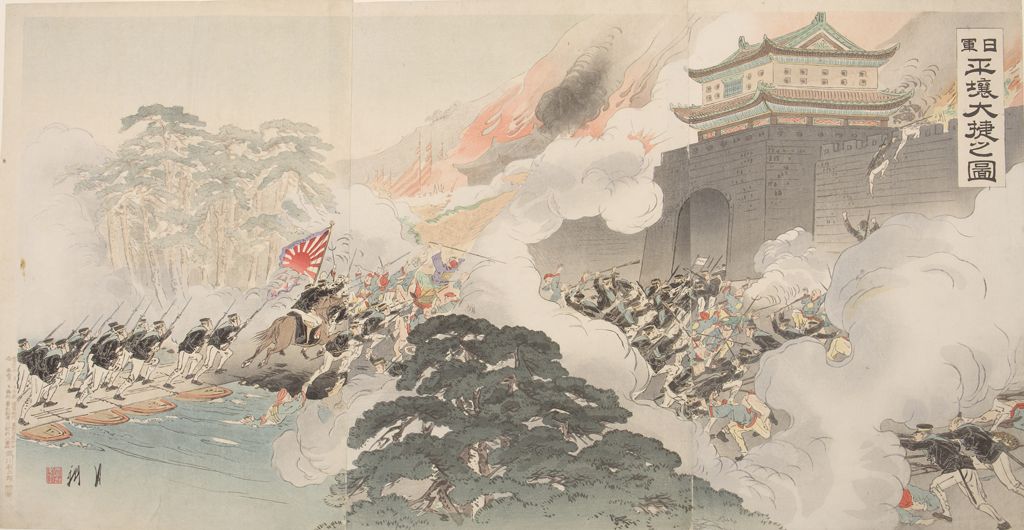
"Triptych: Great Victory for the Japanese Army at P'yông Yang (Nichigun Heijô taisho no zu), Meiji period, dated 1894"
by Ogata Gekko
- Medium:
- Woodblock print
- Source:
- Harvard Art Museum
- Image courtesy of
- Harvard Art Museum
Description
A complete oban triptych documenting the Japanese army's decisive victory at the Battle of Pyongyang on September 15, 1894, in which General Yamagata Aritomo's First Army drove Qing forces from the Korean city in the opening major land engagement of the First Sino-Japanese War. Across three joined panels, Gekko deploys a panoramic compositional strategy that his individual battle sheets cannot accommodate: a continuous terrain stretching from one flank's action to another, with massed troop movements, fortification walls, artillery positions, and the city itself legible as an integrated spatial whole. The triptych format, inherited from the Edo-period tradition of sumo and kabuki triptychs, here carries a nationalistic function, its physical scale amplifying the grandeur of the victory it records. Smoke gradations in bokashi unify the three panels atmospherically, while the foreground figures in Meiji military uniform anchor the scene in contemporary specificity.
More Prints by Ogata Gekko
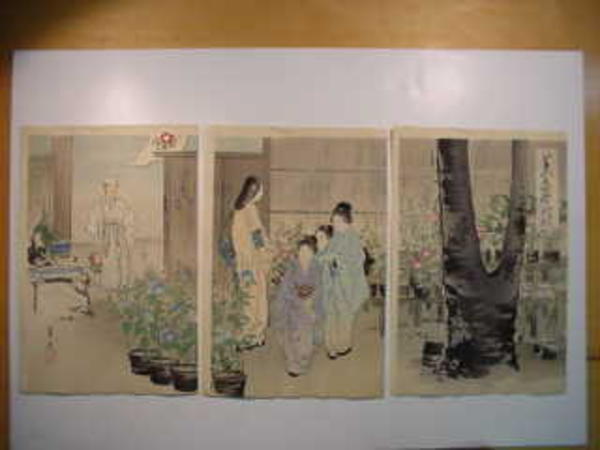
MORNING GLORIES AT IRIYA, TOKYO
Woodblock print

Nippon-damashii, Kyokaku 日本魂 侠客 / Gekko zuihitsu 月耕随筆
Woodblock print
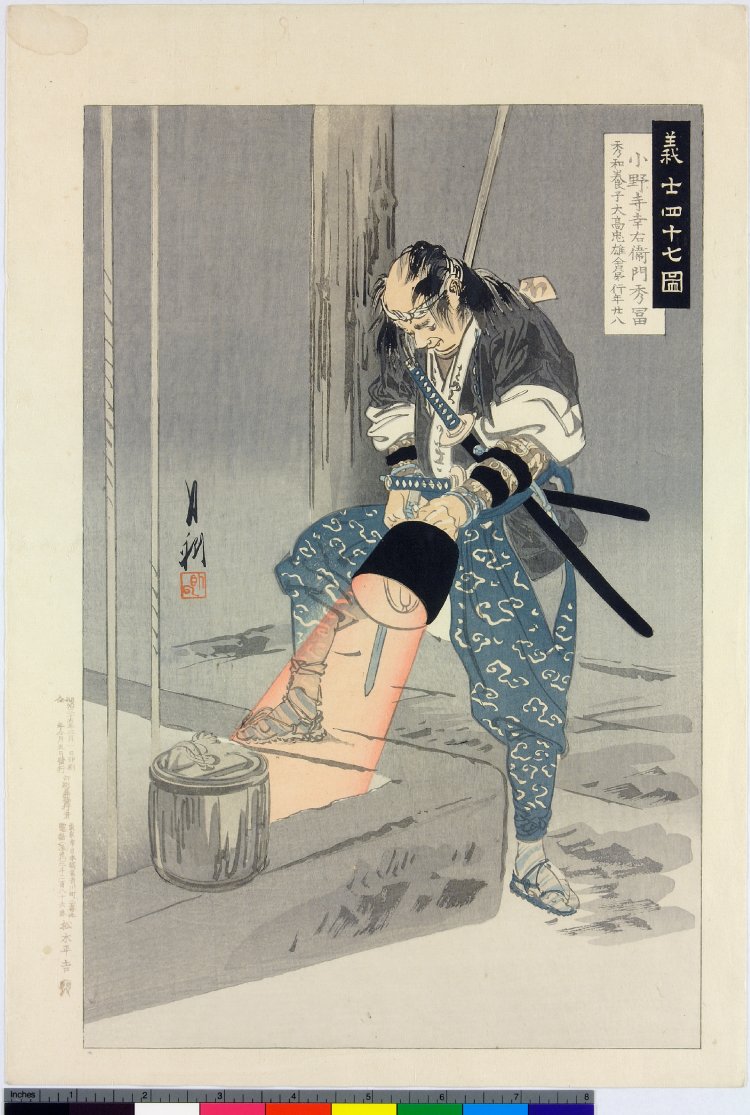
Onodera Koemon Hidetomi 小野寺幸右衛門秀富 / Gishi shijushichi zu 義士四十七図
Woodblock print
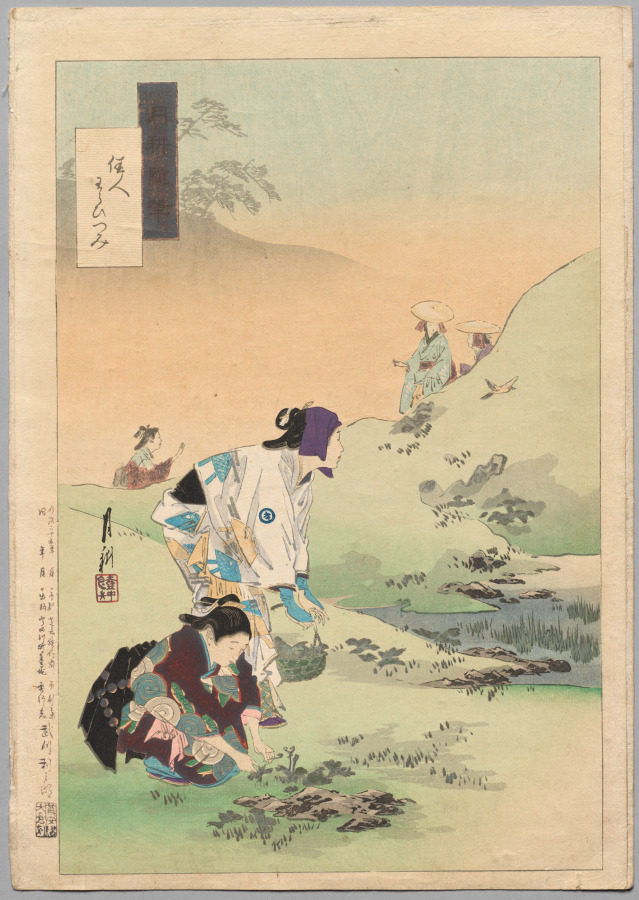
Beauties Harvesting Bracken, from the series Gekkō’s Miscellaney
c. 1886–1899
Woodblock print, ink and color on paper
Frequently Asked Questions
"Triptych: Great Victory for the Japanese Army at P'yông Yang (Nichigun Heijô taisho no zu), Meiji period, dated 1894" was created by Ogata Gekko (尾形月耕).