Woman in Japanese Costume
by Robert Blum
- Date:
- 1890–1892
- Medium:
- Oil on canvas
- Source:
- Brooklyn Museum
Description
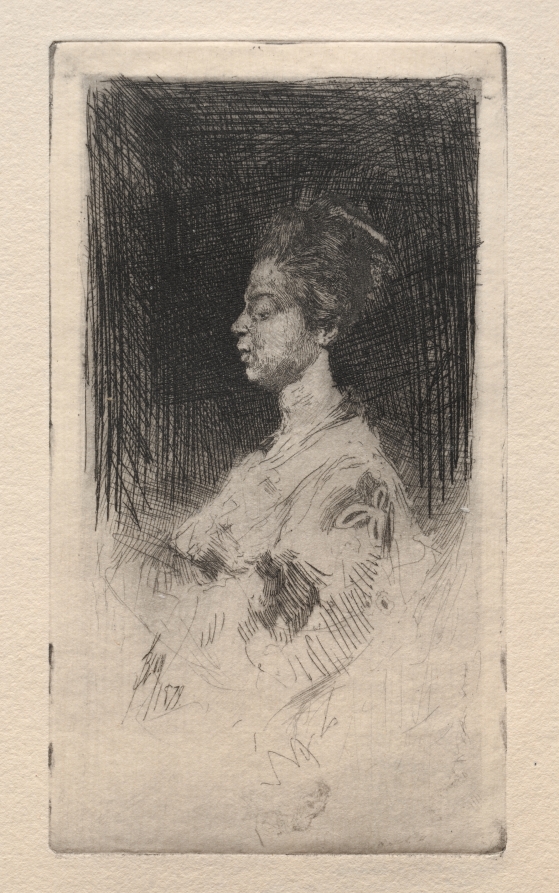
Held in the Brooklyn Museum and painted between 1890 and 1892 during Robert Blum's two-and-a-half-year stay in Japan, Woman in Japanese Costume is the companion piece to the museum's Study in Japanese Costume and one of a small group of intimate figure studies that Blum painted from young Japanese models in his Tokyo studio. The small oil shows the model seated in three-quarter view, her hands folded in her lap and her gaze cast slightly downward, dressed in a pale-coloured kimono with a darker patterned obi; the simple flat background concentrates the entire pictorial interest on the relationship between the figure, the silk and the carefully recorded folds of the cloth. The handling owes everything to Blum's training in the Fortuny manner — brilliant small touches of paint laid wet-into-wet — but the calm posture and unforced naturalism mark the canvas as one of the more sympathetic Western responses to its Japanese subject.
The study belongs to the year in which Blum worked most closely with a single Japanese female model whose name has not survived; the resulting series of paintings, of which the two Brooklyn studies are the most fully resolved, was kept by Blum on his return to New York and only entered the Brooklyn Museum after his posthumous sale. The paintings have come in the modern literature to be seen as the most successful American counterpart to the contemporary bijinga of Toyohara Chikanobu and the early [shin-hanga](/glossary/shin-hanga) painters: a Western kimono portrait made without the ethnographic distance that mars most American japonisme of the period, and recording a moment in which Western and Japanese figure painting drew on a common pictorial vocabulary.