
The Lijang River in the evening
- Medium:
- Mokuhanga (Japanese woodblock)
- Image courtesy of
- Saru Gallery
Description
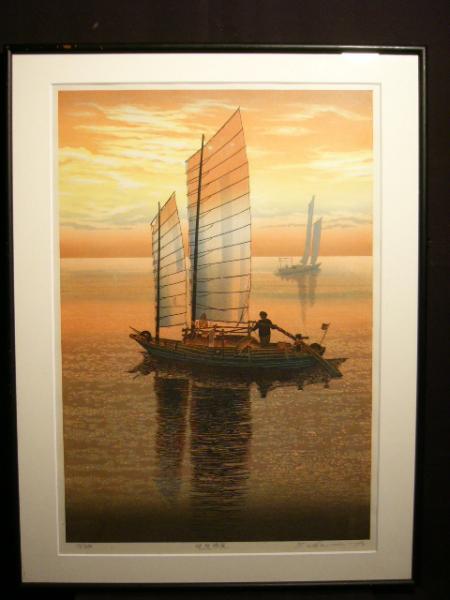
The Lijiang River in Guangxi, China, is known for its karst peaks rising from the water—a subject that invites the kind of layered atmospheric treatment central to Okamoto's landscape practice. The evening setting allows for extended use of bokashi, the gradient inking technique in which color is graduated from saturated to pale across the printing block, particularly suited to skies, water surfaces, and the modeling of distant mountains in low light. The composition likely arranges the karst formations in receding planes, with reflections in the river surface creating a vertical mirroring that doubles the visual density of the image. Okamoto's selection of a Chinese rather than Japanese subject extends the meisho-e (famous places) tradition outward, applying mokuhanga sensibility to a landscape long beloved by Chinese ink painters. The evening light favors a cool palette—indigo, grey, muted ocher—and demands careful tonal control across the multiple blocks required to build atmospheric depth.
More Prints by Ryusei Okamoto


More Rivers & Lakes Prints

Lake Chuzenji, Nikko (Nikko Chuzenjiko)
Nikko Chuzenjiko
1930
Color woodblock print; oban

Lake Kugushi in Wakasa Province (Wakasa Kugushiko), from the series Souvenirs of Travel I (Tabi miyage dai isshu)"
Wakasa Kugushiko
1920
Color woodblock print; oban

Gosai Canal in Niigata (Niigata Gosaibori), from the series "Souvenirs of Travel, Second Series (Tabi miyage dai nishu)"
Niigata Gosaibori
1921
Color woodblock print; oban

The Hori River at Obama (Obama Horikawa), from the series "Souvenirs of Travel, First Series (Tabi miyage dai isshu)"
Obama Horikawa
1920
Color woodblock print; oban
Frequently Asked Questions
The Lijang River in the evening was created by Ryusei Okamoto (岡本隆生).
The Lijang River in the evening depicts rivers & lakes and night scenes.