
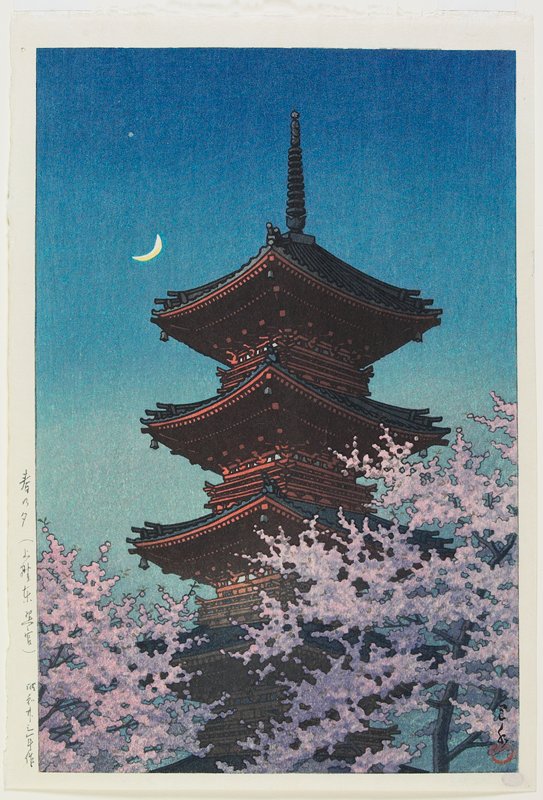
Spring moon on hazy night
- Medium:
- Mokuhanga (Japanese woodblock)
- Image courtesy of
- Saru Gallery
Description
The title references oborozuki, the hazy or veiled spring moon, a recurrent subject in classical waka poetry and in Japanese landscape printmaking. The image likely centers on a moon partially obscured by atmospheric haze or thin cloud, set within a darkened sky, possibly accompanied by silhouetted branches, blossoms, or rooflines along the lower register. Night scenes in mokuhanga rely on careful registration of overprinted dark blocks to build the deep tonality of the sky while retaining a luminous reserve for the moon itself, often achieved by leaving the washi unprinted or by a soft bokashi halo around the lunar form. The hazy effect that distinguishes spring moonlight from autumn's harder-edged disk is typically produced by graduated wiping of the block before impression, allowing pigment to fade outward from the moon. Within Miyamoto Shufu's documented output, this print belongs to a group of nocturnal and seasonal subjects whose handling suggests familiarity with both shin-hanga atmospheric landscape and the older lyrical kacho-e and meisho-e traditions, though biographical sources confirming his training or publisher affiliations remain unavailable.
More Prints by Miyamoto Shufu
More Spring Prints

Frequently Asked Questions
Spring moon on hazy night was created by Miyamoto Shufu (宮本秋風).
Spring moon on hazy night depicts spring, moonlight, and night scenes.