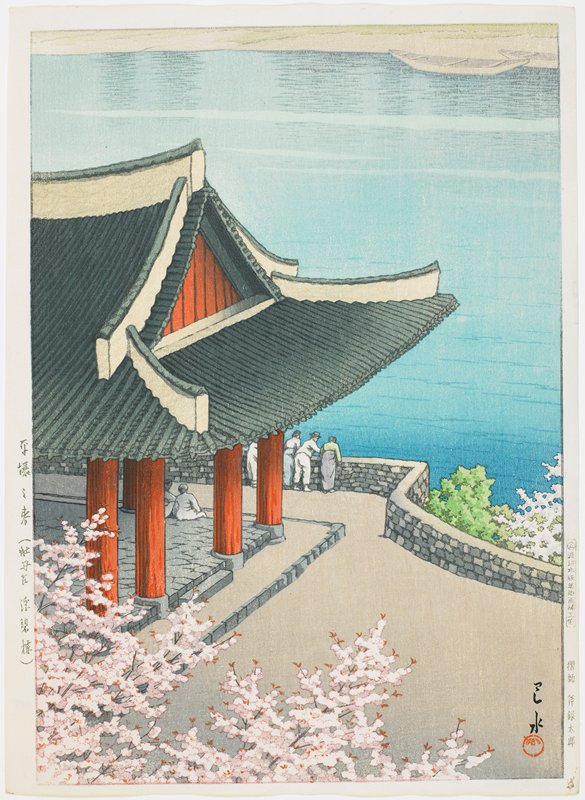
Spring at Pyongyang (Pubyok Pavilion from Moran Hill)
by Kawase Hasui
- Date:
- 1939
- Medium:
- Woodblock print, ink and color on paper
- Format:
- Oban
- Dimensions:
- 39.2 × 27.5 cm
- Publisher:
- Watanabe Shozaburo
- Edition:
- Published by Watanabe Shozaburo
- Source:
- Minneapolis Institute of Art
Description
Spring at Pyongyang (Pubyok Pavilion from Moran Hill), published in 1939 as a standalone composition, depicts the view from Moranbong (Moran Hill) — the wooded hill above the Taedong River at the center of Pyongyang that was the city's historic park and viewpoint — looking down on the Pubyokru pavilion, an ancient two-story pavilion perched on a cliff above the river bend. The spring setting softens the cliff and woodland scenery with new foliage and blossoms. This standalone print relates to the Eight Views of Korea series from the same year, sharing its compositional approach to Korean landscape documentation.
More Prints by Kawase Hasui

More Spring Prints
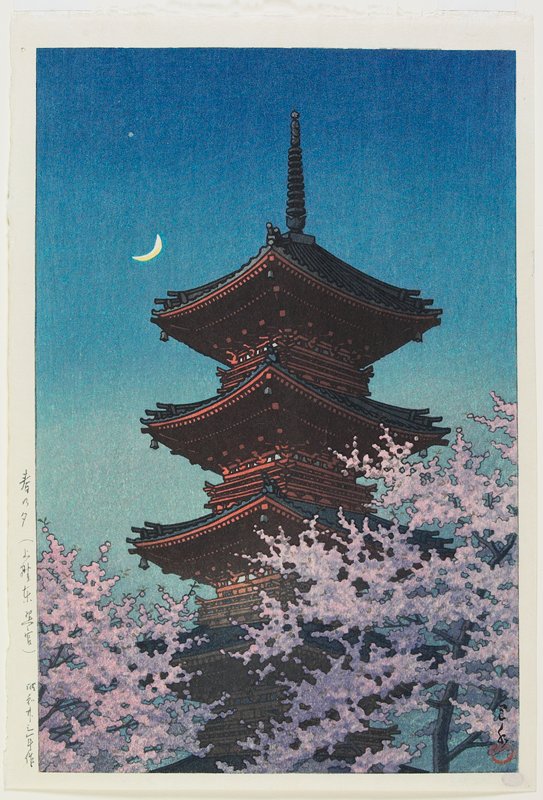
Spring Dusk at the Tōshō Shrine in Ueno
1948
Woodblock print, ink and color on paper
Heian Shrine in the Spring
Woodblock print

Departing Spring
Spring 1925
Woodblock print, ink and color on paper with mica
Woman viewing cherry blossoms, from an unidentified harimaze set
20th century
Woodblock print; ink and color on paper
Featured in Collections
Curated cross-cuts that include this print.
Frequently Asked Questions
Spring at Pyongyang (Pubyok Pavilion from Moran Hill) was created by Kawase Hasui (川瀬巴水) in 1939.
Spring at Pyongyang (Pubyok Pavilion from Moran Hill) uses Bokashi, on woodblock print, ink and color on paper.
Spring at Pyongyang (Pubyok Pavilion from Moran Hill) was published by Watanabe Shozaburo (1939).
Spring at Pyongyang (Pubyok Pavilion from Moran Hill) depicts spring and architecture.
Spring at Pyongyang (Pubyok Pavilion from Moran Hill) measures 39.2 × 27.5 cm (Oban format).