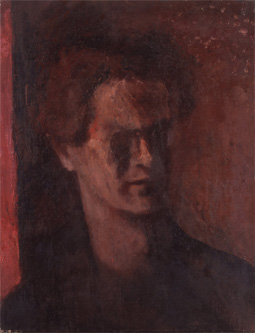
Self-Portrait
自画像
- Date:
- 1922
- Medium:
- Oil on canvas
Description
Painted around 1922 during Suda Kunitarō's four-year residence in Madrid, this Self-Portrait is the earliest surviving image of the painter that has come down to us and the principal visual record of his Spanish years. Aged thirty-one at the time, Suda was then deep in the daily routine of copying at the Prado — Velázquez above all, but also Ribera, El Greco and Tintoretto — and the small canvas declares his absorption of that tradition openly. The head is turned in three-quarter view against a deep, undefined ground, and the modelling is built from a closely keyed range of dark olive, brown-black and warm grey, with the highlights concentrated in the forehead, the bridge of the nose and the soft mouth in a manner that recalls Velázquez's late Madrid portraits. The painting is the first declaration of the dark, tonal, intellectually grounded manner that would mark Suda's mature work; together with the contemporaneous Avila landscape of 1920, it is the foundational document of the Spanish vocabulary he brought back to Kyoto in 1923 and that he would deploy in the great architectural canvases of the 1930s and 1940s.
More Prints by Suda Kunitarō


Frequently Asked Questions
Self-Portrait (自画像) was created by Suda Kunitarō (須田國太郎) in 1922.