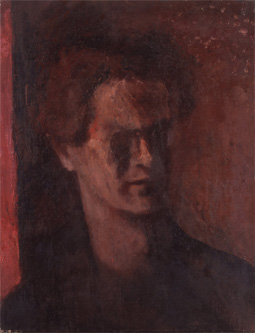
Suda Kunitarō
須田國太郎
1891–1961
Japan
Biography
Suda Kunitarō (須田國太郎, 1891–1961) was a leading Kyoto yōga (Western-style) painter of the Shōwa period and one of the few Japanese oil painters of his generation to combine the practice of painting with a serious academic career in aesthetics and the history of art. Trained in philosophy at Kyoto Imperial University and steeped in the painters of the Spanish Golden Age after years of study at the Prado, and later a professor at the Kyoto Municipal University of Fine Arts (the institution that became Kyoto City University of Arts), Suda is the painter through whom Kansai yōga acquired its characteristic dark, tonal, intellectually grounded language — a language distinct from the bright plein-air manner of Kuroda Seiki's Tokyo school and aligned instead with the chiaroscuro traditions of Velázquez, Ribera, El Greco and Tintoretto.
Suda was born on 6 June 1891 in Kyoto. He attended Kyoto's Third Higher School and then entered the Department of Philosophy at Kyoto Imperial University, taking aesthetics and art history as his specialism and graduating in 1916 before continuing into graduate school. In 1917 he also enrolled at the Kansai Bijutsuin (Kansai Art Institute) to study Western-style oil painting. This unusual dual training, in scholarship and in studio practice, would shape every aspect of his subsequent career.
In 1919, at twenty-eight, Suda left Japan for Spain. He chose Madrid in preference to Paris — a deliberate, contrarian choice in a generation that almost universally headed for Montparnasse — convinced that the realism and dark tonality of Velázquez and the Spanish Baroque masters offered a path to oil painting more sympathetic to Japanese sensibility than the bright French manner. Based in Madrid, he spent much of the next four years copying at the Prado, producing reproductions of Velázquez, El Greco, Ribera and Tintoretto that served both as study and as later teaching aids, and travelling to study Spanish art and the Venetian school, Tintoretto above all. He returned to Japan in 1923.
His return brought neither immediate recognition nor easy entry into the central exhibition circuits of Tokyo. He taught the history of art and continued to paint largely out of the public eye through the 1920s, holding his first solo exhibition only in 1932, at the Shiseido Gallery in Ginza, Tokyo. In 1934 he joined the Dokuritsu Bijutsu Kyōkai (Independent Art Society), which from that point became his principal exhibition platform, and for it he produced a series of large, dark, architecturally minded canvases that established him as the leading representative of a Kansai alternative to the bright Tokyo manner.
The 1930s and the war years brought maturity. Suda took as his characteristic subjects the great architectural monuments of Nara and Kyoto — among them the Hōkan-ji pagoda, painted in 1932, and the azekura (raised log storehouses) of the Shōsōin imperial repository, the subject of his two Azekura canvases of 1943 — rendering them in deep umbers, oxide reds and slate blacks with a frontality and tonal weight openly indebted to Spanish painting. Animals were another favourite subject, above all dogs and birds such as crows and cormorants. His single contribution to the official cycle of wartime record painting was Students Off to War (1944).
After the war Suda's reputation, long confined largely to Kyoto, became national. He became a member of the Japan Art Academy in 1947 and was appointed professor at the Kyoto Municipal University of Fine Arts in 1950, where he taught and exercised a decisive influence on a generation of postwar Kansai oil painters. He continued to write and publish on art history and the theory of painting. In 1958 he received the Mainichi Art Award for his long service to the advancement of Kansai painting, and among the major works of his final decades are Dog (1950), Cormorants (1952) and Kubohachiman (1955), the last now held by the National Museum of Modern Art, Tokyo.
Suda died in Kyoto on 16 December 1961, at the age of seventy. The National Museum of Modern Art, Tokyo holds some twenty of his canvases, and his art has continued to be the subject of major museum retrospectives, most recently Suda Kunitarō: Three Gazes (三つのまなざし) at the Setagaya Art Museum in 2024 — confirming his standing as the principal architect of the dark, scholarly, architecturally grounded current that runs through Kansai yōga from the 1930s into the postwar period, and as one of the most original Japanese painters to have translated a European pictorial language into a recognisably Japanese sensibility without surrendering either tradition.
Key Facts
- Active Period
- 1891–1961
- Nationality
- 🇯🇵Japan
- Works Indexed
- 9
Frequently Asked Questions
Suda Kunitarō (須田國太郎, 1891–1961) was a leading Kyoto yōga (Western-style) painter of the Shōwa period and one of the few Japanese oil painters of his generation to combine the practice of painting with a serious academic career in aesthetics and the history of art. Trained in philosophy at Kyoto Imperial University and steeped in the painters of the Spanish Golden Age after years of study at the Prado, and later a professor at the Kyoto Municipal University of Fine Arts (the institution that became Kyoto City University of Arts), Suda is the painter through whom Kansai yōga acquired its characteristic dark, tonal, intellectually grounded language — a language distinct from the bright plein-air manner of Kuroda Seiki's Tokyo school and aligned instead with the chiaroscuro traditions of Velázquez, Ribera, El Greco and Tintoretto.
Suda Kunitarō was active from 1891 to 1961.
Original prints by Suda Kunitarō can be found in collections including National Museum of Modern Art, Tokyo, Nakano Museum of Art, Nara, Wikimedia Commons (self-portrait painted in Madrid), National Museum of Modern Art, Kyoto.
Woodblock Prints by Suda Kunitarō (9)
Self-Portrait
自画像
1922
Oil on canvas

The Raidō at the Tōshōdaiji Temple
唐招提寺礼堂
1933
Oil on canvas

Violin
ヴァイオリン
1933
Oil on canvas

Azekura B (Log Storehouse B)
校倉(乙)
1943
Oil on canvas

Azekura (Log Storehouse)
校倉
1943
Oil on canvas

Students Off to War
学徒出陣
1944
Oil on canvas

Phoenix Hall under the Burning Sun
炎天の鳳凰堂
1953
Oil on canvas

Kubohachiman
窪八幡
1955
Oil on canvas

Ancient Bronzes
古銅
circa 1940s
Oil on canvas